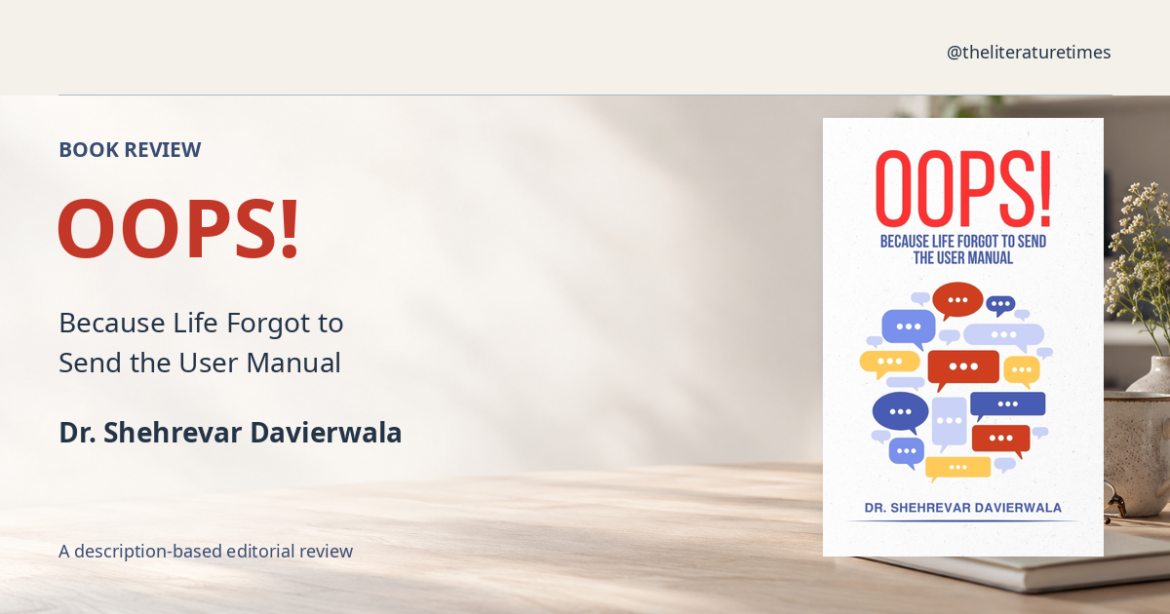
Because Life Forgot to Send the User Manual
A difficult boss, a missed promotion or a career plan that has stopped making sense can make uncertainty feel like a private failure. OOPS! by Dr. Shehrevar Davierwala takes that familiar feeling as its starting point. Its subtitle, Because Life Forgot to Send the User Manual, captures the mismatch between our desire for clear instructions and the untidy situations in which we actually make decisions. Based on its description, this English-language nonfiction book offers a way to reconsider such moments through humour, reflection and practical perspective. Its central appeal lies in the permission to begin with confusion and still consider a useful next step.
The situations named in the book description are deliberately recognisable: stolen credit, awkward meetings, rejection, comparison and the feeling that everyone else has worked life out. Taken together, they connect professional disappointment with the more personal business of self-worth. A workplace setback can disturb someone’s confidence well beyond working hours; comparison can make an otherwise meaningful path seem inadequate. The description gives OOPS! a broad field of concern while keeping its emphasis on ordinary, uncomfortable experiences. That grounding matters because it gives the proposed conversation a clear point of entry for readers who may be tired of advice built around exceptional success stories.
The book organises its outlook around four words: Own, Observe, Pivot and Shine. As presented in the supplied material, these form a sequence for responding when events depart from expectation. First comes an acknowledgment of what happened, followed by attention to what can be learned, a willingness to change direction and a less approval-dependent sense of progress. The framework’s potential strength is its simplicity. It is easy to remember without requiring the reader to accept that every problem has a neat solution. Whether the full book gives each stage enough depth remains a question for a manuscript-based assessment.
Own is especially interesting in a book that explicitly mentions difficult bosses and misplaced credit. A useful reading of the term would separate recognising one’s situation from accepting blame for everything that caused it. People can take responsibility for their next decision without treating another person’s conduct as their own fault. This distinction is an important test for any practical advice about workplace setbacks. The description does not establish how the book handles that boundary, but its combination of professional friction and personal agency makes the question central to the promise it offers readers.
Observe introduces a pause between an unpleasant event and the story someone tells about it. Within the book’s stated framework, that pause invites curiosity about what an experience might reveal. A disappointing outcome may raise questions about expectations, habits, working relationships or a changing ambition. The value of this approach is the shift from a sweeping verdict on the self toward a more specific inquiry. The book’s emphasis on asking better questions supports that reading. It also creates a useful expectation that reflection will have a purpose beyond repeatedly revisiting what went wrong.
Pivot then brings movement into the picture. The supplied description places changing plans alongside changing dreams, suggesting that a redirection need not be treated as a permanent loss of purpose. That is a relevant proposition for graduates finding their footing and professionals questioning a path they once chose confidently. A pivot can be difficult precisely because it requires distinguishing persistence from attachment to an outdated plan. OOPS! identifies that tension rather than promising a flawless route through it. Its reader value will depend partly on how the proposed tools help people think through the choices specific to their circumstances.
Shine, the final term, is linked in the description to loosening the need for other people’s approval. This gives the framework a personal dimension beyond career recovery. The supplied material does not dismiss ambition; it asks readers to consider what they are pursuing and whose judgment they are using to measure themselves. In that context, the promise of shining can be understood as making room for a more independent sense of progress. It is a fitting destination for a book that begins with comparison, provided the idea remains connected to the complicated lives and responsibilities of its intended audience.
The proposed writing approach combines corporate satire, relatable stories, practical tools and wisdom drawn from Indian mythology. Humour has a clear role within that mix. The back-cover description of meetings that outlast their purpose points to workplace absurdity as a source of recognition. Satire can create enough distance from an awkward experience for someone to examine it with less defensiveness. This is a strength of the book’s concept, rather than a verdict on the quality or consistency of its comedy. Those judgments would require reading the actual stories and seeing how humour and advice work together on the page.
Indian mythology adds another layer to the stated approach, bringing a cultural frame to the discussion of contemporary problems. The description does not identify particular narratives or explain how they are interpreted, so it would be premature to credit the book with specific connections. The important editorial question is how clearly those references serve the experiences under discussion. Readers may respond well to a conversation between older sources of wisdom and modern professional uncertainty, especially when the relationship is explained rather than assumed. The premise offers scope for that conversation without providing evidence of its execution.
Davierwala’s supplied biography connects the book to conversations with people across boardrooms, classrooms and cross-cultural initiatives. It describes engagement with varied communities and institutions, including in conflict-affected environments. That background helps explain the emphasis on perspective and the next meaningful step. It does not, by itself, prove that the advice applies equally to every reader. The strongest basis for interest is the author’s stated attention to real conversations and imperfect circumstances. The biography presents OOPS! as emerging from those exchanges, giving its subject a human starting point without requiring a narrative of effortless expertise.
On the evidence available, OOPS! is best approached as a reflective proposition for readers navigating professional uncertainty, changing ambitions and the pressure to appear composed. Its description offers a memorable framework, a recognisable set of concerns and a willingness to use humour alongside practical reflection. A full critical judgment must wait for the manuscript, particularly to assess the specificity of its tools, the development of its stories and the care of its mythological connections. For now, its clearest promise is modest and worthwhile: to help readers examine an unexpected situation closely enough to find a meaningful way forward.