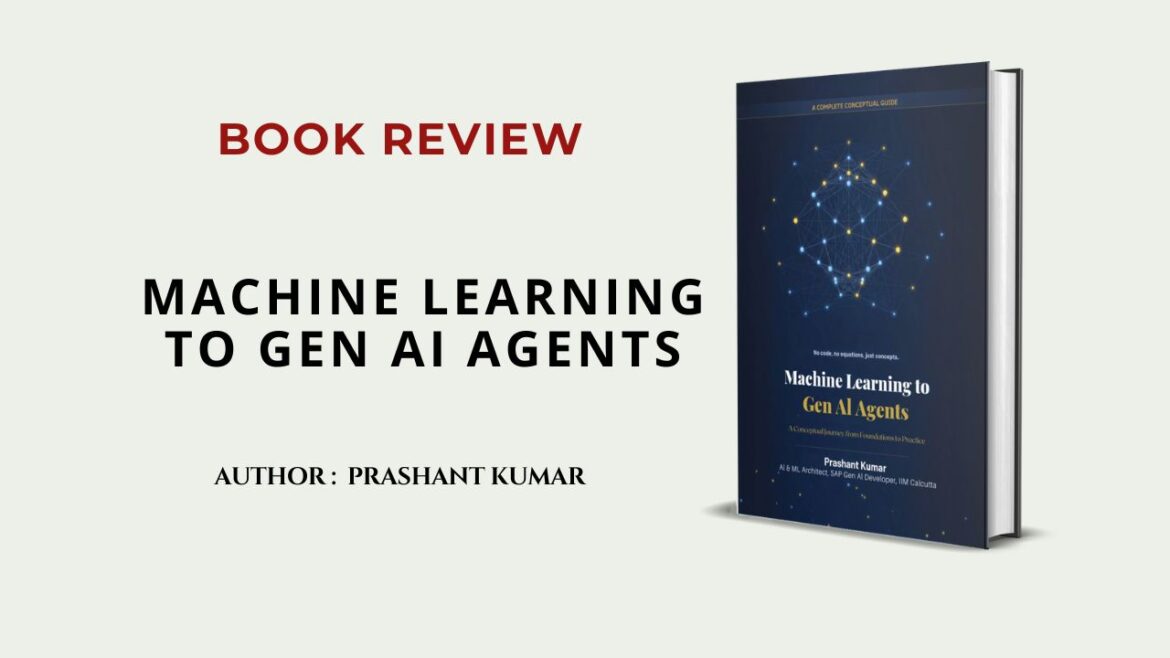
Book Review: Machine Learning to Gen AI Agents by Prashant Kumar
Publisher: Evincepub Publishing | Year: 2026 |
Pages: 516 | ISBN: 978-93-7335-200-8
There’s a particular kind of book that feels less like something you read and more like a conversation you’ve been waiting to have. Prashant Kumar’s Machine Learning to Gen AI Agents: A Conceptual Journey From Foundations to Practice is that book — and I say this as someone who has slogged through too many technical texts that were either dumbed down to the point of insult or so dense with equations they may as well have been written in ancient Sumerian.
Kumar opens with a disarming confession: this book began as notes to himself. He was a fifteen-year enterprise veteran in SAP security and compliance, learning machine learning at his kitchen table in Calgary long after his family had gone to sleep, attending IIM Calcutta’s AI leadership programme at three in the morning across time zones. You believe him immediately — and that origin story matters. It explains why the book reads the way it does: like someone who has actually wrestled with these ideas in the dark, not someone who was handed a contract and a table of contents.
The structure is ambitious. Eighteen chapters across four sections take the reader from the philosophical question of what it even means for a machine to learn, all the way through to building multi-agent AI systems and the ethical guardrails required to keep them from causing chaos. It is, to use Kumar’s own phrase, “one continuous journey from foundations to the frontier.” Remarkably, it largely delivers on that promise.
The Writing First
Let me start where most technical book reviews don’t: the prose. Kumar can write. Not in the sense of “adequate for a technical author,” but genuinely well. The analogies are fresh and they stick. A supply chain explanation doesn’t just describe how Amazon pre-positions inventory — it opens with the 2021 Ever Given disaster and traces which companies recovered in weeks versus months, and why. A section on the prediction-causality distinction doesn’t reach for a statistics textbook; it sits you down in a hospital emergency room and asks whether high cholesterol causes heart attacks or merely correlates with them. The difference is enormous, and Kumar knows it.
This approach — always leading with a story or a concrete scenario before the concept — is consistent throughout, and it works. By the time he introduces something like partial dependence plots or SHAP values, you already have a reason to care about them. That’s a harder pedagogical trick than it looks.
There’s also an editorial discipline here that is genuinely rare. Kumar states upfront that he has deliberately excluded older approaches and deprecated techniques. Sigmoid activation functions, for instance, appear only to build intuition — not as recommendations. For anyone who has ever burned an afternoon following a tutorial only to discover the library it depends on was discontinued two years ago, this commitment feels like a small act of mercy.
The Conceptual Architecture
The book’s four-part structure has real internal logic. Section I lays foundations — not just “what is machine learning” in the rote sense, but a sharp treatment of the distinction between descriptive, diagnostic, predictive, and prescriptive analytics. This taxonomy, introduced early through a struggling restaurant owner trying to understand why her revenue has fallen, becomes a recurring lens throughout the book. It’s one of those frameworks that, once you have it, you start using it to evaluate every analysis you encounter in the wild.
Section II moves into core machine learning — algorithms, model performance measurement, neural networks, computer vision, and natural language processing — all without a single line of code. For readers who have seen these topics treated as obligatory checkbox chapters in other books, Kumar’s versions are surprisingly substantive. The chapter on choosing algorithms is especially strong: rather than presenting an exhaustive taxonomy, it teaches you how to reason about the choice, which is a different and more valuable thing.
Section III, on building and refining models, is where the book earns its production credentials. The chapter on deployment is one of the most honest I have read anywhere. It opens with a scenario that will be painfully familiar to anyone who has worked in applied AI: the model achieves 97% accuracy in a Jupyter notebook, everyone celebrates, and then someone asks how it actually runs in production. Silence. Kumar’s treatment of MLOps maturity levels, from “manual everything” to full CI/CD automation, is drawn from real experience building a pharmaceutical research AI copilot — and it reads that way. The framework he presents is explicitly his own synthesis, not borrowed from a single authoritative source. That intellectual honesty is refreshing in a field where everyone tends to present their particular stack as the obvious correct answer.
The Frontier Sections
Section IV, covering generative AI and agents, is where the book enters genuinely new territory. The chapter on prompt engineering is thorough without being prescriptive, which is the right balance — prompting is still as much craft as science. The RAG chapter (Retrieval-Augmented Grounding) is remarkable for its depth: Kumar goes well beyond the standard vector database tutorial into a discussion of domain-specific extraction challenges, including a detailed treatment of optical chemical structure recognition in pharmaceutical research — drawn, again, from a system he actually built.
The agentic AI chapter is among the best introductions to the topic I’ve encountered. Kumar traces the shift from AI that answers questions to AI that accomplishes tasks with appropriate excitement but also appropriate caution. The practical breakdown of architectural patterns — prompt chaining, routing, parallelisation, orchestrator-worker, and evaluator-optimiser — gives the reader actual vocabulary for reasoning about these systems, and the honest cost accounting (roughly 15x more expensive in tokens for multi-agent systems compared to simple chat) is exactly the kind of detail that helps practitioners make real decisions rather than chasing demos.
The final chapter, on building safe and trustworthy AI, is both the most sobering and the most necessary. Kumar opens with the OpenClaw incident — a genuinely remarkable case of an open-source AI agent that gathered 145,000 GitHub stars in weeks before security researchers found over 42,000 exposed installations leaking credentials and private data. It is a perfect illustration of the book’s closing argument: that we are building infrastructure capable of real harm, and that the guardrails must be designed in from the beginning, not bolted on afterward.
Where the Book Could Go Further
No book of this scope can do everything, and it would be unfair to hold this one to an impossible standard. The conceptual approach — no code, no equations — is a deliberate choice and the right one for Kumar’s stated audience of leaders, architects, and practitioners who want the full picture. But readers who want to move from understanding to implementation will need companion resources, and the book’s references section (Appendix B) is a starting point rather than a comprehensive guide.
A few sections also feel slightly uneven in depth — the computer vision chapter, for instance, moves quickly relative to some of the later material. But these are minor complaints against a book that covers an enormous amount of ground with genuine coherence.
The Bigger Picture
What I kept returning to while reading this book is that it is doing something more than teaching machine learning. It is making an argument — quietly but persistently — that understanding these systems is a civic responsibility as much as a professional one. There is a chapter section on AI governance that frames it clearly: when AI systems influence loan approvals, hiring decisions, and criminal sentencing recommendations, you cannot engage with the policy questions thoughtfully without understanding what the systems actually do. Kumar’s version of “AI literacy” is not about knowing the math. It is about knowing enough to ask the right questions, recognize when something is being deployed inappropriately, and imagine better alternatives.
That ambition — to produce not practitioners but citizens — is what elevates this book above the many competent technical introductions that have appeared in the past few years. It is written for an intelligent adult who wants to understand the world as it actually is in 2026, not the world as it was when the textbooks were written.
Machine Learning to Gen AI Agents won’t be the last book you read on this topic. But it might be the best first book — and for a surprising number of readers, it may be enough on its own to fundamentally change how they see the technology shaping everything around them.
Rating: 4.5 / 5
Recommended for: Business leaders navigating AI strategy, product managers building AI-adjacent systems, practitioners who want conceptual depth without mathematical prerequisites, and anyone who needs to make decisions about AI and would prefer to make them well.