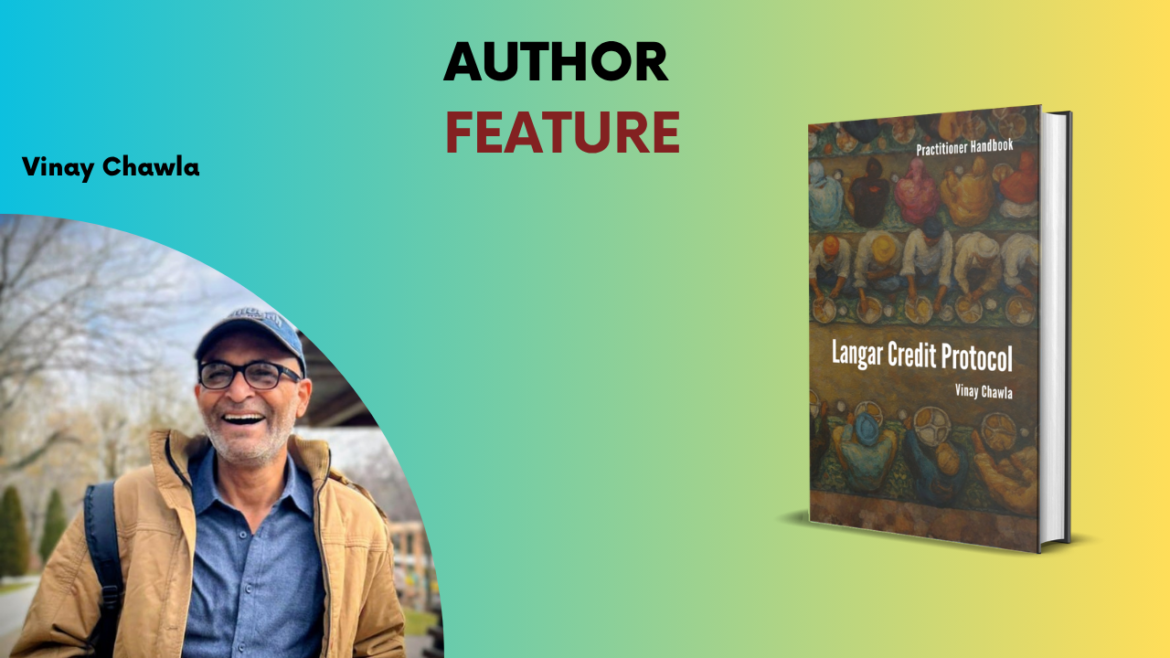
Title: Langar Credit Protocol- Practitioner Handbook
Name: Vinay Chawla
ISBN: 978-93-4726-336-1
Publisher: Inksight Publishers
Measuring Kindness with Clarity – The Journey Behind Langar Credit Protocol
In India, the tradition of sharing food is not new. For centuries, people have believed that feeding others is one of the highest forms of service. From temples to gurudwaras, from small villages to big cities, food has always brought people together.
But in today’s modern world, where systems, data, and global goals matter, even acts of kindness need structure and recognition. This is where Langar Credit Protocol – Practitioner Handbook by Vinay Chawla becomes important. Behind this unique and thoughtful work is a person who is trying to connect tradition with modern systems, and service with measurable impact.
A Leader with a Vision
Vinay Chawla is the Executive Director of Langar Carbon. His work focuses on sustainability, community service, and creating systems that bring real change. Unlike many professionals who work only within offices or reports, he is deeply connected to ground-level realities. He understands that real impact happens in communities where people help each other without expecting anything in return.
Inspired by the Spirit of Langar
The idea behind his work comes from the traditional concept of “Langar”. Langar is a system where food is prepared and served to everyone, without discrimination. It represents equality, sharing, and compassion. Vinay Chawla saw that this simple act of feeding people has a powerful social impact. It supports food security.
It reduces hunger. It builds community bonds. But he also noticed something important this impact is often not measured or recognised in formal systems.
Bridging Tradition and Modern Systems
This observation became the starting point of his journey. Vinay Chawla wanted to create a way to connect traditional community service with modern frameworks like sustainability and global development goals. He realised that if these contributions could be measured properly, they could be recognised at a larger level. This thought led to the creation of the Langar Credit Protocol.
Understanding the Purpose of the Book
The Langar Credit Protocol – Practitioner Handbook is not a typical book. It is a practical guide. It provides a structured way to measure and verify community-based food contributions. It helps organisations, volunteers, and institutions understand how their work supports global goals like United Nations Sustainable Development Goals especially SDG 2 (Zero Hunger) and SDG 12 (Responsible Consumption). Vinay Chawla has designed this framework in a way that it can work even in areas where data is limited.
Working in Low-Data Environments
One of the biggest challenges in community work is the lack of proper data. In many rural or informal settings, people do important work, but there is no system to record it. Vinay Chawla understood this problem. He created a system that does not depend heavily on complex data. Instead, it focuses on practical verification methods that are easy to use. This makes the framework inclusive and accessible.
A Practical and Ground-Level Approach
The strength of Vinay Chawla lies in his practical thinking. He does not create ideas only for theory. He focuses on real-life application. The handbook is designed for practitioners people who are actually working in the field. It guides them step by step on how to document, verify, and present their contributions. This makes the book useful and action-oriented.
Aligning with Global Standards
Another important aspect of his work is alignment with international standards. Vinay Chawla has ensured that the protocol follows ISO aligned frameworks. This gives credibility to the system. It allows community work to be recognised not just locally, but also globally. This connection between local action and global recognition is a key achievement.
A New Way of Looking at Service
Traditionally, acts like feeding people are seen as charity. But Vinay Chawla presents a new perspective. He shows that such acts are not just charity they are contributions to sustainability and social development. By measuring these contributions, he gives them value in modern systems. This changes the way people look at service.
Encouraging Participation
One of the goals of Vinay Chawla is to encourage more people to participate in community service. When people see that their efforts are recognised and valued, they feel motivated. The protocol creates a sense of purpose and responsibility. It shows that even small actions can create a big impact.
A Simple Yet Powerful Writing Style
Even though the subject is technical, Vinay Chawla keeps the language simple. He explains ideas in a clear and easy way. This ensures that people from different backgrounds can understand and use the framework. His aim is not to complicate, but to simplify.
A Vision for the Future
The work of Vinay Chawla is forward-looking. He believes that the future of development lies in combining tradition with modern systems. He wants to create a world where community efforts are properly recognised and supported. Through the Langar Credit Protocol, he has taken a step in that direction.
Conclusion: Turning Service into Measurable Impact
The journey of Langar Credit Protocol – Practitioner Handbook reflects the vision and dedication of Vinay Chawla. He has shown that even the simplest acts like sharing food can have a powerful impact when understood and measured correctly. His work bridges the gap between tradition and modern systems. It reminds us that kindness, when supported by structure, can create lasting change. In a world that often focuses on numbers, he brings attention to the value of human connection and shows how it can be recognised, respected, and expanded. Through his efforts, service is not just an emotion it becomes a measurable force for good.