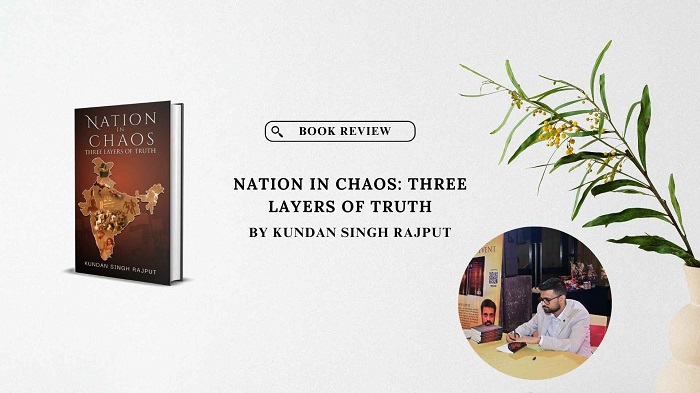
Nation in Chaos: Three Layers of Truth by Kundan Singh Rajput is not just another book about India’s struggles and aspirations—it is a mirror held up to society, science, and spirituality, urging readers to pause, reflect, and redefine what it truly means to be part of a nation. Unlike conventional socio-political commentaries, this work intertwines rational inquiry with timeless wisdom, offering a layered perspective on the challenges of modern India. It is a book that requires patience, openness, and courage from its readers, because it dismantles illusions that many may be comfortable clinging to.
At its core, the book revolves around three layers of truth: societal truth, scientific truth, and universal truth. These layers are not presented in isolation but flow into each other in a way that reflects the complexity of life itself. Societal truth examines the traditions, customs, and inherited values that continue to guide the Indian psyche, for better or worse. Scientific truth brings in the rational lens of modern science and inquiry, encouraging readers to rely on evidence and logic rather than blind acceptance. Universal truth, however, elevates the discussion to the eternal wisdom found in consciousness, spirituality, and sacred texts such as the Bhagavad Gita. Together, these truths form a holistic framework for understanding not only India’s present chaos but also the possibility of its transformation.
What makes the book compelling is the author’s insistence that the chaos around us is not merely external but also internal. Feelings of disconnection, loneliness, and the erosion of empathy are as much part of the national crisis as corruption, inequality, and social unrest. By placing inner consciousness at the heart of the narrative, the book avoids being a one-dimensional critique of society and instead becomes a call for personal transformation. This is where it resonates deeply with readers who may feel adrift in an increasingly fragmented world.
The integration of yogic philosophies into the narrative adds depth and relevance. Concepts like Karma Yoga, Karuna Yoga, Vigyan Yoga, and Meditation Yoga are not presented as abstract doctrines but as practical pathways to live more meaningful lives. The author highlights that focusing on duty, compassion, self-confidence, non-violence, mindfulness, and breathing are not esoteric practices reserved for ascetics, but essential habits that can ground individuals in turbulent times. By doing so, the book bridges ancient wisdom with contemporary struggles, making it relatable to modern readers.
Kundan Singh Rajput also raises important questions about education, society, and the nation’s moral compass. He emphasizes that mixed signals from society, relatives, educational institutions, and social media have left many young Indians confused and indecisive. Instead of providing a prescriptive formula, he invites readers to cultivate awareness and question the origins of their thoughts, choices, and actions. This is both empowering and challenging, as it shifts responsibility back to the individual rather than external systems alone.
The strength of the book lies in its narrative balance—it neither glorifies India’s past blindly nor succumbs to cynicism about its future. Instead, it acknowledges the richness of India’s cultural and philosophical heritage while pointing out how layers of inherited chaos, colonial mindsets, and social divisions continue to obscure its true potential. The emphasis on “Satyameva Jayate”—truth alone triumphs—threads through the book as a reminder that truth, no matter how uncomfortable, is the only foundation on which lasting progress can be built.
Stylistically, the book is accessible yet profound. The writing avoids unnecessary jargon, making it approachable for students, professionals, and general readers alike. Yet, beneath its simplicity lies an urgency that cannot be ignored. The references to the Bhagavad Gita, the teachings of Nobel laureates, and the author’s lived experiences create a rich tapestry of thought that is both intellectual and spiritual.
For those seeking entertainment or escapism, this may not be the right choice. But for readers who yearn to engage with ideas that challenge, inspire, and provoke reflection, Nation in Chaos will prove rewarding. It is less a passive read and more an active dialogue with the self, demanding honesty and openness from the reader.
Ultimately, this book is a wake-up call. It reminds us that a nation is not defined by GDP figures or military strength alone, but by the consciousness of its people. By illuminating societal, scientific, and universal truths, it nudges us toward an inner awakening that could ripple outward into societal transformation. It urges us to reclaim empathy, compassion, and wisdom before the chaos becomes irreversible.