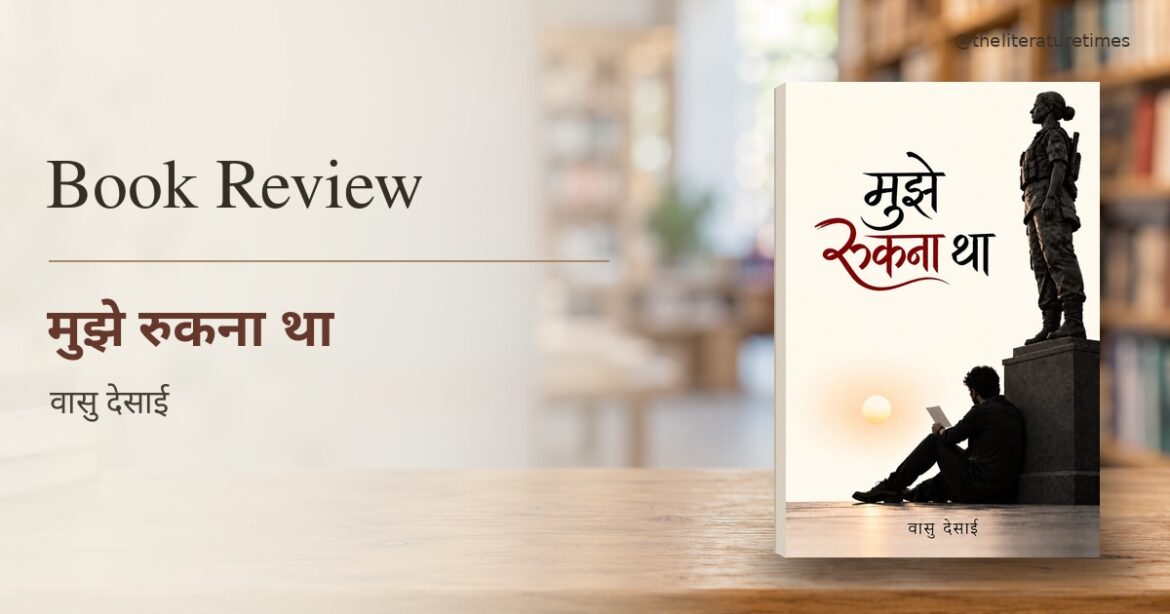
The most interesting question in Vashu Desai’s मुझे रुकना था concerns what Harsh Kataria must do with his guilt. The wealthy businessman leaves Mumbai seeking peace, but the narrative gradually makes clear that a quieter environment cannot, by itself, answer his moral unease. Desai builds a Hindi novel around the connection between outward success and inward estrangement, then tests that connection through family, romance, spiritual travel and military duty. Its emotional appeal lies in the possibility that a person who has become absorbed in his own achievements can learn to recognise the claims other lives make upon him.
The opening establishes that conflict through a family conversation rather than a statement of philosophy. Harsh tells his parents that he is leaving the business, returning to a limit he says he set years earlier. Mahesh and Devyani cannot readily reconcile the son they know with the decision he announces. Their anxiety gives the departure a cost. Harsh’s search may be necessary to him, but his freedom is supported by a family and an organisation that must absorb his withdrawal. This is an effective starting point because it keeps personal reinvention connected to relationships, rather than treating departure as an uncomplicated victory.
Anvika enters with a different kind of authority. Their early conversation around the Kamakhya temple is brisk and occasionally teasing, and the roadside tea that follows places Harsh outside the habits his wealth has made familiar. She is willing to speak to him plainly. When later scenes establish her as an army officer, that directness becomes part of a wider portrait of discipline and responsibility. Her presence gives the novel much of its conversational energy. She can make him smile, listen to his account of himself and insist that he consider whether his conduct towards other people deserves the confidence he once placed in it.
The extended account of Harsh’s business career is important to that process. Desai shifts from the present journey into Harsh’s recollections, tracing the impatience and determination of a young man who wants to choose his own course. His father’s advice about humility provides a useful counterpoint to the ambition that follows. Expansion and influence eventually sharpen into a desire to secure every advantage. When the story reveals the human consequences that haunt him, the opening withdrawal gains a different meaning. The change of perspective gives Harsh more substance than the familiar figure of a prosperous man who merely feels that something is missing.
The novel also gives landscape an active emotional role. The Brahmaputra offers Harsh an interval of sustained attention; the hills and rain around Cherrapunji change the pace of his experience; later journeys bring him into other spiritual settings. Desai repeatedly makes the surrounding world echo a character’s state of mind. This creates an accessible, strongly visual style, although the narration often explains the significance of a setting instead of leaving the reader to infer it. The contrast between the crowded demands of Harsh’s former life and the spaces of his journey is most persuasive when it is carried by what he notices and how he behaves.
A further strength is the connection between love and practical care. Anvika’s commitments to children in Haldwani widen the meaning of family, while her relationship with her grandfather gives her life an emotional centre independent of Harsh. These scenes matter because they place an existing purpose beside his search for one. Her care takes time and effort; it asks for continuity. The novel is at its most thoughtful when it allows Harsh to encounter that model of responsibility without immediately translating it into another personal achievement. Companionship becomes a challenge to his self-absorption as well as a source of comfort.
Desai favours emotional clarity over restraint. Much of the prose works through direct dialogue, expressive comparisons and reflections that state the lesson a scene is meant to suggest. The Hindi also makes room for everyday English expressions, especially in business and military exchanges. This approach keeps the narrative easy to follow and supports the characters’ quick changes from banter to seriousness. At times, however, successive explanations of sorrow, peace or destiny leave limited space for ambiguity. Readers who prefer a quieter psychological style may wish that some scenes trusted gestures and pauses to carry more of their own meaning.
The book’s range also changes its rhythm. The early movement is a family and romantic drama, the central journey includes sustained philosophical conversation, and the later military sequences become forceful and graphic. This expansion increases the stakes attached to Anvika’s profession, but it also asks the reader to move between markedly different registers. The action is best approached as part of the novel’s heightened dramatic world rather than as a documentary account of military procedure. Readers drawn primarily to a gentle spiritual romance should be prepared for a story that includes death, traumatic guilt and explicit violence as well as tenderness.
Its central idea nevertheless remains coherent across those changes. Harsh’s problem is not exhausted by deciding where to travel or whom to love. He must learn what it means to remain present when responsibility is difficult and the desired outcome is beyond his control. The title’s recurring idea of stopping gains force through this distinction. The novel gives readers grounds to ask whether regret can become useful action, and whether searching for a purpose may sometimes prevent a person from recognising the obligations already close at hand. Those questions provide the strongest basis for a discussion after reading.
मुझे रुकना था will suit readers who welcome emotionally expansive Hindi fiction, explicit reflection and a love story shaped by demands larger than the couple themselves. Its strengths are the moral weight behind Harsh’s departure, the energy of his exchanges with Anvika and the connection it draws between belonging and care. Its tendency to explain feelings and intensify dramatic moments is also central to its style, and will affect how individual readers respond. The novel’s most lasting invitation is to reconsider success through the quality of one’s attention and commitments, an idea that gives Harsh’s search significance beyond the comforts he initially leaves behind.