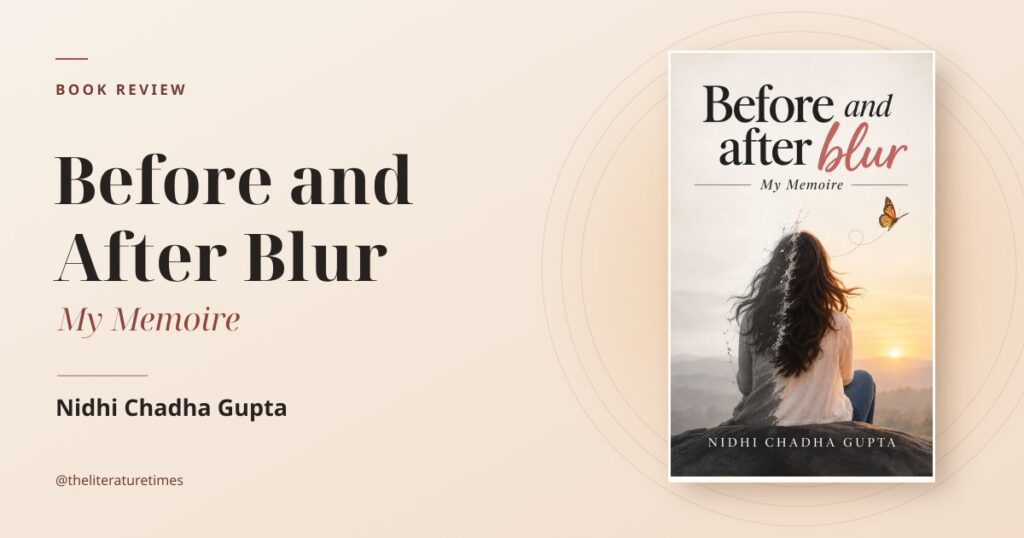
Illness memoirs often hinge on the moment a diagnosis divides life into a before and an after. In Before and After Blur: My Memoire, Nidhi Chadha Gupta puts the less tidy word at the end of that division. The blur is the uncertainty that belongs to both halves: the loss of an assumed future and the ongoing work of imagining one without a reliable sense of what the body will allow.
The long middle of an illness story
Gupta brings fourteen years of living with multiple sclerosis to the memoir. That span matters because the story’s central pressure is cumulative. A diagnosis can explain why plans have become harder to make, but it cannot tell a person which ambitions to set aside, which to hold on to or how long to wait before trying again. For someone who understood herself as ambitious and confident, the distinction between a changed plan and a changed identity is particularly sharp.
The book’s strongest thematic choice is to make dignity, rather than victory, the measure of how a life is lived. A victory narrative looks for an outcome it can report. Dignity raises more immediate questions: How much can I ask of myself today? What remains mine to decide? Those questions are more useful to this memoir than any promise of overcoming illness. They also explain why the word ‘blur’ does more work in the title than either ‘before’ or ‘after’.
Hope without a timetable
Yoga and spirituality matter here as parts of Gupta’s personal life. Their significance lies in what they offer her: a way to attend to the present without needing an answer for every uncertainty. The distinction is worth keeping in view. A practice may have meaning for an individual without becoming a prescription for anyone else. Equally, the value of hope is not that it produces a predictable result. It is that a person can still care about the shape of the days ahead.
Readers looking for an account of identity under pressure will find a more fitting point of entry than those looking for a clinical guide or a programme for recovery. What gives the memoir its critical interest is the space it leaves for ambition and hardship to coexist. Gupta’s premise asks readers to consider a life that has changed profoundly, yet still belongs to the person living it. That is a quieter and more convincing proposition than the familiar assurance that adversity makes everyone stronger.
Read the book release coverage or find the memoir at Astitva Prakashan.



Your perspective matters
Share your thoughts respectfully. Comments are moderated.