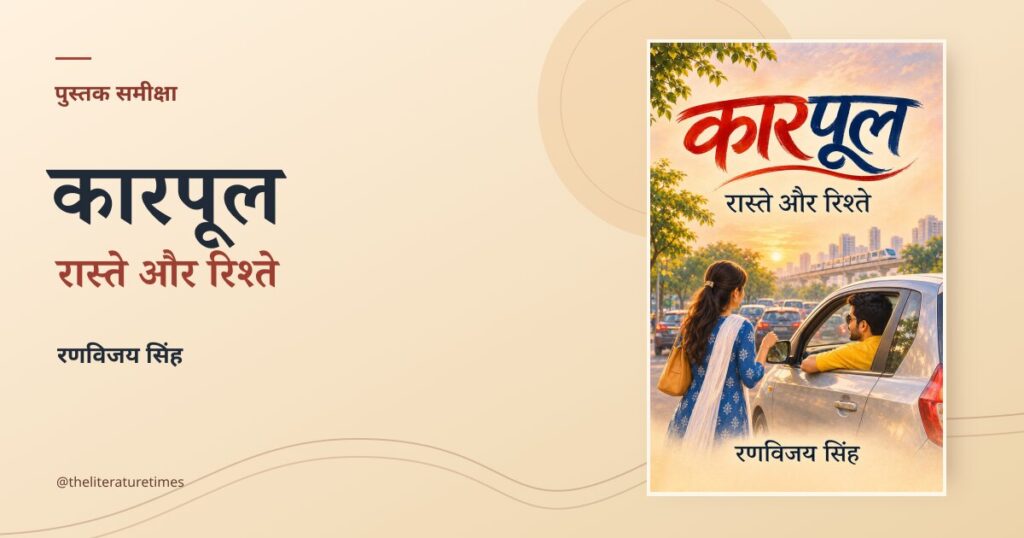
The journey of this novel begins inside a silver Baleno, stuck in traffic near Mayawati Park in Greater Noida. Three strangers, travelling together towards Delhi, initially share nothing more than a common route. The interesting question explored in Ranvijay Singh’s novel, Carpool: Raaste Aur Rishte, is how travelling the same road repeatedly can gradually turn a fellow passenger into a part of our lives.
Three Different Lives in One Car
Rishabh’s father is a Hindi teacher in Dehri-on-Sone. Rishabh carries an old coin given to him by his father. Tanya, a government officer, has experienced a broken engagement. Simran, who works in the corporate sector, has kept a secret to herself for ten years. Bringing these three characters together gives the story different shades of silence. One holds on to a memory, another carries the emotional impact of a past relationship, while the third travels with something she is not yet ready to share.
Small Gestures Along the Journey
A bottle of water offered without being asked for and homemade litti-chokha serve as meaningful details that help readers understand the relationships developing within the story. Offering someone water does not require knowing their past. Food, on the other hand, can bring memories of home into the car. The unexpected rain at Dhaula Kuan and the Chhath offering on the Yamuna represent two different experiences within this shared world. One is an unexpected interruption during an ordinary commute, while the other becomes an opportunity to remain connected to one’s home and traditions, even while living in a city.
Distance and a Sense of Belonging
The distance between Greater Noida and Delhi can be measured in kilometres. However, there is no simple way to measure how far the characters are from their homes, their pasts, or their possible futures. The opportunity in New York and four days of silence bring this difference into focus. An opportunity to move forward can be exciting, yet discussing it is not always easy, especially when other people have gradually become part of one’s plans.
One of the novel’s most compelling ideas is that trust does not always grow through grand declarations. Sometimes, it develops through ordinary, repeated encounters. However, sharing a regular journey does not automatically give anyone the right to know another person’s entire story. This distinction adds an interesting emotional dimension to the narrative.
For readers who enjoy stories about living away from home in metropolitan cities, forming new relationships, and maintaining connections with their roots, Carpool: Raaste Aur Rishte offers an engaging exploration of human connections. Its appeal lies in the delicate balance between distance and closeness, personal boundaries and shared experiences, and the unexpected relationships that can emerge along an ordinary journey.





Your perspective matters
Share your thoughts respectfully. Comments are moderated.