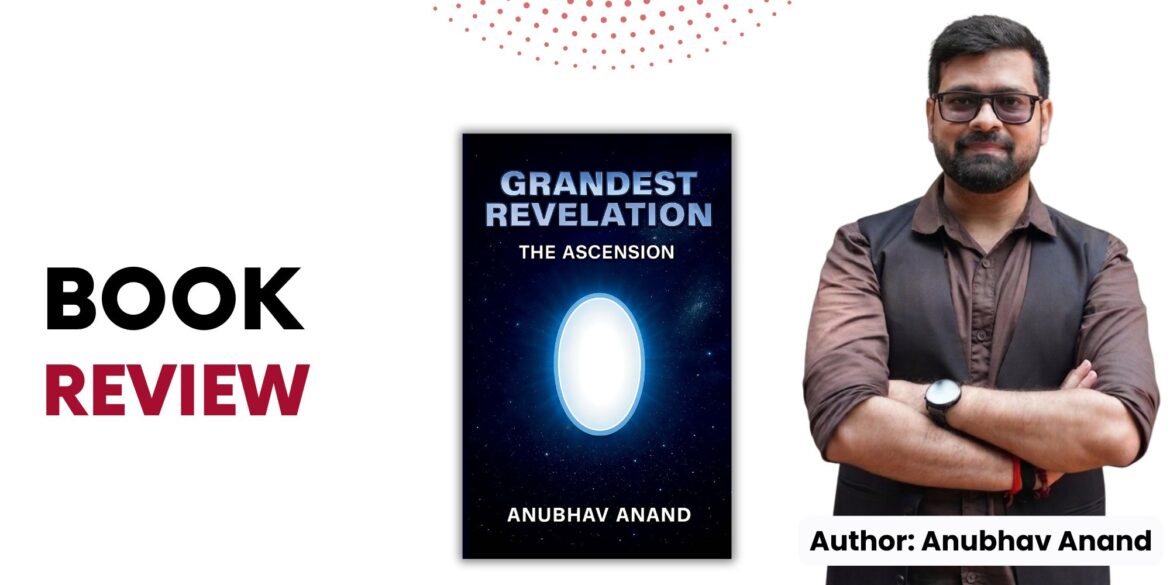
- Book Title: Grandest Revelation: The Ascension
- Author: Anubhav Anand
- Publisher: Evincepub Publishing
- ISBN: 9789373351094
- Year: 2026
- Pages: 346
- Genre: Science Fiction / Space Fantasy
Grandest Revelation: The Ascension is a science fiction and fantasy novel that takes readers into a huge universe filled with stars, celestial powers, prophecies, war, emotions, and survival. Written by Anubhav Anand, the book is the third part of the Grandest Revelation series and continues the story after the destruction and tragedy that happened in the earlier installment. The novel is ambitious in scale and tries to combine action, mythology, emotional drama, and cosmic imagination into one grand narrative.
The story begins after the fall of Káymargue, the home and safe place of the Demistars. The Demistars are special beings born from the union of good stars and humans. Their enemies are the Creatures, who are born from evil stars and mortals. The universe of this novel is divided between two powerful groups — the Prognast, representing good stars and Demistars, and the Entagnast, representing evil stars and Creatures. This conflict between good and evil forms the heart of the story.
One of the strongest qualities of this novel is its imagination. The author creates a completely different world where stars are not just objects in space but living beings with personalities, powers, emotions, and political interests. This idea itself is very creative and gives freshness to the story. Readers who enjoy fantasy universes like Harry Potter, Percy Jackson, or Star Wars may find similarities in the scale of imagination, but the concept of stars becoming human-like beings gives this book its own unique identity.
The book opens with a feeling of loss and sadness. Arthur Kane Davis, one of the most respected Demistars, has already died in the earlier battle, and the remaining team members are emotionally broken. Káymargue, which once looked like a symbol of hope and unity, slowly turns into a place filled with fear and uncertainty. The emotional pain of losing Ravin Bhan and Davis affects the characters deeply.
The characterisation in the novel is one of its major strengths. Every important character has a separate identity, personality, and emotional conflict. Grisha Hathaway stands out as perhaps the most powerful and interesting character in the story. She is aggressive, fearless, emotionally damaged, and driven by revenge. Her anger after Ravin’s death becomes one of the central emotional forces of the book. The author writes her pain in a convincing manner, especially in the scenes where she remembers Ravin and struggles with grief. These emotional sections add depth to the story and stop it from becoming only an action-based fantasy novel.
Ethan Brown is another fascinating character. His mysterious celestial powers and his uncertainty about his own identity make him emotionally relatable. Throughout the novel, there are hints that Ethan may be far more important than anyone realises. His powers appear unusual even among Demistars, creating suspense for future developments. His relationship with Grisha also feels natural because they share emotional pain and responsibility together.
Mark Jones plays the role of a reluctant leader after Davis’s death. He is not as confident or commanding as Davis, and this weakness actually makes him realistic. He is under pressure, struggling with responsibility, and trying to protect everyone despite not having all the answers. His emotional vulnerability makes him human and believable.
The supporting characters also contribute nicely to the narrative. Shawn Hammer brings youthful energy, Candice Brown adds courage and loyalty, while old-age Demistars like Lariah-Nom and Eisle-Ro-Fauh add wisdom and mystery. Even the villains are written with enough presence to feel dangerous. Ras Alhague, though not physically present everywhere, creates fear through his reputation and influence. Arrakis, especially, becomes an effective antagonist because of his direct involvement in the tragedy of Ravin’s death.
Another strong point of the novel is its world-building. The glossary and explanations about celestial powers, portals, wormholes, stars, and ancient terms help readers understand this complicated universe better. The author has clearly spent a lot of time creating the mythology of this fictional universe. Terms like Demistar, Entagnast, Prognast, Portalaque, and Ministry of Heavenly Body give the book its own identity and mythology. This level of detail makes the world feel large and alive.
The action sequences are intense and cinematic. The attack on Káymargue is one of the most thrilling parts of the novel. The chaos, destruction, portals opening, celestial powers exploding, and emotional desperation are written in a highly visual way. Readers can imagine the scenes almost like a movie. The pacing during battle scenes is fast, and the tension remains strong throughout these moments.
The idea of the “Maize” is also very interesting. It functions almost like a cosmic escape mechanism that scatters the characters across different locations in the universe. This creates suspense and opens many possibilities for future storytelling. The scattering of characters reminds readers of survival stories where heroes are separated and forced to discover themselves individually before reuniting.
Emotionally the novel talks a lot about survival, identity, destiny, sacrifice, and belonging. Even in a universe filled with stars and cosmic wars, the characters struggle with very human emotions — loneliness, fear, love, guilt, and hope. The author especially succeeds in showing how grief changes people. Grisha’s pain after Ravin’s death is perhaps the emotional core of the novel. Her memories of Ravin are touching and tragic.
The writing style of the novel is descriptive and dramatic. The author often uses long sentences and grand expressions to create an epic feeling. Sometimes this style works very well, especially during emotional or action-heavy moments. The descriptions of battles, celestial powers, and settings feel vivid and imaginative. However, at some places, the language becomes overly complex and heavy. Some sentences are too long and could have been simpler for easier reading. Readers who are not used to fantasy novels may occasionally find the narrative difficult to follow because of the large number of characters, terms, and concepts introduced quickly.
The book also has a few weaknesses. One issue is pacing. While the action scenes are excellent, some conversations and explanations feel stretched. There are moments where characters discuss plans or theories for too long, which slows the momentum of the story. The novel could have been tighter with some editing.
Another challenge is the large cast of characters. Though each character has importance, readers may sometimes struggle to remember all the names, celestial relations, and powers. Since the story is part of a series, new readers may feel confused at first despite the “Previously On” section. The book clearly expects readers to already know much of the background story.
At times, the dialogues sound slightly unnatural because many characters speak in a highly dramatic tone. Real conversations usually contain more simplicity and variation. In some scenes, almost every character speaks with the same level of seriousness, which reduces individuality in dialogue style. Simpler conversations in certain moments could have made the characters feel even more real.
Still, these weaknesses do not reduce the ambition and creativity of the novel. It is clear that Anubhav Anand has imagined this universe with great passion and dedication. The amount of detail in the lore, powers, celestial politics, and emotional relationships shows serious effort and planning.
One of the most impressive things about the novel is how Indian readers may connect with its emotional storytelling style. Even though the setting is cosmic and international, the emotional themes feel familiar. Loyalty, sacrifice, friendship, revenge, and destiny are themes often found in Indian epics and mythology. In some ways, the conflict between Prognast and Entagnast feels similar to the timeless battle between dharma and evil found in Indian storytelling traditions.
The novel also explores leadership and responsibility in an interesting manner. After Davis’s death, nobody is fully prepared to lead. Mark is insecure, the younger Demistars are emotional, and the entire group is fractured. This creates realism because in difficult times, people often struggle to replace strong leaders. The uncertainty among the characters makes their journey more believable.
The scenes where characters are scattered into different locations are emotionally effective because they create loneliness and uncertainty. Grisha landing in enemy territory, Eisle reaching Australia, and Mark meeting Sirius all show different emotional responses to crisis. These chapters create curiosity because readers want to know how the separated characters will survive and reunite again.
The science fiction elements of the story are mixed with fantasy very smoothly. Portals, wormholes, celestial energy, and interstellar politics give the novel a science fiction flavour, while prophecies, magical powers, and ancient cosmic wars add fantasy elements. This mixture makes the story appealing to fans of both genres.
Another important aspect is the emotional relationship between the characters. The novel does not focus only on battles. It also spends time exploring affection, trust, friendship, and romantic feelings. Ethan and Melinda’s soft relationship, Lariah’s feelings for Grisha, Eisle’s emotional distance from Ethan, and Ravin’s unspoken love for Grisha make the characters emotionally layered. These emotional connections help balance the large-scale cosmic conflict.
The novel’s atmosphere is often dark and serious. Death, betrayal, destruction, and fear remain present throughout the story. Yet there are occasional lighter moments between the characters that provide relief and make the friendships feel genuine. These moments are important because they prevent the novel from becoming emotionally exhausting.
From a literary perspective, the book succeeds more in imagination and emotional scale than in technical perfection. The storytelling is ambitious, heartfelt, and cinematic. While the editing, pacing, and dialogue could improve, the author’s vision remains powerful. The book feels like it was written with genuine passion for storytelling rather than simply following commercial formulas.
Readers who enjoy detailed fantasy worlds, supernatural powers, emotional conflicts, and large-scale battles will likely enjoy this novel greatly. It especially suits young adult and new adult readers who enjoy long fantasy sagas with strong emotional themes. Those who prefer fast, simple, and realistic stories may find the book overwhelming because of its complex mythology and dramatic style.
Grandest Revelation: The Ascension is an imaginative and emotionally charged science fiction fantasy novel that shows the creative potential of modern Indian fantasy writing. Anubhav Anand has created a universe filled with mystery, danger, emotions, and cosmic wonder. The novel may not be perfect in structure or pacing, but its creativity, emotional intensity, and ambitious storytelling make it memorable.
The strongest parts of the book are its imaginative world-building, emotional storytelling, and cinematic action scenes. The weaknesses mainly lie in pacing, overly dramatic dialogue, and the complexity of the large cast. However, the positives clearly outweigh the negatives.
In conclusion, Grandest Revelation: The Ascension is a bold attempt at building an epic Indian science fiction fantasy universe. It combines mythology, cosmic imagination, emotional pain, survival, and destiny into a compelling narrative. Readers who invest their time and attention into this universe will discover a story full of passion, mystery, and emotional power. It proves that Indian authors are fully capable of creating large-scale fantasy worlds that can stand proudly alongside international fantasy fiction.
To buy this book on Amazon: https://www.amazon.in/GRANDEST-REVELATION-ASCENSION-ANUBHAV-ANAND/dp/9373351095