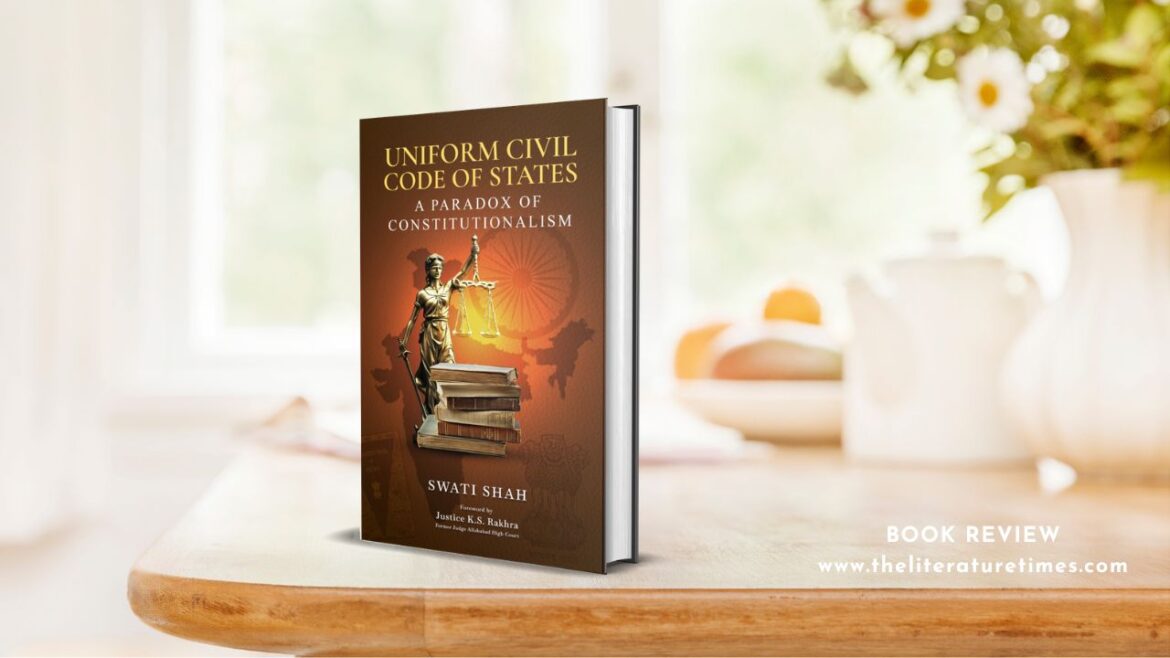
Uniform Civil Code of States: A Paradox of Constitutionalism by Swati Shah is a timely and intellectually engaging contribution to the study of Constitutional Law in India. The book addresses one of the most debated and sensitive legal issues in contemporary India—the Uniform Civil Code (UCC)—while placing it within the broader framework of constitutional principles, personal laws, and socio-political realities. It succeeds in presenting a balanced and scholarly analysis that is equally valuable for law students, judicial service aspirants, academicians, researchers, and legal practitioners.
One of the most commendable aspects of the book is its systematic approach to a complex subject. The author carefully examines the historical evolution of personal laws in India and explains their relationship with constitutional values such as equality, secularism, justice, and individual rights. Rather than approaching the topic from a purely ideological perspective, the book emphasizes legal reasoning and constitutional interpretation, allowing readers to understand the multifaceted nature of the Uniform Civil Code debate.
The discussion on the constitutional feasibility and desirability of implementing a Uniform Civil Code is particularly insightful. Swati Shah explores various dimensions of the issue, including the conflict between individual religious freedoms and the state’s obligation to promote social reform. The analysis is enriched by references to landmark judicial pronouncements and constitutional provisions, enabling readers to appreciate how courts have interpreted and addressed questions relating to personal laws and legal uniformity.
The book’s examination of international legal reforms provides an added layer of depth. By discussing reforms in personal laws across different countries, the author offers a comparative perspective that helps readers understand how other legal systems have attempted to reconcile cultural diversity with legal uniformity. This comparative approach broadens the scope of the discussion and encourages readers to think critically about the possibilities and challenges of legal reform in India.
Another significant strength of the work lies in its treatment of the Directive Principles of State Policy. The author explains their constitutional significance and their connection to the concept of a Uniform Civil Code with clarity and precision. The inclusion of important judicial observations, particularly those emerging from the landmark Minerva Mills judgment, adds credibility and legal substance to the discussion. These references help bridge the gap between constitutional theory and practical legal interpretation.
From an academic standpoint, the book is highly useful for competitive examination aspirants, especially those preparing for PCS (J), Higher Judicial Services, UGC-NET, and other law-related examinations. Constitutional Law constitutes a major portion of many legal examination syllabi, and the author’s focused discussion of personal laws and the Uniform Civil Code makes the book an effective study resource. The language remains accessible without compromising academic rigor, allowing readers from different levels of legal education to benefit from its content.
Swati Shah’s academic and professional background is clearly reflected in the quality of the work. Her experience in legal practice, research, and teaching enables her to present legal concepts in a manner that is both practical and scholarly. The book demonstrates a strong command over Constitutional Law and Family Law, and the author’s familiarity with the concerns of judicial service aspirants is evident in the structured presentation of the subject matter.
The writing style is clear, organized, and reader-friendly. Complex constitutional issues are broken down into understandable discussions supported by legal authorities, case laws, and constitutional provisions. This makes the book not only informative but also engaging for readers who may be approaching the subject for the first time. The author’s effort to maintain objectivity throughout the discussion deserves special appreciation, as the topic itself often attracts highly polarized opinions.
What makes this book particularly relevant is its engagement with current socio-political debates. The Uniform Civil Code remains a subject of ongoing public discourse, legislative consideration, and judicial attention. By addressing the issue through constitutional analysis rather than political rhetoric, the book provides readers with a reliable foundation for understanding one of India’s most significant legal and social questions.
Overall, Uniform Civil Code of States: A Paradox of Constitutionalism is a well-researched, thought-provoking, and academically valuable work. It successfully combines constitutional theory, legal analysis, judicial interpretation, and comparative perspectives to provide a comprehensive understanding of the Uniform Civil Code and its implications. The book stands as an important resource for anyone seeking a deeper understanding of Constitutional Law, personal laws, and the evolving landscape of legal reform in India. It is highly recommended for students, scholars, legal professionals, and competitive examination aspirants looking for a nuanced and authoritative study of this critical constitutional issue.