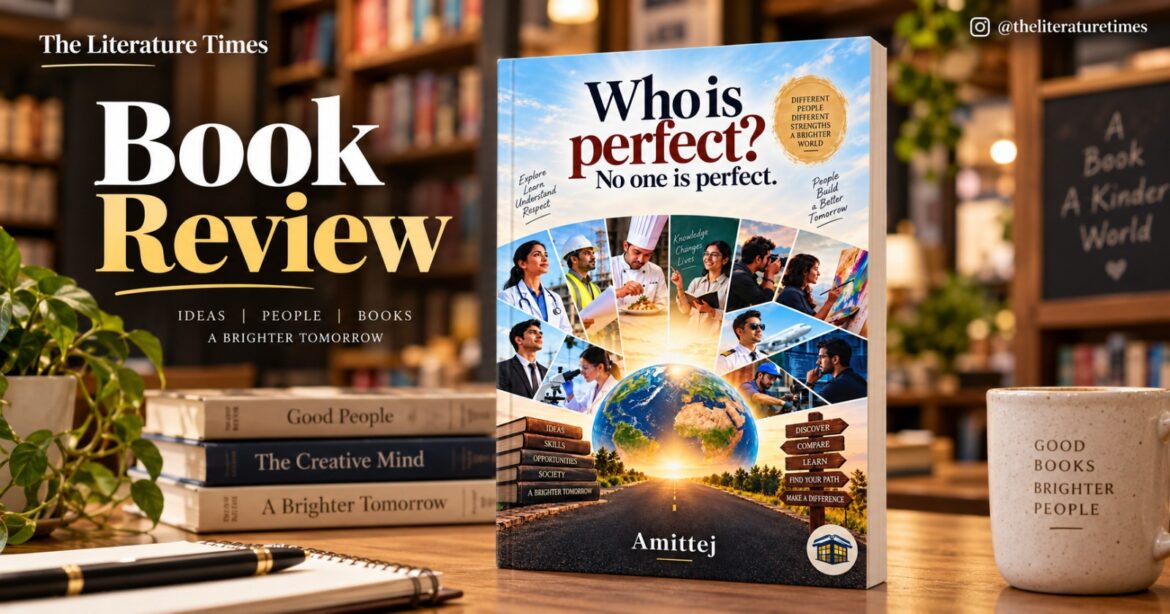
In a world where career choices are often influenced by social expectations, financial success, and professional status, Amittej’s Who Is Perfect? No One Is Perfect. offers a refreshing perspective on professions and the people behind them. Designed primarily for students and young readers, this book explores the diversity of careers while encouraging readers to appreciate different forms of work. At its heart lies a simple yet meaningful message: no individual is perfect, and every profession has something valuable to teach us.
One of the most interesting aspects of the book is its central question: “What do you want to become when you grow up?” Almost everyone has encountered this question during childhood. While some children dream of becoming doctors, engineers, teachers, or scientists, others imagine careers in art, sports, entertainment, business, or fields they have yet to discover. Amittej uses this familiar question as a starting point to explore the vast world of professional possibilities. Rather than limiting the discussion to popular career choices, the book encourages readers to look beyond familiar titles and understand the people who make different professions meaningful.
The book’s alphabetical structure, covering professions from A to Z, gives it an accessible and organised format. This approach allows readers to explore a wide range of occupations without feeling overwhelmed by the subject. Each profession is examined through several perspectives, including its introduction, daily responsibilities, required skills and education, challenges, rewards, similarities with other careers, and distinctive qualities. The structure promises a comprehensive overview of professional life, making the book suitable for students beginning their career exploration as well as readers who wish to expand their general knowledge.
A particularly valuable element of Amittej’s approach is the emphasis on understanding what professionals actually do. Job titles can sometimes create incomplete impressions of the work involved. An architect does more than draw buildings, a teacher does more than deliver lessons, and an actor does more than perform before a camera. Every occupation involves responsibilities, preparation, problem-solving, and skills that may not be immediately visible to outsiders. By directing attention towards these less obvious aspects, the book encourages readers to look beyond appearances and develop a deeper appreciation of the work people perform.
Another strength of the book is its balanced perspective on career success. Young people often encounter the idea that certain professions are more respectable or desirable because of their salaries, social recognition, or perceived prestige. Although these considerations can influence career decisions, they do not fully determine whether a person will find their work satisfying. Interests, abilities, values, working conditions, personal goals, and available opportunities also play important roles. Amittej’s decision not to rank professions creates an inclusive foundation for career exploration. Instead of suggesting that readers should aspire to a particular occupation, the book invites them to ask meaningful questions about different careers and consider what might suit their individual strengths and aspirations.
The title, Who Is Perfect? No One Is Perfect., introduces the book’s most relatable message. Behind every professional identity is a human being who experiences uncertainty, makes mistakes, encounters setbacks, and continues learning. This reminder is particularly important for young readers, who may sometimes believe that successful people achieve their goals without struggling along the way. Amittej challenges this assumption by highlighting the importance of adaptability, perseverance, and continuous improvement. The message extends beyond the workplace, offering a broader lesson about accepting human limitations while remaining committed to personal growth.
The book also presents an interesting opportunity to connect career awareness with life skills. Different professions require different forms of knowledge, but many share common qualities such as communication, discipline, creativity, teamwork, and problem-solving. Learning about an architect may encourage an appreciation for planning, while understanding the work of a scientist may inspire curiosity and critical thinking. Similarly, the responsibilities of teachers, artists, entrepreneurs, and technicians can reveal lessons about patience, imagination, initiative, and practical decision-making. This connection between professional knowledge and personal development gives the subject a wider relevance than a conventional list of occupations.
Amittej’s intended audience is another reason the book’s concept stands out. Students who are unsure about their future can benefit from the reminder that they do not need to have every answer immediately. Career discovery is a gradual process, and interests can change as people gain experience and knowledge. Parents and educators may also find the book useful as a starting point for conversations about career possibilities, individual preferences, and the importance of respecting different professional choices.
The book’s greatest strength is its encouraging and inclusive philosophy. Its A-to-Z format offers an accessible framework, while its emphasis on professional responsibilities, challenges, and rewards aims to provide a broader understanding of working life. The effectiveness of this approach ultimately depends on how clearly and thoroughly each profession is explored, but the underlying concept offers considerable educational value.
Overall, Who Is Perfect? No One Is Perfect. by Amittej presents career exploration as an opportunity to discover, understand, and appreciate the many ways people contribute to society. Rather than prescribing a particular definition of success, it encourages curiosity, respect, and self-reflection. For young readers standing at the beginning of their career journeys, its central message is reassuring: there is no single path that everyone must follow, and perfection is not a requirement for meaningful achievement. Sometimes, the first step towards choosing a future is simply learning about the possibilities that exist.
Book Link – https://amzn.in/d/0c3Y1Iyr