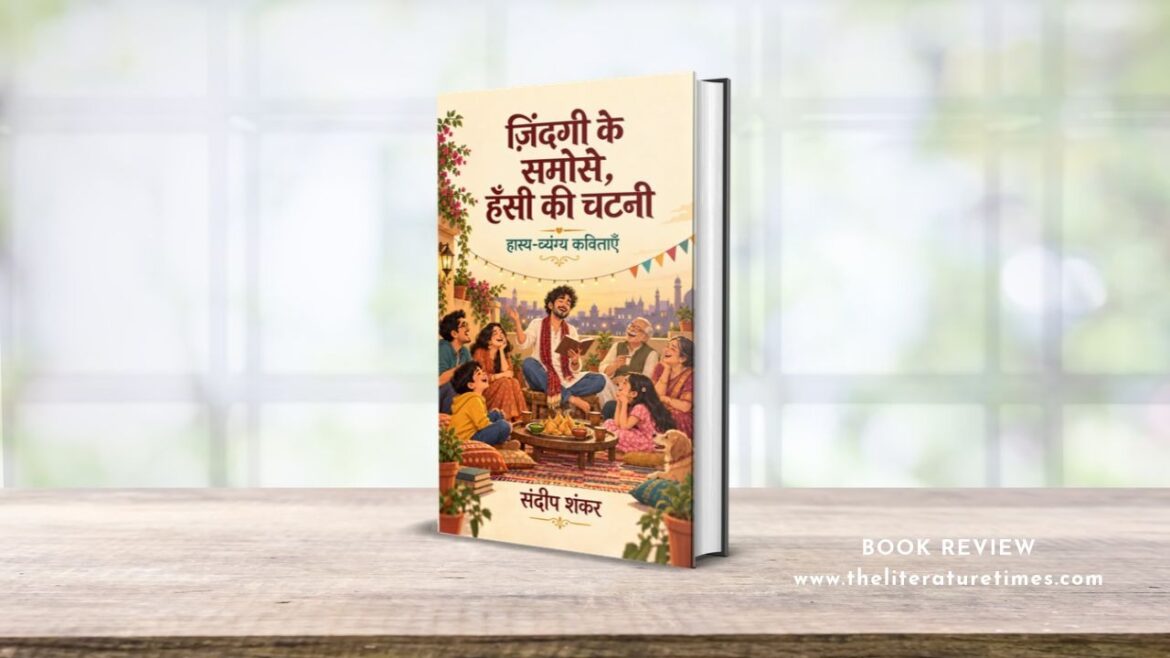
Sandeep Shanker’s Zindagi Ke Samose, Hansi Ki Chatni proposes a generous relationship between humour and poetry. Its subject is the life that people already know: familiar experiences, remembered occasions and the small absurdities that become clearer when viewed with a little distance. The collection brings together humour, satire and poems with a storytelling character. That combination gives its stated purpose a useful breadth. Amusement opens the door, while recognition gives readers a reason to remain. The most appealing part of the book’s premise is its invitation to smile at oneself, an approach that makes room for affection within the sharper work of satire.
The title establishes this sensibility before any discussion of literary form begins. Samose and chatni belong to the vocabulary of appetite and everyday pleasure. Applied to life and laughter, they suggest that experience acquires a different flavour through the way it is received. The metaphor is attractive because it remains close to ordinary speech. Readers need no specialised reference to understand its invitation. It also gives the collection a clear expectation to meet: humour should feel immediate, varied and worth returning to. The title’s playfulness therefore performs an editorial function, introducing both the material and the attitude with which it asks to be read.
Humour, satire and narrative verse make different demands on a writer. Humour can rest on an amusing recognition; satire introduces a judgement about behaviour; a poem shaped as a story needs some sense of movement. Their combination is promising because each can extend the others. A remembered incident can give a comic observation a human setting, while a satirical turn can prevent a pleasant anecdote from becoming merely decorative. Shanker’s chosen mixture is consequently worth considering as a literary approach, rather than simply a category of light entertainment. It allows everyday experience to carry several kinds of meaning without requiring an imposing subject.
The emphasis on laughing at oneself is especially significant. Satire can become comfortable when it gives its audience an uninterrupted position of superiority. Self-directed humour disturbs that comfort. Readers may recognise a habit they share or an expectation they once held, and the joke then involves them. The book’s description explicitly includes this invitation to self-recognition. As an organising intention, it offers a humane basis for the collection: human inconsistency becomes something to acknowledge together. That approach can preserve the pleasure of a joke while leaving space for a quieter consideration of why the behaviour seems so familiar.
The description of the poems as story-like also provides a useful clue to their intended appeal. An incident gives a reader something to follow, even before its implications are fully apparent. In poetry, that movement can create anticipation and make a shift in perspective matter. The available material does not establish how individual poems handle rhythm, length or endings, so those formal achievements cannot be assumed. What can be appreciated is the suitability of narrative to Shanker’s purpose. If a poem asks readers to revisit their own experience, the unfolding of an occasion can provide an inviting route into that recognition.
There is an interesting artistic challenge in writing about familiar life. Familiarity makes a subject accessible, but it does not automatically make the treatment distinctive. A writer still has to notice something that the reader has overlooked, or frame a known feeling with sufficient freshness. This is the standard against which a collection of this kind deserves to be read. Its value depends on the quality of attention brought to ordinary material. Shanker’s biography, with its interest in small observations and amusing incidents, helps explain his choice of territory. It gives the project coherence without settling the question of execution in advance.
The book’s invitation to step away briefly from a hurried life adds another dimension to that territory. A pause can change the scale at which an experience is considered. Something irritating or embarrassing in the moment may later become available for reflection, and sometimes for laughter. The collection places this possibility beside an invitation to remember loved ones. That pairing gives its humour an emotional context. The reader is being invited to reconsider life in company, with some tenderness towards the people involved. It is a measured aspiration, grounded in the ordinary pleasure of finding a moment to smile.
Forewords by Shri Vineet ‘Panchhi’ and Dr. Tushar Shah are among the publication details supplied for the book. Their presence is relevant to its introduction, although the forewords themselves are not available here and their arguments should not be guessed. The poems are presented primarily in Hindi using Devanagari, with a Roman-script Hinglish presentation intended to reach more people who understand Hindi. These choices indicate an outward-facing project. The collection wants to be encountered by readers with different levels of comfort in the written script, while retaining the language in which its humour was conceived.
Light verse deserves to be approached with an understanding of what its lightness asks of the writer. An apparently easy observation still needs a reason to become a poem, and a friendly tone still depends on careful choices. Shanker’s chosen territory invites precisely this kind of attention. The relevant questions concern the freshness of a familiar situation and the relationship between an amusing detail and the feeling it leaves behind. The collection’s premise is appealing because it makes room for both. It treats ordinary experience as sufficient material for a literary exchange, giving readers a clear and approachable point from which to begin.
Zindagi Ke Samose, Hansi Ki Chatni is most persuasive in the attitude it brings to that exchange. It gives laughter a place beside memory and makes self-recognition part of its stated pleasure. This creates room for satire that remains aware of shared human weakness, and for storytelling that can lead to reflection without announcing a lesson. The collection’s appeal rests on that modest but worthwhile ambition. For readers drawn to Hindi humour with a personal, conversational point of entry, Shanker’s book presents an engaging proposition: reconsider the life already around you, and allow your own place in its comedy to become visible.