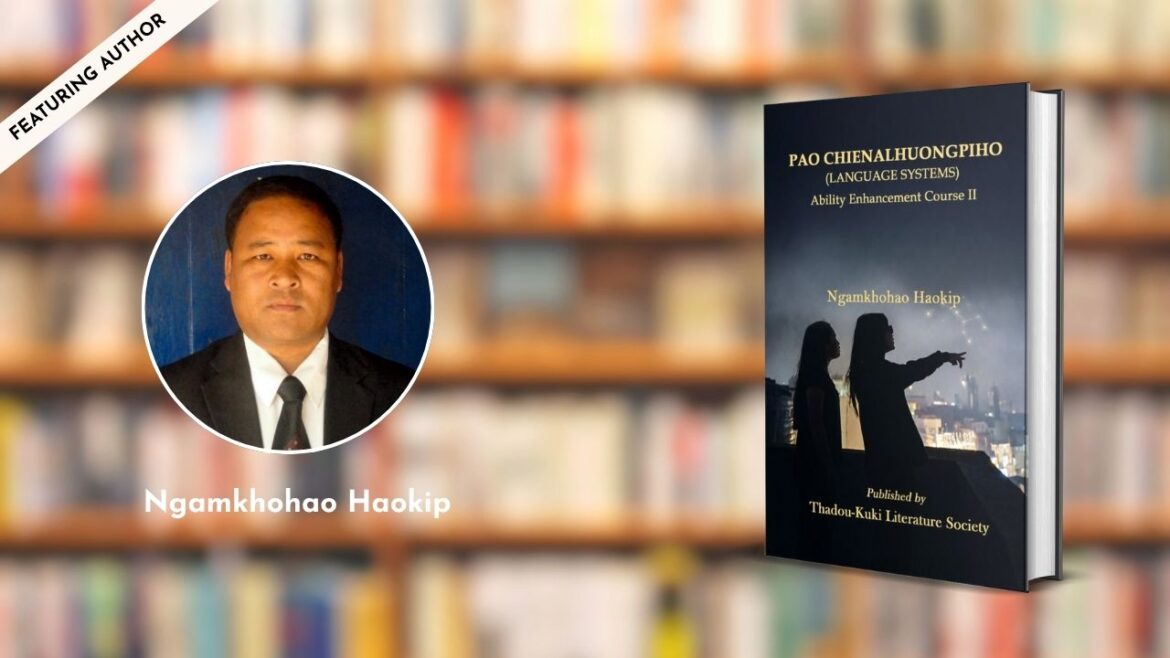
In a world where many indigenous languages face the challenge of preservation and relevance in modern education, educators and language enthusiasts play a crucial role in ensuring that linguistic heritage continues to thrive. Among such dedicated individuals is Ngamkhohao Haokip, an accomplished educator, literary contributor, and passionate advocate of the Thadou-Kuki language. With more than three decades of experience in the field of education, he has devoted his life not only to teaching young minds but also to promoting and strengthening the linguistic and cultural identity of the Thadou-Kuki community.
Ngamkhohao Haokip’s journey reflects a deep commitment to both education and cultural preservation. As a school teacher for over thirty years and currently serving as the Principal of a school under the Ministry of Tribal Affairs, Government of India, he has consistently demonstrated leadership, dedication, and a vision for empowering future generations. His professional achievements in education are complemented by his active involvement in literary and cultural initiatives aimed at preserving the rich heritage of the Thadou-Kuki people.
His love for language and literature is evident through his long-standing association with the Thadou-Kuki Literature Society. As a Life Member and the incumbent Chairman of the Society, he has played a significant role in promoting literary activities, encouraging language development, and supporting efforts to standardize and enrich the written form of Thadou-Kuki. His contributions extend beyond organizational leadership; he is also a creative writer who has authored numerous poems in the language, helping to preserve its beauty and expressive potential through literature.
This passion for language preservation and education has culminated in his remarkable work, “Pao Chienalhuongpiho: Language Systems.” The book represents a significant milestone in Thadou-Kuki language studies and serves as a valuable resource for students, educators, and language enthusiasts alike. Primarily written for second-semester undergraduate students studying Thadou-Kuki as a Major Indian Language (MIL) subject under Manipur University and DM University, the book addresses an important academic need while simultaneously contributing to the broader development of the language.
What makes “Pao Chienalhuongpiho” particularly noteworthy is its innovative approach to language instruction. The book introduces new vocabulary, fresh sentence structures, and engaging methods of presentation that make language learning both accessible and enjoyable. Rather than limiting itself to conventional grammatical explanations, it encourages learners to explore the language in a practical and meaningful way. This makes it not only a textbook for students but also a useful guide for anyone interested in learning or improving their understanding of Thadou-Kuki.
The publication stands out as one of the first works of its kind in the language. By providing structured and contemporary learning material, it bridges a critical gap in academic resources available for Thadou-Kuki learners. The book reflects the author’s deep understanding of the language and his awareness of the challenges faced by students who seek quality educational material in their mother tongue. Through this work, he demonstrates that indigenous languages can be taught with the same rigor, creativity, and academic excellence as any major language.
Beyond its educational value, the book carries broader cultural significance. Languages are repositories of history, traditions, collective memory, and identity. When a language is strengthened, an entire community benefits. Ngamkhohao Haokip understands this connection deeply. His efforts are not merely about teaching grammar or vocabulary; they are about ensuring that future generations remain connected to their roots while confidently participating in the modern world.
His work also highlights the importance of indigenous language education within India’s diverse linguistic landscape. As conversations around multilingual education and cultural inclusion gain prominence, contributions like “Pao Chienalhuongpiho” demonstrate how regional and tribal languages can be preserved through scholarly effort and practical educational tools. The book serves as an example of how dedicated individuals can make meaningful contributions to language development, even in communities where educational resources may be limited.
Colleagues, students, and members of the literary community recognize Ngamkhohao Haokip as someone who combines academic discipline with cultural responsibility. His leadership within educational institutions and literary organizations reflects a lifelong commitment to service. Whether guiding students in the classroom, leading language initiatives, or writing literary works, he continues to inspire others to value their linguistic heritage and pursue knowledge with enthusiasm.
In an era where globalization often places smaller languages at risk, voices like his are more important than ever. Through education, literature, and community engagement, Ngamkhohao Haokip has emerged as a guardian of the Thadou-Kuki language and a champion of its future. His work reminds us that language preservation is not simply about protecting words; it is about preserving identity, history, and cultural continuity.
“Pao Chienalhuongpiho: Language Systems” stands as a testament to his vision and dedication. It is more than a textbook—it is a contribution to the cultural and educational growth of an entire community. Through this pioneering work, Ngamkhohao Haokip continues to leave a lasting impact on students, readers, and language advocates, ensuring that the richness of the Thadou-Kuki language remains vibrant for generations to come.