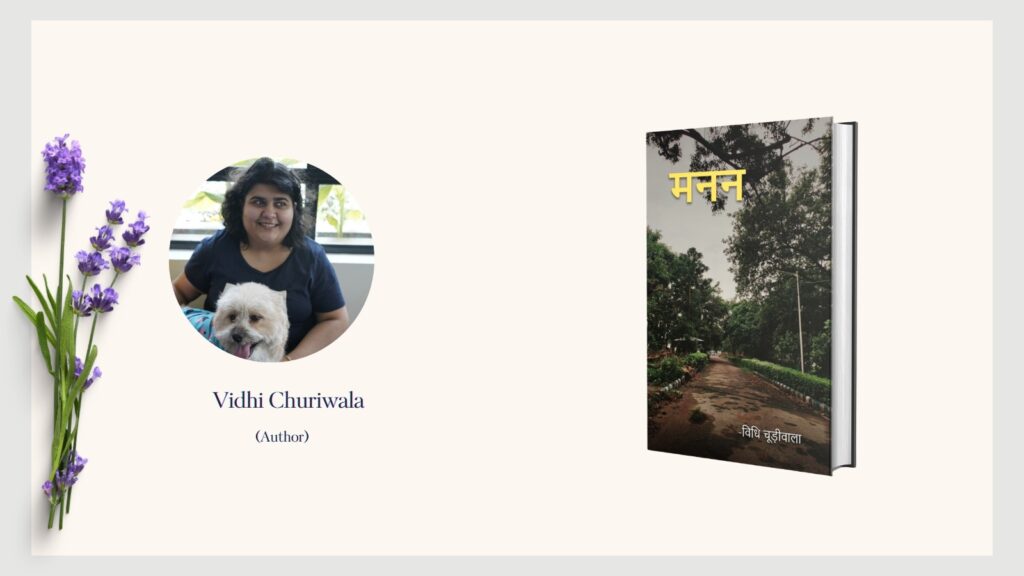
Manan by Vidhi Churiwala is not just a book; it is an invitation—an invitation to pause, to listen, and to question. In an age dominated by constant noise, both external and internal, the work stands out as a quiet refuge, offering readers a chance to step back and reflect on the delicate intricacies of life, relationships, and, most profoundly, the self. Churiwala’s writing does not seek to instruct or to impose; rather, it acts as a gentle companion, guiding readers toward the subtle art of introspection.
The premise of Manan is deceptively simple. Life, as we know, is a cacophony of events, responsibilities, and distractions. Rarely do we stop to acknowledge the moments when the external clamor fades and the inner voice begins to speak. These moments of clarity, often fleeting and unexpected, form the heartbeat of Churiwala’s work. The book thrives in these spaces of stillness, where contemplation is not a deliberate act but a natural unfolding. Through her prose, Churiwala emphasizes that the human mind is most alive in these intervals, where questions arise unbidden, stirring both curiosity and unease.
Unlike traditional self-help or philosophical works, Manan does not offer answers. There is no roadmap, no set of instructions for navigating the labyrinth of human emotions. Instead, the book presents questions—questions that each reader will meet in their own way. These questions are both universal and deeply personal, touching upon themes of love, heartbreak, solitude, expectation, and self-realization. What Churiwala does so effectively is to articulate the inner dialogues that often go unspoken, the doubts and musings that define our experiences but are rarely given a voice.
One of the central themes of Manan is the exploration of relationships. Churiwala delves into the myriad ways humans connect and disconnect, love and let go, understand and misunderstand one another. She examines not only romantic bonds but also friendships, familial ties, and the tenuous relationship we maintain with society at large. Through her questioning, the book reminds readers that relationships are never purely external—they are mirrors reflecting our own desires, insecurities, and unacknowledged truths. Churiwala’s insight is that understanding others begins with understanding oneself, and this recognition forms the first step toward authentic connection.
Solitude, too, occupies a significant place in Manan. In a world where loneliness is often stigmatized, Churiwala portrays solitude not as a state to be feared but as an opportunity for self-exploration. The moments when one is alone are portrayed as sacred spaces, where the mind can untangle the knots of past experiences, unspoken fears, and unresolved emotions. Far from advocating isolation, the book encourages embracing these moments of introspection, suggesting that true growth often begins when we are in quiet dialogue with ourselves. It is in these silences that the questions of identity, purpose, and fulfillment rise most clearly, urging readers to confront them with courage and honesty.
Expectations and heartbreak are addressed with similar delicacy. Churiwala captures the tension between what we hope for and what life delivers, illustrating how unmet expectations often leave imprints far deeper than immediate disappointments. Heartbreak, in her treatment, is not simply a story of loss—it is a mirror reflecting the impermanence of attachment, the fragility of the human heart, and the inevitability of change. By framing heartbreak and disillusionment as spaces for reflection rather than merely pain, Manan allows readers to approach their own emotional experiences with greater compassion and understanding.
Yet, at the core of Manan is the exploration of the self. Churiwala’s work is, in many ways, a meditation on identity—not the superficial identities we present to the world, but the deeper, often hidden layers of thought, feeling, and consciousness. The book encourages readers to question what defines them, to examine the assumptions they carry, and to explore the spaces where authenticity resides. By asking questions rather than providing answers, Churiwala creates a dynamic space where readers are free to engage with their own truths, however complex or uncomfortable they may be.
Churiwala’s writing style complements the contemplative nature of the work. Her prose is lucid yet poetic, simple yet profound. There is a rhythm to her sentences that mirrors the ebb and flow of thought, a cadence that draws readers into a reflective state. Her choice of words, often understated, carries layers of meaning that unfold with repeated reading. This is a book that does not demand to be finished in haste; rather, it invites slow, deliberate engagement, rewarding patience with moments of insight that linger long after the page is turned.
Ultimately, Manan is a book about questioning—about learning to sit with uncertainty, to explore without seeking immediate resolution, and to embrace the complexities of human experience. In a society that often prioritizes answers, solutions, and quick fixes, Churiwala’s work is a rare reminder of the value of reflection, introspection, and the quiet pursuit of understanding. It is a book that honors the inner voice, encourages readers to trust their own intuition, and celebrates the transformative power of self-inquiry.
Manan leaves readers with no neat conclusions, and that is precisely its strength. By resisting the urge to resolve the questions it raises, the book mirrors life itself: messy, unpredictable, and infinitely open to interpretation. Vidhi Churiwala has crafted not merely a collection of thoughts but a companion for the mind, a gentle guide for anyone willing to pause, to reflect, and to engage deeply with the questions that define what it means to be human. In reading Manan, one is reminded that the journey toward self-awareness is ongoing, and the questions that arise along the way are as significant as any answers we may find. Churiwala’s work is an ode to that journey—a testament to the quiet, persistent curiosity that lies at the heart of the human s







Your perspective matters
Share your thoughts respectfully. Comments are moderated.