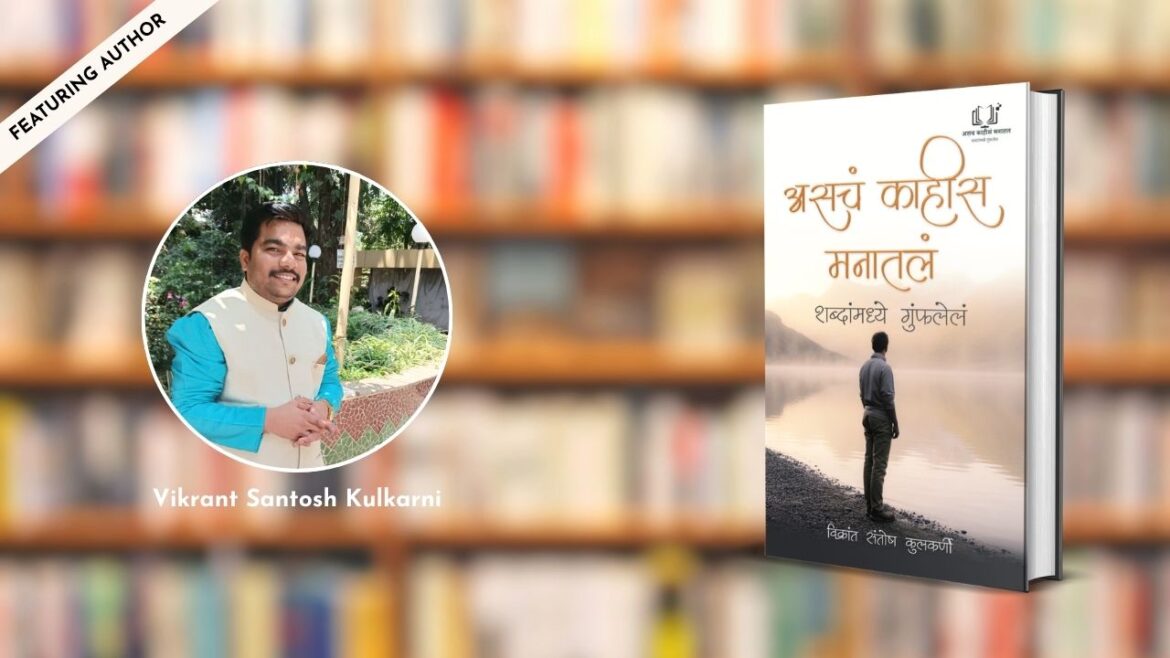
Some writers arrive in the literary world with grand announcements, while others enter quietly—carrying with them a gentle authenticity that resonates deeply with readers. Vikrant Santosh Kulkarni belongs to the second kind. His debut book Asach Kahis Manatal: Shabdanmadhye Gumfalel is not merely a collection of stories and poems; it is a tender mirror held up to the inner life of the common individual. Through its words, Vikrant opens a door into the emotional corners that most people experience but rarely articulate.
What makes Vikrant’s voice so appealing is its striking simplicity. He does not attempt to impress with complicated metaphors or intellectual jargon. Instead, he writes with honesty—an honesty that reflects the everyday struggles, joys, dilemmas, and silent emotions of middle-class life. In a world ruled by speed, ambition, and constant noise, Asach Kahis Manatal feels like a moment of pause, a quiet breath that allows readers to acknowledge their own unspoken feelings.
Vikrant’s journey toward writing began long before he put pen to paper. Professionally, he is a software developer—a field driven by logic, precision, and structured thinking. And yet, beneath this world of code lived a heart that observed life with sensitivity. He found stories in daily routines, poetry in fleeting moments, and meaning in subtle interactions. While the world around him functioned in binaries and algorithms, Vikrant remained deeply aware of the shades of emotion that color human life. This duality—logic on one side and lyrical introspection on the other—forms the distinctive foundation of his creative personality.
As a first-time author, Vikrant did not set out to craft a monumental literary project. Instead, he wrote from the raw, heartfelt spaces of experience. Many of his stories touch upon themes that quietly define the lives of millions: job insecurity, aspirations weighed down by responsibility, the fragile dynamics of marriage, and the silent distances that slowly grow within relationships. These are emotions that seldom find a place in everyday conversations, yet they shape people profoundly. Vikrant captures them with a gentle sensitivity that makes readers feel seen.
What enriches his writing further is his ability to weave poetry across two languages—Marathi and Hindi. Each poem in the collection becomes a window into thoughts that flutter softly within the heart, thoughts that often remain unexpressed. In this bilingual literary approach, Vikrant offers readers the freedom to feel, reflect, and connect in the language closest to their emotions. His poems do not attempt to dazzle; they aim to heal, to comfort, and to remind readers that their inner experiences matter.
The stories in Asach Kahis Manatal feel deeply rooted in the everyday Indian reality. Vikrant does not write about extravagant worlds or dramatic events; instead, he turns toward the quiet and often overlooked spaces of life. He writes of people who wake up each morning with hope, carry invisible burdens, make silent compromises, and still manage to smile through it all. In portraying these lives, he pays tribute to the emotional resilience of the middle class—a resilience rarely acknowledged yet universally felt.
While Vikrant’s writing feels incredibly personal, it is strikingly relatable. Readers often find themselves whispering, “Yes… I have felt this too.” His words offer a sense of companionship—a reminder that no one is truly alone in their journeys of confusion, longing, love, disappointment, or hope. This shared emotional experience is precisely what gives Asach Kahis Manatal its soulful power.
As a writer, Vikrant draws inspiration from the people around him, the subtle changes within society, and the many layers of human relationships. He observes life not from a distance but with involvement, empathy, and curiosity. This empathetic gaze is evident in every page of his book. Even when he writes about pain or conflict, his tone remains compassionate, never judgmental. He allows readers to inhabit the emotional world of his characters with empathy rather than criticism.
Despite being a debut author, Vikrant carries himself with thoughtful humility. He is not driven by the desire for fame; instead, he writes because he genuinely wants to express what often goes unspoken. For him, writing is not a performance—it is a deeply personal process of introspection and expression. This authenticity reflects not only in his stories but also in his approach to poetry, where he blends simplicity with emotional depth.
Asach Kahis Manatal is not just the beginning of Vikrant’s literary journey—it is a promise. A promise that he will continue to explore the complexities of human life through words. A promise that he will remain true to the emotional honesty that defines his writing. And a promise to his readers that their inner worlds—no matter how hidden—will always find a place in his stories and poems.
With this collection, Vikrant Santosh Kulkarni has carved a space for himself as a writer who listens deeply, observes quietly, and writes sincerely. His book becomes not only a reflection of his own heart but also a soothing companion for readers navigating the delicate terrain of their own emotions. In a world overflowing with noise, his words offer a soft, meaningful whisper—one that stays with you long after the last page is turned.