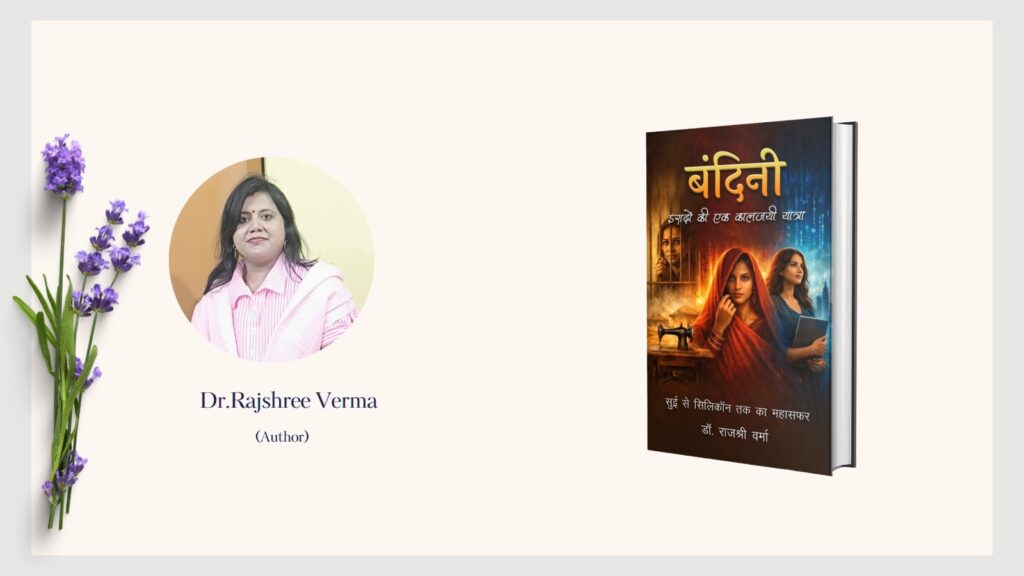
Dr. Rajshree Verma emerges as a distinctive literary voice whose work is deeply rooted in lived experience, cultural consciousness, and an unflinching observation of society. In Bandini: Iraadon Kee Ek Kalajayee Yatra, she crafts not merely a narrative but an emotional and generational chronicle that reflects the silent yet persistent evolution of women’s strength across time. Her journey as an author is inseparable from her identity as a thinker, a healer, and a keen observer of human nature, making this work both intimate and universal in its appeal.
Hailing from Bihar, a land historically enriched by philosophical depth and intellectual awakening, Dr. Verma’s worldview carries the imprints of resilience and reflection. Growing up amidst values that emphasized education, empathy, and human dignity, she developed an early sensitivity toward the layered realities of women’s lives. The figures she encountered in her surroundings—a selfless mother, a resilient wife, an aspiring daughter—did not remain mere observations; they transformed into enduring impressions that would later shape the emotional architecture of her storytelling. This grounding in reality gives her narrative a rare authenticity, making her characters feel lived rather than imagined.
Her academic journey in homeopathic medicine further deepens her literary sensibilities. As a physician trained to understand not just physical ailments but the emotional and psychological undercurrents behind them, she brings a nuanced understanding of human behavior into her writing. This dual lens of science and sensitivity allows her to construct characters that breathe, suffer, hope, and evolve in ways that resonate deeply with readers. In Bandini, this perspective is evident in the way each character’s internal conflicts are portrayed—not as isolated incidents but as reflections of larger societal conditioning.
The book itself stands as a powerful testament to the enduring struggle and transformation of women. Beginning in the modest, tradition-bound environment of Muzaffarpur and gradually expanding into the vast possibilities of a globalized, digital world, the narrative traces the journeys of three generations—Sarla, Vidya, and Aradhana. Each of these women represents not just a phase in time but a stage in the awakening of voice and identity. Sarla embodies silent endurance, a woman shaped by societal expectations and confined within them. Vidya reflects the transitional phase, where awareness begins to emerge, yet courage is still negotiating with fear. Aradhana, in contrast, symbolizes assertion and evolution, a voice that not only questions but also redefines boundaries.
What makes this narrative particularly compelling is its refusal to simplify the idea of empowerment. Dr. Verma does not present liberation as a sudden, dramatic rebellion; instead, she portrays it as a gradual, often painful process of realization. The silence that once defined women’s existence does not disappear overnight—it transforms, gathers strength, and eventually finds expression. This layered depiction adds depth to the narrative, making it both relatable and thought-provoking.
The thematic core of the book lies in its exploration of paradoxes. Women, who are often revered as embodiments of power and creation, are simultaneously subjected to restrictions imposed by the very society they sustain. This contradiction is not merely stated but intricately woven into the lives of the characters. Through their experiences, the reader is invited to reflect on the subtle yet pervasive structures that shape gender roles and expectations. The story does not accuse or idealize; it observes, questions, and gently provokes introspection.
Stylistically, Dr. Verma’s writing is evocative yet grounded. Her language carries a quiet intensity, allowing emotions to unfold naturally rather than being forcefully imposed. There is a lyrical quality in the way she describes internal states, balanced by a straightforward narrative flow that keeps the reader engaged. The transitions between generations are handled with care, ensuring continuity while highlighting change. This balance between fluidity and structure enhances the reading experience, making the book accessible without compromising its depth.
Another noteworthy aspect of the book is its psychological realism. The characters are not portrayed as flawless icons of strength but as individuals navigating their vulnerabilities. Their fears, doubts, and moments of hesitation are given as much importance as their acts of courage. This humanization prevents the narrative from becoming didactic and instead makes it deeply empathetic. Readers are likely to find fragments of their own experiences reflected in these characters, which adds to the book’s emotional impact.
Ultimately, Bandini: Iraadon Kee Ek Kalajayee Yatra is more than a generational story; it is a reflection of a collective journey. It speaks to the gradual yet irreversible shift from silence to voice, from confinement to possibility. Dr. Rajshree Verma succeeds in creating a work that is both a tribute to the resilience of women and a reminder of the work that still lies ahead. Her ability to blend personal insight with broader social commentary ensures that the book remains relevant across contexts and generations.
In bringing together her experiences as a physician, her cultural roots, and her empathetic understanding of human relationships, Dr. Verma has crafted a narrative that lingers long after it is read. It is a work that invites not just reading, but reflection—a quiet yet powerful call to recognize, respect, and continue the journey of voices that were once unheard.







Your perspective matters
Share your thoughts respectfully. Comments are moderated.