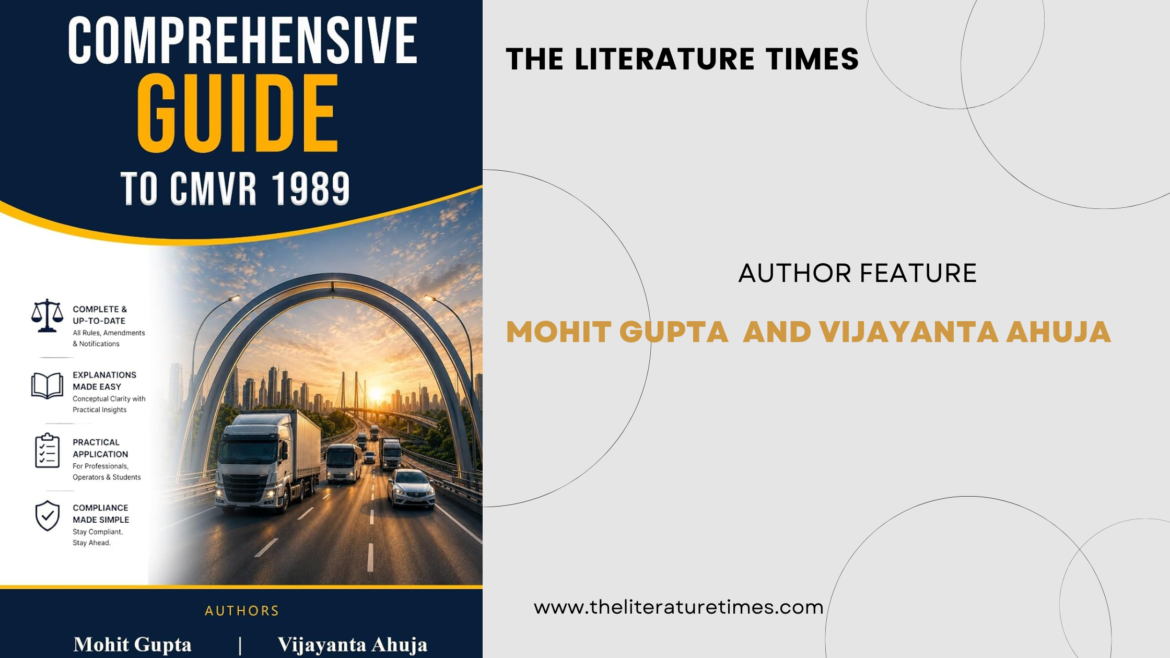
India’s automotive sector is undergoing a profound transformation. From the rise of electric vehicles and connected mobility to increasingly sophisticated safety standards and evolving compliance requirements, the industry today operates within a regulatory environment that is more complex than ever. At the heart of this framework are the Central Motor Vehicles Rules (CMVR), 1989, which continue to play a critical role in governing vehicle standards, licensing, registration, transport operations, road safety, and regulatory compliance. It is within this complex landscape that Vijayanta Ahuja and Mohit Gupta bring their collective expertise to create a comprehensive and practical guide to understanding the CMVR 1989.
The book is designed to address a challenge that professionals, students, manufacturers, legal practitioners, fleet operators, and transport authorities frequently encounter. There is often a gap between understanding legislation in its original statutory form and applying it effectively in real-world situations. While the bare rules provide the legal foundation, navigating their technical language, procedural requirements, amendments, notifications, and practical implications can be challenging. This guide attempts to bridge that gap by presenting the regulatory framework in a structured, accessible, and application-oriented manner.
For Mohit Gupta, the subject comes from more than 25 years of professional experience in automotive regulatory affairs, vehicle validation, and certification. His academic background, comprising a B.Tech, M.Tech, MBA, and LLB, reflects the interdisciplinary nature of his expertise. His professional journey has placed him at the intersection of engineering, law, certification, and regulatory compliance, giving him a distinctive understanding of how automotive regulations function beyond the pages of legislation. Through this book, that experience is translated into a resource intended to make complex regulatory concepts more approachable, particularly for students and young professionals entering the automotive industry.
His contribution is significant because automotive regulation is not simply a legal discipline. It requires an understanding of technology, engineering standards, manufacturing processes, safety requirements, documentation, and statutory procedures. A professional attempting to navigate this environment must therefore be able to understand how these different dimensions interact. Gupta’s multidisciplinary background enables the book to approach CMVR from this broader perspective, making the content relevant not only to legal professionals but also to those working directly with vehicles and automotive systems.
Vijayanta Ahuja, meanwhile, brings more than two decades of experience at the intersection of policy, technology, and automotive regulation. Her career reflects the changing priorities of India’s mobility ecosystem, where technological innovation increasingly needs to be aligned with safety, sustainability, legal compliance, and public trust. Her work in areas connected to transit safety, electric mobility, autonomous vehicles, and international standards provides the book with a forward-looking perspective on regulation.
One of the most important challenges facing regulators and industry stakeholders today is the pace at which mobility technology is evolving. Electric vehicles, autonomous technologies, advanced safety systems, alternative propulsion technologies, and connected vehicles are transforming traditional concepts of transportation. Regulations must evolve alongside these developments without compromising safety or creating unnecessary barriers to innovation. Ahuja’s experience in navigating this intersection gives the book relevance beyond the existing regulatory framework. It also encourages readers to consider how automotive regulations may influence the future of mobility in India.
The book’s scope is extensive. It examines important areas such as licensing and registration, technical standards, vehicle construction and equipment requirements, transport vehicle operations, permits, road safety, traffic regulations, maintenance requirements, and emission standards. By organizing these subjects thematically, the authors aim to make the regulatory framework easier to navigate for readers who may otherwise find the sheer volume of statutory material overwhelming.
Another valuable aspect of the guide is its emphasis on the changing nature of compliance. Automotive regulations cannot be treated as static documents. Amendments, judicial interpretations, administrative notifications, and technological developments continually influence how rules are understood and implemented. By incorporating updated amendments, judicial precedents, and administrative notifications, the book seeks to provide readers with a more contemporary understanding of the CMVR framework.
For manufacturers and automotive businesses, regulatory compliance is closely connected with product development and market access. A vehicle must satisfy technical and safety requirements before it can successfully enter the market, while manufacturers must continuously monitor regulatory changes that could affect their products and processes. For fleet operators and transport organizations, compliance extends into licensing, permits, vehicle operation, maintenance, and safety. Legal professionals, meanwhile, require an accurate understanding of the rules and their interpretation. The guide therefore occupies a useful position between legal reference material and professional practice.
Perhaps one of the book’s strongest qualities is its educational value. The authors recognize that the future of India’s automotive industry depends not only on established professionals but also on the next generation of engineers, lawyers, managers, policymakers, and regulatory specialists. For students and young professionals, entering the world of automotive regulation can be particularly challenging because it requires knowledge across multiple disciplines. By simplifying technical terminology and organizing complex provisions into logical sections, the book can serve as an accessible starting point for developing that understanding.
The collaboration between Ahuja and Gupta is particularly relevant because their professional experiences represent complementary sides of the regulatory ecosystem. Gupta’s foundation in technical validation, certification, and legal understanding is complemented by Ahuja’s extensive experience in policy, governance, standards, and emerging mobility technologies. Together, their perspectives create a broader view of automotive regulation. The book considers not only what the rules say, but also why they matter and how they influence the development of India’s transportation infrastructure.
At a time when India is positioning itself as a major automotive and mobility hub, regulatory clarity has become increasingly important. Innovation cannot thrive independently of responsible governance. Safe and sustainable mobility requires frameworks that encourage technological advancement while protecting passengers, road users, manufacturers, and the wider public. The CMVR 1989 remains a fundamental component of this ecosystem, and understanding its provisions is therefore essential for anyone involved in India’s automotive and transport sectors.
Ultimately, this book is more than a compilation of rules. It is an attempt to make an extensive regulatory framework understandable, navigable, and practically useful. By bringing together technical expertise, legal understanding, policy experience, and knowledge of emerging mobility technologies, Vijayanta Ahuja and Mohit Gupta offer readers a resource designed for both present-day compliance and a deeper understanding of the future of transportation regulation.
As India’s roads, vehicles, and mobility systems continue to evolve, the relationship between innovation and regulation will become even more important. This guide arrives at a significant moment, offering professionals and aspiring industry leaders a structured way to understand the rules that shape how India moves.