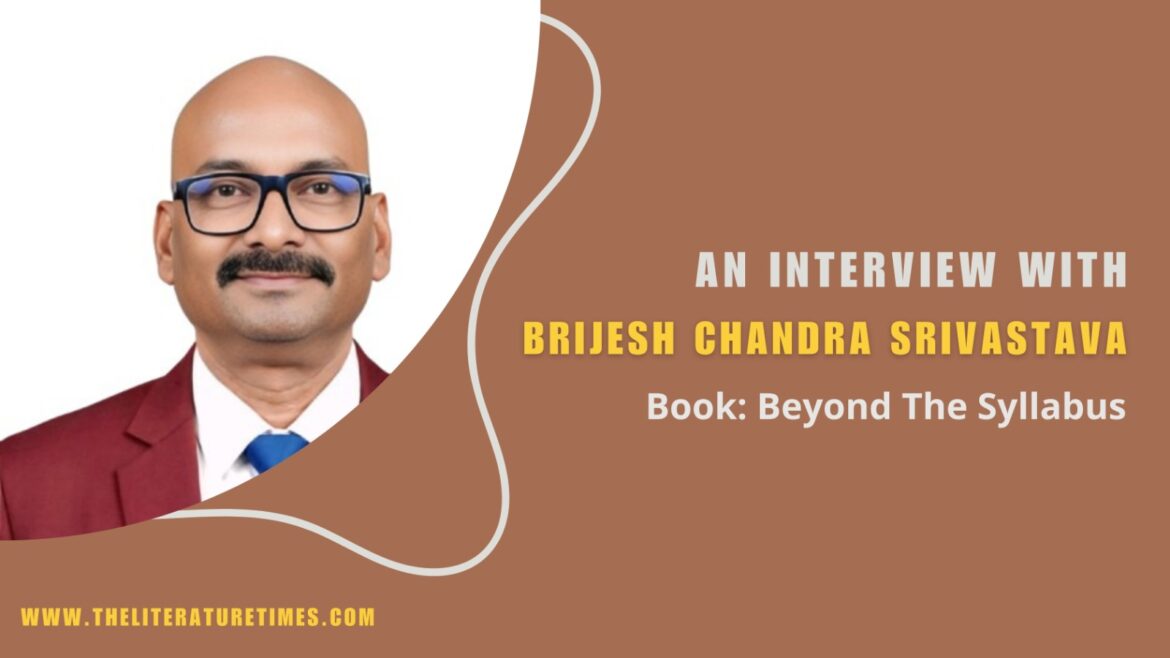
Beyond the Syllabus: The Strategy, Psychology & Mindset Manual for UPSC Civil Services is a comprehensive guide for UPSC Civil Services aspirants addressing what lies beyond coaching and content — the strategic thinking, psychological resilience and mindset architecture that determines who performs when it matters most. Foreword by Shri Gyan Prakash Upadhyaya IAS (1987 Batch, IIT Roorkee & MIT). Words of Endorsement by Shri Avinash Chandra IPS (Retd.). Reflections by Paras Malik — three-time UPSC Interview candidate.
The Literature Times:‘Beyond the Syllabus’ — the title alone feels like a provocation to the entire UPSC coaching industry. Was that deliberate?
Brijesh Srivastava: Deliberate, yes. Apologetic, no.
The UPSC examination is perhaps the most thoroughly syllabus-obsessed exercise in Indian public life. Aspirants spend three, four, five years mapping every corner of a prescribed territory — polity, economy, geography, history, ethics — until they can recite it backwards. And then a significant number of them walk into the Mains, or the Interview, and something fails. Not the knowledge. Something else.
The title is a signpost pointing to that something else. Strategy. Psychology. The architecture of the mind under sustained pressure. The ability to think — not just recall — when an examiner asks a question that no coaching material has ever framed in quite that way.
If the title provokes the coaching industry, I would gently suggest they ask themselves why. A title that says ‘beyond the syllabus’ is not an attack on the syllabus. It is an acknowledgement that the syllabus, however brilliantly taught, is necessary but not sufficient. That distinction matters enormously.
The Literature Times:You are a civil engineer who spent thirty-six years building railways and bridges. What could you possibly know about UPSC preparation that a dedicated UPSC coach does not?
Brijesh Srivastava: A fair question — and one I asked myself before writing a single word.
Here is what I know that most UPSC coaches, through no fault of their own, cannot know: what happens to a human being across four decades of performing under institutional pressure. Project deadlines that could not move. Audit observations that had to be answered. Client negotiations where the wrong word cost months. Parliamentary committee reviews. World Bank assessments.
The UPSC examination is a three-year sprint. A career in public infrastructure is a forty-year marathon. And every psychological principle that governs performance in one governs performance in the other. The amygdala does not know the difference between an examination hall and a site dispute. Cortisol rises the same way. Focus narrows the same way.
A UPSC coach knows the syllabus with a depth I cannot match. But I know the mind under pressure with a lived intimacy that the syllabus cannot teach. We are not competing. We are completing each other.
And beyond that — I have read the Bhagavad Gita, Chanakya’s Arthashastra, and the IAS officers’ own memoirs more carefully than most coaching manuals. The UPSC itself, if you read its papers carefully, is asking for exactly what I am writing about.
The Literature Times: The book has a tagline — ‘मेरा कोई batch नहीं… पर मेरा कोई match नहीं.’ That is rather bold. Who is this line for?
Brijesh Srivastava: It is for every aspirant who has been told — gently or brutally — that they do not belong in the top tier.
UPSC preparation in India is heavily institutionalised. If you are from a particular coaching centre, a particular city, a particular background — there is a subtle but real sense that you are on the inside track. If you are not, there is an equally subtle but real sense that you are playing catch-up.
The line is for the aspirant from a small town, studying from books borrowed from the district library, with no batch, no network, no mentor with the right connections. I know that aspirant. I was something like that aspirant, in a different context, forty years ago.
But I also wrote it because I genuinely believe it. The examination hall is the great equaliser. When you sit down with that answer sheet, your coaching centre’s brand name is not in the hall with you. Your batch rank is not there. Only you and your mind are there. And if that mind is trained — truly trained, not just stuffed — then the absence of a famous batch is not a disadvantage. It is irrelevant.
Mera koi batch nahi. Par mera koi match nahi. That is not arrogance. That is the correct belief system for anyone attempting one of the most difficult examinations in the world.
The Literature Times: Two IAS officers wrote the forewords — Shri Gyan Prakash Upadhyaya and Shri Avinash Chandra IPS. How did they respond when they first read the manuscript?
Brijesh Srivastava: With a recognition that I found deeply moving — because it came from people who had actually lived through the selection process.
Gyan Prakash Upadhyaya ji — IAS 1987 batch, IIT Roorkee alumnus, MIT — read the manuscript and said something that stayed with me: that this is the book he wished had existed when he was preparing. That from someone of his standing was not a compliment. It was a confirmation.
Avinash Chandra ji brought the IPS perspective — which is different from the IAS perspective in important ways. The psychological demands of the two services are not identical. His endorsement gave the book a breadth it would not have had with a single service lens.
What struck me about both responses was what they did not say. Neither of them corrected my understanding of the examination. Neither said — no, that is not how it works. They recognised the accuracy of what I had described, from the inside, because they had been through it.
That is the most rigorous validation a book on UPSC preparation can receive. Not from a reviewer, but from those who cleared it.
The Literature Times: The book dedicates an entire section to the UPSC Interview — the Personality Test. Most guides spend perhaps a chapter on it. Why does it deserve so much of your attention?
Brijesh Srivastava: Because it is the stage where the examination stops being about content and becomes entirely about the person.
Every candidate who reaches the Interview has cleared Prelims and Mains. They are all, by that point, knowledgeable. The board already knows they know things. The Interview is not a knowledge test. It is a character test — a sustained, probing, sometimes deliberately uncomfortable assessment of how this person thinks, responds under pressure, holds a position, changes a position, and conducts themselves when they do not know the answer.
And yet most preparation for the Interview consists of practising answers to predictable questions. What is your DAF? What is your home state? What are your hobbies? As if the board has not seen ten thousand such answers in the same cycle.
The Interview rewards something that cannot be crammed — genuine intellectual curiosity, the ability to say ‘I do not know but here is how I would think about it,’ comfort with ambiguity, and a quality of presence that the board can feel across a table.
These are developable qualities. They take time and the right kind of practice. That is what the section addresses. Not what to say — how to be.
The Literature Times: Q6. Paras Malik — who reached the UPSC Interview three times — has written the Reflections in your book. What does a three-time Interview candidate bring to a book on UPSC preparation that a successful candidate cannot?
Brijesh Srivastava: Honesty.
A successful candidate has an ending that justifies the journey in retrospect. Everything they did, in hindsight, becomes the right thing. The sleepless nights were worth it. The strategy was correct. The mindset was sound. Selection confirms everything.
Paras reached the Interview three times. He sat before the board three times and was found — three times — to have fallen just short of selection. He knows the examination from the inside with a depth that selection does not always produce. He knows what it feels like to prepare correctly, to perform correctly, and still not cross the final threshold.
His reflections in the book are not about failure. They are about the particular clarity that comes from sustained engagement with something difficult — the kind of clarity that people who succeed on the first attempt rarely have the opportunity to develop.
I also included him because this book is not a celebration of selection. It is a companion for the journey. And for most aspirants, the journey is long, and the most important thing about it is not the result — it is what it builds in you.
The Literature Times: You write about optional subject selection at some length. Is optional subject really a psychological decision, or is it simply a pragmatic one?
Brijesh Srivastava: It is both — and the mistake most aspirants make is treating it as purely pragmatic.
The standard advice is well known: choose the optional with the highest scoring history, the shortest syllabus, the most overlap with General Studies. Spreadsheets are made. Alumni are surveyed. Toppers’ strategy documents are studied.
And then the aspirant spends twelve to eighteen months with a subject they find interesting on paper but genuinely tedious in practice. The motivation to go deep — to write answers with genuine engagement, to find connections between the optional and the contemporary world — simply is not there.
The Mains answer sheet is a document. The examiner reading it is a human being. They can feel, across the page, whether the person who wrote this answer was genuinely interested in it or performing the act of interest. That quality — or its absence — is not something that can be faked across nine papers and five hundred answers.
Choose the optional you would read on a Sunday afternoon when there is no examination in sight. Everything else will follow.
The Literature Times: There is a chapter in the book about the gap year — what to do when you have to attempt again. This is unusual territory for a preparation guide. Why go there?
Brijesh Srivastava: Because for a very large number of UPSC aspirants, the gap year is not a theoretical possibility. It is the reality. And nobody is writing about it honestly.
The coaching industry, for understandable commercial reasons, is oriented toward hope and forward momentum. Buy the next course. Attend the next test series. Revise the strategy. There is nothing wrong with any of that. But it does not address what actually happens in the months after a result that did not go as expected.
The gap year is psychologically the most dangerous period in an aspirant’s journey. The structure of the previous year is gone. The cohort has dispersed — some have cleared, some have left. Family pressure, which was patient during the preparation year, is now less patient. The aspirant is alone with a result that says: not yet.
What do you do with that? How do you rebuild without simply repeating? How do you address what actually went wrong without demoralising yourself? How do you maintain the belief that the next attempt will be different?
These are not motivational questions. They are strategic and psychological ones. And they deserved a chapter.
The Literature Times: The Bhagavad Gita appears in this book as it did in Awareness to Mastery. Are you perhaps over-relying on one ancient text?
Brijesh Srivastava: Ha! A fair challenge. Let me defend myself briefly and then concede the point slightly.
The Gita appears in both books because the Gita addresses the central problem of both books: how does a prepared, capable person perform at their highest level when the stakes are at their highest? That is Arjuna’s problem. That is every JEE aspirant’s problem. That is every UPSC candidate’s problem. The text is not being misapplied — it is being applied to exactly the situation it was designed for.
But I also draw on Chanakya’s Arthashastra in Beyond the Syllabus — extensively. Chanakya was, among other things, the most sophisticated strategic thinker India has produced, and his understanding of statecraft, governance, and the qualities required of a good administrator maps directly onto what the UPSC is looking for in an IAS officer. It is not a coincidence that the examination tests ethics, governance, and public policy. Chanakya was writing about these things two thousand years ago.
I also draw on contemporary neuroscience, on the documented experiences of serving IAS officers, and on my own four decades of observation.
The Gita is not a crutch. It is a companion. There is a difference.
The Literature Times: A final question — and a personal one. You never sat for UPSC. You never wore the uniform. What gives you the right to write about the dream of those who do?
Brijesh Srivastava: The right that any honest observer earns — by paying attention for long enough.
I never applied for UPSC. That is true. But I spent thirty-six years working alongside IAS officers, IPS officers, IRS officers — in project meetings, in government corridors, on construction sites where the collector’s decision determined whether a bridge got built or stalled for a decade. I watched how they thought. I watched how they made decisions under pressure. I watched what separated the good ones from the excellent ones — and it was never, in my observation, the rank they cleared at.
I also spent years mentoring young engineers who had wanted to sit for UPSC and did not, or who sat and did not clear, and who carried that quietly for the rest of their careers. I understood what the examination meant to them — not as a career path, but as a statement about themselves.
And I read Paras Malik’s account of sitting before the board three times. I read what he experienced, and I recognised it — not from the examination hall, but from the project review meeting, the arbitration chamber, the client confrontation where everything depended on what you said in the next thirty seconds.
The dream belongs to the aspirant. The book belongs to the observer who paid close enough attention to that dream to say something useful about it. I believe I have. The readers will decide.