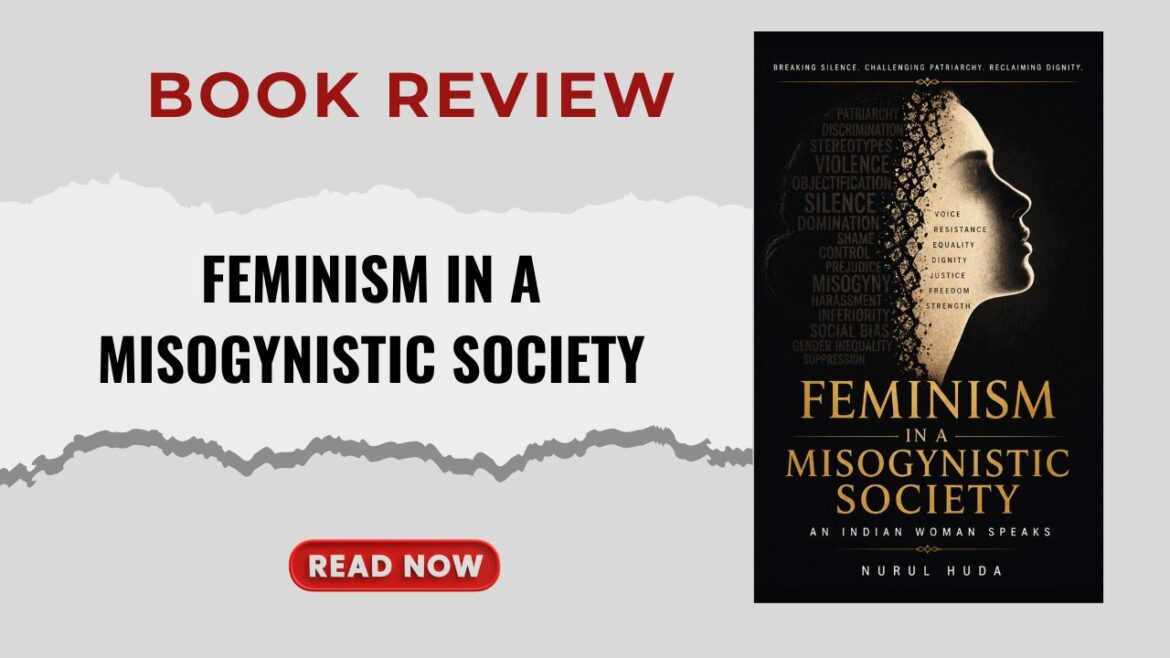
In an age where conversations around feminism are often reduced to slogans, debates, or social media outrage, Feminism in a Misogynistic Society emerges as a deeply reflective and emotionally intelligent work that attempts to explore the quieter, more invisible dimensions of women’s lived experiences. Rather than relying on sensationalism or ideological aggression, the book approaches feminism through observation, psychological insight, and social reality. It does not merely discuss oppression as an external force; it examines how systems of control slowly enter the mind, shape identity, and become normalized across generations.
What makes this book particularly compelling is its writing style. The language is simple yet deeply penetrating, almost meditative at times. The author does not rush toward conclusions or attempt to impose a rigid framework on the reader. Instead, the narrative unfolds gradually, layer by layer, allowing readers to recognize patterns that often remain unnoticed in everyday life. The book feels less like a lecture and more like a conversation—one that is uncomfortable, honest, and necessary.
One of the strongest sections of the book is its exploration of silence. The author challenges the common assumption that silence indicates agreement or weakness. Instead, silence is presented as survival—a conditioned response created by environments where speaking comes with emotional, social, or institutional consequences. The discussion around women learning to question their own perceptions, suppress their reactions, and edit themselves before speaking is particularly powerful. The book carefully explains how self-doubt is not always personal insecurity, but often the result of repeated dismissal and conditioning. This psychological depth gives the work a remarkable sense of realism.
Equally impactful is the chapter on the “good girl” conditioning. Here, the author examines how obedience, emotional restraint, politeness, and self-sacrifice are rewarded from childhood and eventually become internalized as virtue. The analysis is subtle but devastating. The book shows how many women grow up learning to prioritize acceptance over authenticity, and how this constant self-monitoring gradually transforms into self-policing. The idea that silence becomes “a strategy for maintaining connection” is one of the book’s most memorable insights because it captures the emotional complexity behind conformity. The author is not simply criticizing social expectations; they are revealing the emotional systems that make those expectations feel natural.
Another important strength of the book lies in its discussion of internalized misogyny. Rather than portraying women only as victims of patriarchal systems, the book courageously examines how oppressive structures are often unconsciously reproduced within society itself. Women policing other women, enforcing standards of “respectability,” and participating in systems of judgment are discussed not with blame, but with psychological clarity. This nuanced approach prevents the book from becoming simplistic. It acknowledges that oppression survives not only through power, but through repetition, conditioning, and inherited social patterns.
What makes the work intellectually engaging is its focus on emotional conditioning rather than overt political argument. The author repeatedly shows how systems of inequality sustain themselves through subtle mechanisms: shame, approval, guilt, fear of visibility, and the need for acceptance. The analysis of how women learn to regulate tone, expression, and even ambition in anticipation of judgment is especially insightful. Many readers—particularly women—may find themselves recognizing experiences they had never fully articulated before.
At the same time, the book avoids hopelessness. Beneath its critique lies a quiet but persistent belief in self-awareness and transformation. The author emphasizes that what has been socially conditioned can also be questioned and unlearned. The process of reclaiming self-trust, emotional authenticity, and freedom of expression is described not as rebellion, but as reconstruction. This gives the book emotional balance. It is critical without becoming cynical.
From a literary perspective, the prose is elegant in its restraint. The author uses repetition effectively to emphasize emotional truths, and the reflective tone creates an almost philosophical atmosphere throughout the text. Certain passages read like meditations on identity, fear, and belonging rather than conventional social commentary. This style may feel slow to readers expecting activism-driven writing, but for others it will be precisely what makes the book memorable. It prioritizes introspection over outrage and understanding over accusation.
However, the book’s greatest strength may also become a limitation for some readers. Because the work focuses heavily on psychological and emotional analysis, it spends less time discussing concrete social, economic, or political solutions. Readers looking for statistical research, legal analysis, or policy-driven feminist discourse may find the text more reflective than practical. Yet this seems intentional. The book is less concerned with presenting institutional arguments and more interested in exposing the invisible emotional architecture of misogyny.
Overall, Feminism in a Misogynistic Society is an important and thought-provoking contribution to contemporary feminist writing. It stands apart because it refuses simplification. Instead of presenting feminism merely as resistance against men or systems, it explores how deeply social conditioning shapes identity, silence, morality, and emotional behavior. The result is a book that feels deeply human, emotionally intelligent, and psychologically honest.
This is not a book that demands immediate agreement. It is a book that asks readers to pause, reflect, and recognize the invisible structures that influence everyday life. And perhaps that is its greatest achievement—it transforms familiar experiences into conscious understanding. For readers interested in feminism, psychology, gender studies, or simply the complexity of human conditioning, this book offers a powerful and unforgettable reading experience.
Title: Feminism In A Misogynistic Society
Author: Nurul Huda
Publisher: Evincepub Publishing