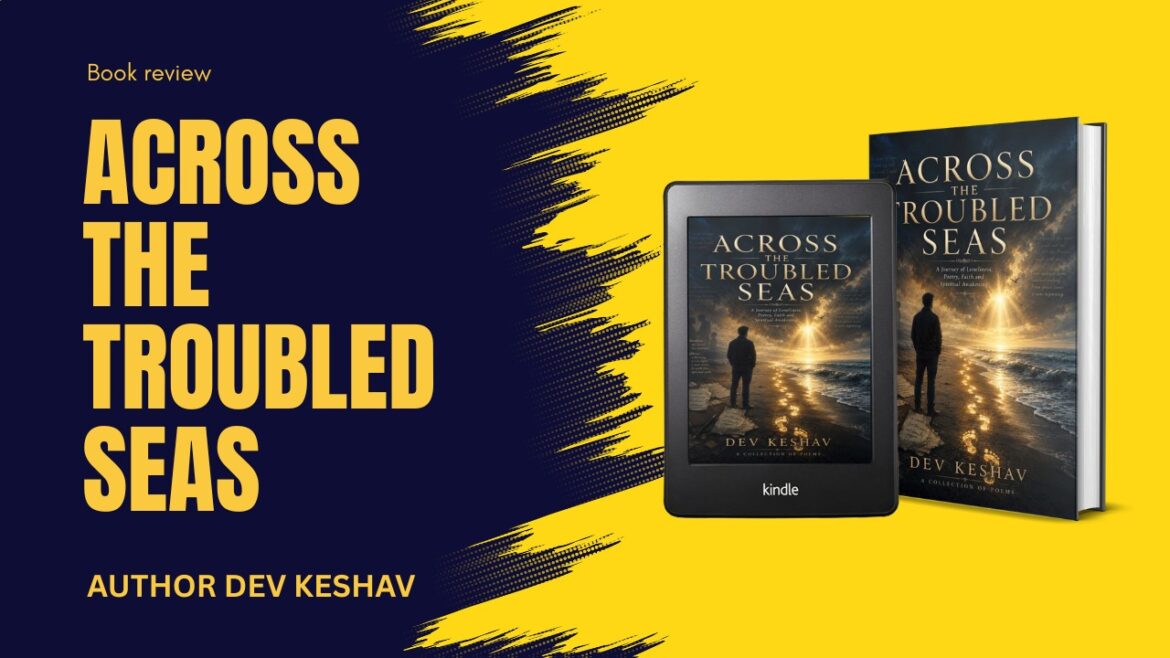
Title: Across The Troubled Seas
Author: Dev Keshav
Publisher: Evincepub Publishing
There are books that entertain, books that challenge, and then there are books that bear witness. Across The Troubled Seas belongs firmly in the third category. Dev Keshav’s poetry collection reads like a testimony – of survival, loss, displacement, love, war, and spiritual awakening. It is deeply personal yet universal enough to resonate with anyone who has grappled with life’s uncertainties.
What makes this book compelling is its emotional authenticity. The poems do not feel constructed for effect; they feel remembered. There is a strong autobiographical pulse running throughout the collection, making it less like reading poetry and more like listening to someone recount the most defining moments of their life.
The title itself is apt. Life here is presented as a voyage – unpredictable, dangerous, and transformative. The “troubled seas” are not merely external events like war or migration but internal battles of identity, faith, and mortality.
One of the strongest aspects of this collection is its thematic diversity. The war section is particularly impactful. Poems like Vietnam and Make War Not Peace carry a strong anti-war sentiment, questioning the senselessness of violence and the systems that perpetuate it. Keshav writes not as an observer but as someone emotionally entangled in the consequences of war. There’s anger, sorrow, and moral exhaustion in these verses.
Yet the book is equally rich in softer, contemplative moments. Poems such as Raindrops and The Water Miracle take simple natural images and transform them into reflections on gratitude and scarcity. These poems remind readers that beauty often lies in the smallest things – a drop of water, a moment of rain, a passing memory.
Keshav also explores the immigrant experience with unusual sensitivity. In First Time Bombay, the fear and alienation of entering a crowded unfamiliar world are vividly captured. There is vulnerability here, a sense of being unanchored, which many readers will connect with. Migration in this book is not romanticized; it is shown as both necessity and emotional rupture.
Another noteworthy feature is the book’s spiritual evolution. The later poems increasingly turn toward existential questions: Who are we beyond the body? What is destiny? What survives after death? Poems like Destiny, The Soul, and The Ascent reveal a poet who has moved beyond worldly concerns into a space of philosophical searching. This progression gives the book an almost narrative structure – from youthful conflict to mature introspection.
The language throughout remains simple, almost conversational. This accessibility makes the collection inviting, even for readers who do not often read poetry. Keshav’s strength lies in clarity rather than abstraction. His images are straightforward, but they linger because of the emotions attached to them.
There are moments where the poems feel rough around the edges, but strangely, that imperfection adds to their charm. It makes the collection feel alive, like an old diary preserved with all its honesty intact.
What lingers after finishing Across The Troubled Seas is its sense of humanity. The poet never claims to have found all the answers. Instead, he offers his questions, scars, and reflections as companions for the reader’s own journey.
This is not poetry that seeks applause; it seeks connection.
For readers of reflective poetry, memoir-like verse, or spiritually inclined literature, this book offers much to engage with. It is a collection that asks you not just to read, but to remember – your own storms, your own voyages, your own troubled seas.
And in doing so, it becomes more than a book. It becomes a mirror.
Buy on Amazon: https://www.amazon.in/dp/9373352296/