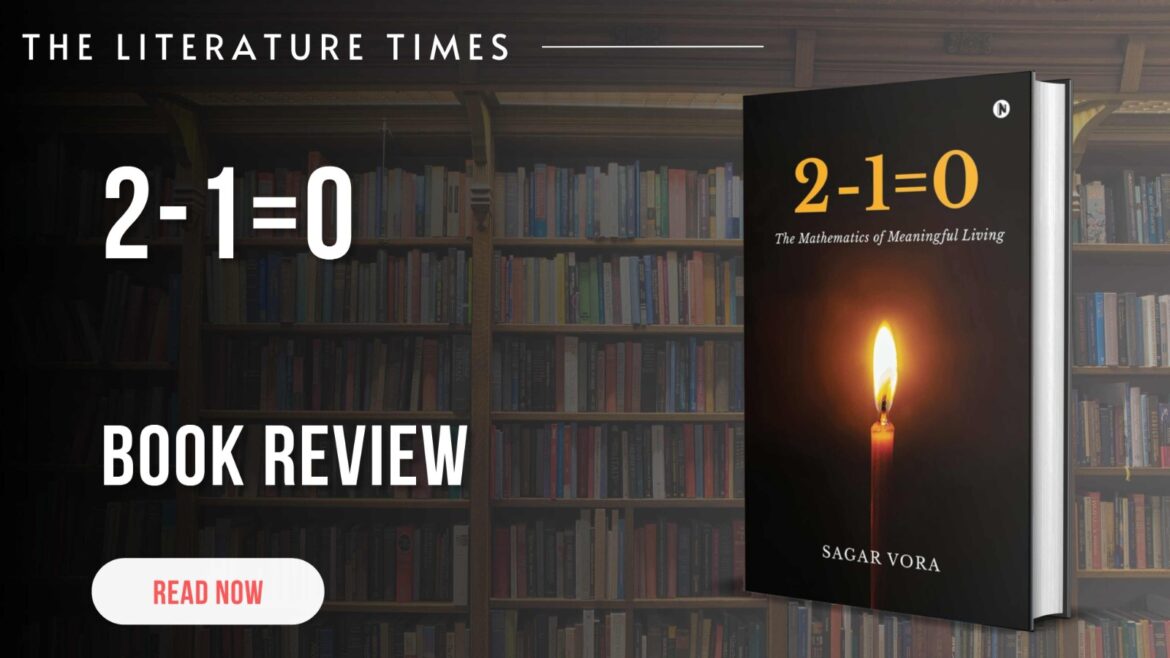
Sagar Vora’s 2-1=0: The Mathematics of Meaningful Living is an introspective and thought-provoking exploration of the invisible equations that govern human existence. Blending philosophy, personal reflection, storytelling, and practical wisdom, the book presents a compelling argument that life’s meaning often depends not on grand achievements but on the presence of a few essential elements. Through a simple yet powerful mathematical metaphor, Sagar invites readers to examine the relationships, values, and habits that sustain a fulfilling life.
At the heart of the book lies a deceptively simple equation: when one vital component is removed from an otherwise complete system, the whole can lose its meaning. Whether it is trust in a relationship, purpose in work, faith in difficult times, or presence in daily life, the absence of a single foundational element can create a void that no amount of external success can fill. This central idea serves as the framework for the book and provides readers with a fresh lens through which to view their own lives.
One of the book’s greatest strengths is its accessibility. Sagar avoids complex philosophical jargon and instead relies on everyday experiences and relatable situations to communicate profound insights. The mathematical analogies are easy to understand, yet they carry significant emotional and intellectual weight. By presenting life lessons through equations, he transforms abstract concepts into memorable reflections that readers can easily recall and apply. The result is a work that feels both intellectually engaging and emotionally resonant.
The author’s writing style is warm, conversational, and reflective. Rather than positioning himself as an authority dispensing wisdom from a distance, Sagar writes as a fellow traveler navigating the complexities of life. This approach creates an immediate sense of connection with the reader. Each chapter feels less like a lecture and more like a thoughtful conversation, allowing readers to engage with the ideas at their own pace. The absence of a preachy tone is particularly refreshing in a genre that often risks becoming overly instructional.
A notable feature of 2-1=0 is its emphasis on emotional intelligence. The book recognizes that life’s challenges are rarely solved through logic alone. While the mathematical framework provides structure, the true focus remains on human emotions, relationships, and inner growth. Sagar explores themes such as love, trust, patience, resilience, gratitude, and faith with sincerity and depth. His observations reflect an understanding of the emotional realities that many people experience but often struggle to articulate.
The recurring message of becoming the “+1” serves as the book’s most inspiring and actionable idea. Rather than dwelling on what is missing, Sagar encourages readers to focus on what can be added. This shift from loss to contribution transforms the book from a collection of reflections into a practical philosophy of living. The concept is simple but remarkably effective because it empowers readers to take responsibility for creating meaning rather than waiting for circumstances to improve. In a world often dominated by narratives of scarcity and dissatisfaction, this emphasis on intentional addition feels both timely and uplifting.
The author’s professional background in finance, leadership, and problem-solving contributes a unique dimension to the work. While many books on personal growth rely heavily on abstract theory, Sagar grounds his reflections in observations drawn from real life. His insights into human behavior, workplace dynamics, personal relationships, and self-doubt feel authentic because they emerge from lived experience rather than theoretical speculation. This practical foundation enhances the book’s credibility and broadens its appeal to professionals, entrepreneurs, parents, and individuals seeking greater clarity in their lives.
Another strength of the book is its ability to meet readers where they are emotionally. Whether someone is experiencing grief, uncertainty, burnout, disappointment, or simply a period of introspection, the book offers gentle encouragement without oversimplifying difficult realities. Sagar acknowledges pain and loss while simultaneously emphasizing the possibility of renewal. This balance between realism and hope prevents the work from slipping into either pessimism or unrealistic positivity. Instead, it offers a compassionate perspective that recognizes life’s complexities while affirming the potential for growth.
However, readers seeking highly structured methodologies or step-by-step frameworks may find the book less prescriptive than other works in the self-development genre. Its strength lies more in reflection than instruction. The chapters encourage contemplation rather than action plans, making the reading experience deeply personal. For some, this open-ended approach will be liberating; for others, it may leave a desire for more concrete tools and exercises. Nevertheless, this stylistic choice aligns with the book’s central purpose, which is to inspire awareness rather than dictate solutions.
The book’s greatest achievement is perhaps its ability to make readers pause. In an age characterized by constant distraction and relentless productivity, 2-1=0 advocates for presence, reflection, and intentional living. It reminds readers that meaning is not found exclusively in accomplishments but in the quality of attention given to life’s most important relationships and experiences. The lessons are not revolutionary in themselves, but Sagar presents them with such clarity and sincerity that they feel newly discovered.
Ultimately, 2-1=0: The Mathematics of Meaningful Living is a heartfelt meditation on what makes life meaningful. Through elegant metaphors, relatable stories, and thoughtful reflections, Sagar Vora offers readers a framework for understanding the fragile yet beautiful equations that shape human existence. It is a book that speaks softly rather than loudly, inviting contemplation instead of demanding change. By encouraging readers to become the “+1” in their own lives and in the lives of others, Sagar delivers a message that is both simple and profound. The result is a reflective and inspiring work that lingers in the mind long after the final page, reminding us that meaning is not something we find—it is something we choose to create.