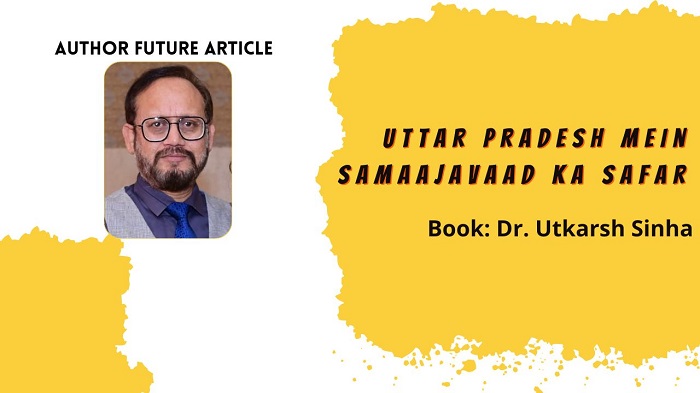
In the dynamic landscape of Indian politics, few ideologies have left as profound an imprint on Uttar Pradesh (UP) as socialism. Dr. Utkarsh Sinha’s latest book, Uttar Pradesh Mein Samaajavaad ka Safar, traces this ideological journey with scholarly depth and journalistic clarity. The book presents a comprehensive chronicle of how socialism evolved from an ideal during India’s freedom struggle into a potent political movement shaping the destiny of UP till 2025.
At the heart of this work lies Dr. Sinha’s meticulous exploration of socialist thought and its enduring relevance. The author revisits the foundational years when stalwarts like Acharya Narendra Dev, Ram Manohar Lohia, and Jayaprakash Narayan infused socialism with moral vision and revolutionary zeal. Their ideas—rooted in equality, justice, and democracy—gave voice to farmers, workers, and marginalized communities. Dr. Sinha illustrates how Lohia’s “Sapta Kranti” (seven revolutions) and Narendra Dev’s ethical socialism became guiding principles for generations of leaders who sought to build a more inclusive India.
The book delves into the transformative decades that followed—the Mandal Commission, the anti-Emergency resistance, and the rise of leaders like Mulayam Singh Yadav, who carried Lohia’s legacy into the heart of regional politics. Dr. Sinha highlights how socialism in UP evolved beyond ideology to become a movement intertwined with people’s aspirations for representation and dignity.
In contemporary times, Akhilesh Yadav emerges in the narrative as the torchbearer of modern socialism. Dr. Sinha examines how Akhilesh’s leadership redefined socialism for the digital age through welfare schemes, infrastructural projects, and his “PDA” (Backward, Dalit, and Minority) strategy. By linking social justice with technological advancement—exemplified by the laptop distribution program, metro networks, and the push for a caste census—Akhilesh’s brand of socialism embraces inclusivity and progress. His performance in the 2024 Lok Sabha elections, where his party won 37 seats, reflects the renewed vitality of socialist politics in the state.
However, Dr. Sinha does not overlook the challenges confronting socialism. He offers a balanced critique of its organizational weaknesses, leadership gaps, and the growing influence of Hindutva politics. Yet, his conclusion remains optimistic—arguing that the future of socialism in Uttar Pradesh depends on its ability to adapt through digital engagement, social inclusion, and coalition-building.
Beyond being a political commentary, Uttar Pradesh Mein Samaajavaad ka Safar is also a sociological study of changing power structures in India’s largest state. It serves as a vital reference for researchers, students, and political enthusiasts seeking to understand the ideological battles that continue to shape Indian democracy.
Dr. Utkarsh Sinha himself is an exemplary figure in the field of media and public discourse. A journalist, columnist, and documentary filmmaker based in Lucknow, he brings over 25 years of experience spanning print, television, radio, and digital journalism. A native of Ballia and alumnus of Gorakhpur University, he earned his Ph.D. from Ram Manohar Lohia Avadh University. Having edited four Hindi newspapers and contributed more than 800 articles to leading publications worldwide, Dr. Sinha’s intellectual rigor shines through in every chapter.
His curiosity as a traveler—having explored 21 countries—adds a global perspective to his understanding of society and politics. With Uttar Pradesh Mein Samaajavaad ka Safar, Dr. Utkarsh Sinha cements his position not only as a chronicler of history but as a thoughtful commentator on the evolving spirit of Indian socialism.