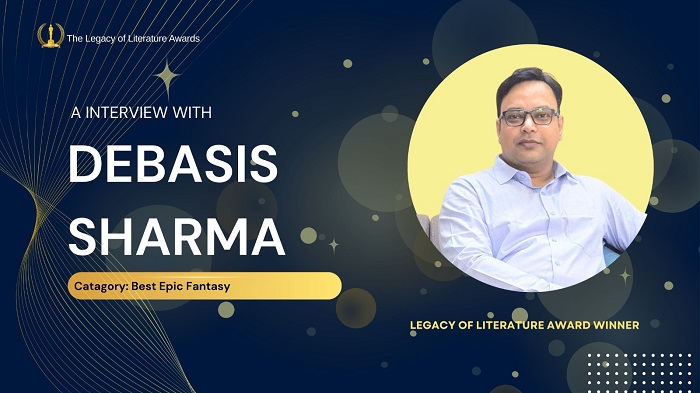
Debasis Sharma is a visionary storyteller who weaves mythology, spirituality, and epic fantasy into immersive narratives of cosmic proportions. With a deep fascination for ancient lore and timeless philosophies, the author crafts worlds where divine forces, destiny, and human courage collide.
In Rudra Chakrin: Rise of the Tenth, they bring to life a sweeping saga of a prophesied warrior rising amidst global chaos and supernatural corruption. Through vivid world-building, spiritual symbolism, and emotionally charged heroism, the author invites readers on a transformative journey exploring enlightenment, inner shadows, and the eternal battle between light and darkness.
The Literature Times: What inspired you to create the mythic universe of Rudra: Rise of the Tenth?
Debasis Sharma: The mythic universe of Rudra Chakrin, with Rise of the Tenth as its first instalment, is deeply inspired by both Tibetan prophecies and Hindu traditions. Tibetan texts describe Rudra Chakrin as Kalki, the final avatar of Lord Vishnu, who is prophesied to appear at the end of the Kali Yuga and will be the 25th King of Shambhala. Similarly, Hindu prophecy describes Kalki as the tenth avatar, destined to restore dharma at the end of dark age. This vision of a cosmic warrior appearing at the edge of darkness gave me a profound narrative foundation.
It allowed me to merge the fierce, transformative energy of Rudra—a humble village boy—with the restorative mission of Kalki, creating a character who embodies both the destruction of illusion and the renewal of truth. For me, this prophecy is not merely about the end of an era, but about the eternal cycle of decline and rebirth. By envisioning Rudra as Kalki, I wanted to invite readers into a mythic journey that feels both timeless and urgently relevant, reminding us that even amidst chaos, the promise of renewal is never far away.
The Literature Times: The story blends prophecy, mythology, and cosmic battles. How did you approach merging these elements into a cohesive narrative?
Debasis Sharma: To me, prophecy, mythology, and cosmic battles aren’t separate things; they’re all part of the same, never-ending story. The narrative of Rudra Chakrin: Rise of the Tenth was initially contextualized within prophetic traditions, specifically Tibetan and Hindu epics, which gave me the framework of destiny and inevitability. Subsequently, mythology served as the medium for investigating enduring archetypes, encompassing heroes, deities, and aspirants, while cosmic conflicts furnished the dramatic backdrop for their interactions.
The key is balance: prophecy gave the story its spiritual weight, mythology gave it cultural resonance, and battles gave it urgency and spectacle. By weaving them together, I tried to give it a feel that every clash of swords is also a clash of ideas, every divine intervention is also a human choice. My goal is to create a cohesive universe where the mystical and the mortal are inseparable, and where the journey of Rudra as Kalki reflects both the grandeur of myth and the struggles of our own age.
The Literature Times: Rudra is both a warrior and a seeker of enlightenment. How do you balance action with spiritual depth in his character arc?
Debasis Sharma: Rudra’s journey is built on the tension between outer battles and internal transformation. As a warrior, he faces cosmic conflicts that demand courage, strategy, and sacrifice. But beneath every clash lies a deeper quest: the search for truth, meaning, and liberation. I tried to balance these dimensions by ensuring that action is never just spectacle; it is always symbolic of the spiritual struggle within. Every sword he raises, every arrow he releases is also a confrontation with illusion, every victory a step toward enlightenment.
This transformation makes Rudra more than a hero, he becomes a seeker whose battles are both physical and metaphysical. By weaving spiritual depth into the heart of his action, Rudra’s journey is not only about defeating enemies, but about transcending ignorance and embodying the eternal rhythm of destruction and renewal.
The Literature Times: The concept of an “eternal cycle of defeat” is intriguing. What philosophical or mythological ideas influenced this theme?
Debasis Sharma: The idea of an eternal cycle of defeat in Rudra Chakrin: Rise of the Tenth is rooted in the cyclical worldview of Eastern philosophy. In Hindu cosmology, time is not linear but a repeating rhythm of Yugas/ ages of rise, decline, destruction, and renewal. Each cycle ends in apparent defeat, yet that defeat is only the threshold to rebirth. Similarly, Tibetan prophecies speak of Rudra Chakrin as Kalki, the warrior who appears at the end of Kali Yuga, reminding us that even collapse is part of a larger cosmic order.
Philosophically, I was influenced by the paradox that defeat is never final—it is a necessary dissolution of illusion. Myths across cultures – from the Kurukshetra war in the Mahabharata to the Ragnarok of Norse tradition all shows this truth. These stories shows that battles end in destruction, but this destruction allows for new beginnings. By weaving this theme into Rudra’s journey, I wanted readers to feel that every downfall carries within it the seed of transformation, and that the cycle of defeat is ultimately the cycle of awakening.
The Literature Times: Divine weapons and immortal sages play significant roles in the story. Did you draw inspiration from specific mythological texts or traditions?
Debasis Sharma: The presence of divine weapons and immortal sages in Rudra Chakrin: Rise of the Tenth is deeply inspired by classical mythological traditions. I drew upon the Mahabharata, the Ramayana, and ancestral tales passed down by my parents and grandparents. In these stories, celestial weapons such as the Brahmastra, Sharanga Bow or Sudarshana Chakra are not merely instruments of war, but manifestation of cosmic principles. They represent the delicate balance between destruction and preservation, and I wanted my narrative to carry that same sacred weight.
The ageless sages in my tale mirror figures such as Vyasa, Kripacharya, and, most notably, Rishi Parashuram, the mentor of Kalki, who rise above the constraints of time to shepherd humanity through the centuries. In both Hindu and Tibetan traditions, these sages are revered as custodians of wisdom, reminding us that enlightenment is as enduring and powerful as any weapon. By weaving these elements together, I am trying to create a universe where battles are fought not only with steel and fire, but also with insight, discipline, and timeless knowledge.
The Literature Times: Rudra faces a “shadow self” during his journey. What does this confrontation symbolize in the context of his transformation?
Debasis Sharma: Rudra’s encounter with his shadow self is one of the most crucial moments in his journey. It symbolizes the confrontation with the darker aspects of his own being—the fears, doubts, and illusions that must be faced before true transformation can occur. In mythology and philosophy, the shadow is not simply an enemy; it is a mirror, forcing the hero to recognize that the greatest battles are often internal.
For Rudra, this confrontation represents the threshold between being a warrior and becoming a seeker. By facing his shadow, he learns that enlightenment is not achieved by escaping darkness but by integrating it, transforming it into wisdom. This moment underscores the theme that destruction of illusion and renewal of truth must begin within, and only then can he embody the destiny of Kalki—the redeemer at the end of Kali Yuga.
The Literature Times: The world is filled with corrupted entities, cosmic forces, and hidden realms. What was your process for building such an expansive universe?
Debasis Sharma: Building the expansive universe of Rudra Chakrin: Rise of the Tenth was a process of weaving together prophecy, mythology, and imagination into a cohesive tapestry. I began by grounding the world in ancient traditions, Hindu cosmology, Tibetan prophecies, and the archetypes of gods, sages, and warriors. These elements provided the foundation for cosmic forces and eternal cycles. Next, I introduced corrupted beings and concealed dimensions, inspired by the notion that every era of decay is characterized by distortion, deception, and shadowy powers that test those who seek the truth.
My approach is both structural and symbolic. Structurally, I tried to map the universe, ensuring that every realm, force, and entity had a role in the larger cycle of Kali Yuga. Symbolically, I infused each element with meaning, corruption as the erosion of dharma, cosmic battles as the clash between illusion and truth, hidden realms as the spaces where enlightenment is tested. By balancing mythic archetypes with imaginative detail, I aim to create a universe that feels vast yet interconnected, where every conflict is both external drama and inner transformation.
The Literature Times: Vibhishana, the immortal king of Lanka, is a powerful figure from mythology. What motivated his inclusion in Rudra’s quest?
Debasis Sharma: In Rudra Chakrin: Rise of the Tenth, Vibhishana does not directly appear, but his presence is felt through reference. As the immortal king of Lanka, he carries immense symbolic weight. His choice of dharma over blood ties in the Ramayana makes him a timeless custodian of righteousness. I wanted readers to sense that his wisdom and moral clarity are part of the larger cosmic fabric of Rudra’s journey. His eventual arrival in the second book( coming soon) will mark a powerful turning point, as he steps in to guide Rudra when the stakes are even higher.
By planting the seed of his presence early, I aimed to create anticipation and show that Rudra’s quest is not solitary. It is supported by a lineage of dharmic figures who transcend time. Vibhishana’s role will ultimately highlight that the battle against corruption and illusion is not just fought with weapons, but with the enduring strength of wisdom and moral courage.
The Literature Times: Your story examines destiny, sacrifice, and cosmic balance. What do you hope readers understand or reflect on after finishing the book?
Debasis Sharma: At its heart, the story of Rudra Chakrin: Rise of the Tenth is not just about gods, warriors, or cosmic battles, it is about the human condition. Through destiny, sacrifice, and cosmic balance, I wanted to show that every individual carries a role in the larger rhythm of existence. Destiny is not a fixed script but a call to responsibility. Sacrifice isn’t a defeat; it’s the cost of change. And cosmic balance isn’t just a theoretical concept; it’s a reminder that our actions echo through time and the cosmos.
The central message I wish to convey is that even amidst turmoil and despondency, the potential for regeneration persists. The cycles of decline and rebirth are eternal, and Rudra’s journey reflects the truth that light is born from shadow, and harmony from struggle. If readers close the book reflecting on their own role in this cosmic dance—how their actions, sacrifices, and choices contribute to balance, then the story has fulfilled its purpose.
The Literature Times: If Rudra: Rise of the Tenth were adapted into a film or series, what key moment or battle would you be most excited to see come alive on screen?
Debasis Sharma: If Rudra Chakrin: Rise of the Tenth were adapted into a film or series, the moment I would be most excited to see on screen is Rudra’s confrontation with his shadow self. It’s not just a battle of swords and cosmic energy. It’s a visual manifestation of his inner struggle, where every strike symbolizes the clash between illusion and truth. Watching that unfold with the grandeur of cinematic storytelling would capture both the spectacle of action and the depth of spiritual transformation.
Another sequence that would be breathtaking on screen is the cosmic battle of Kali Yuga, where divine weapons blaze like stars and immortal sages guide Rudra toward his destiny as Kalki. The fusion of prophecy, mythology, and high‑stakes combat is tailor‑made for epic visual storytelling. These moments embody the heart of the narrative: that every external war is also an internal awakening, and that even in chaos, renewal is always possible.