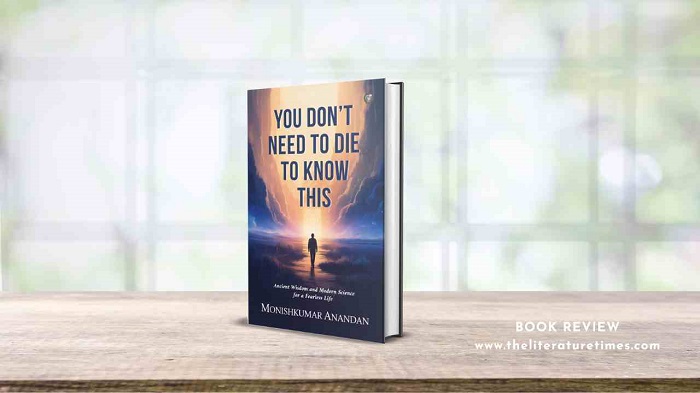
You Don’t Need to Die to Know This by Monishkumar Anandan is a deeply reflective and compassionate exploration of life, death, and the nature of consciousness. Rather than treating death as a morbid or distant subject, the author reframes it as a powerful teacher—one that can awaken us to live more fully, fearlessly, and lovingly in the present moment. Blending personal experience, spiritual wisdom, and modern scientific inquiry, the book gently guides readers toward inner clarity without demanding belief in any single doctrine or ideology.
The book opens with a profoundly personal incident in which the author experiences a near-death episode. This moment of suspended breath and absolute stillness becomes the catalyst for a lifelong inquiry into what it truly means to live. Instead of dramatizing the experience, Anandan narrates it with calm honesty, allowing readers to feel the quiet transformation that followed. This opening sets the tone for the book—intimate, sincere, and grounded in lived experience rather than abstract philosophy.
One of the book’s greatest strengths is its ability to bridge ancient wisdom with modern understanding. The author draws from diverse spiritual traditions—Hinduism, Buddhism, Christianity, Islam, Sikhism, and Taoism—highlighting how each approaches death not as an end, but as a transition. Despite cultural and theological differences, Anandan reveals a striking common thread across religions: the emphasis on compassion, ethical living, and awareness in the present life. Death, in this view, is not meant to frighten humanity into obedience but to remind us of what truly matters.
Equally compelling is the book’s engagement with modern mystics and contemporary spiritual thinkers such as Sadhguru, Eckhart Tolle, Osho, Ram Dass, Mooji, and Alan Watts. These voices add immediacy and relevance, translating timeless truths into language accessible to modern readers. Through their teachings, death is stripped of its terror and reintroduced as a natural companion to life—one that urges us to release ego, fear, and attachment. The author does not elevate these figures as unquestionable authorities but presents them as fellow travelers pointing toward inner stillness and awareness.
The scientific dimension of the book adds further depth. Anandan discusses near-death experiences, consciousness studies, and research conducted by medical professionals and neuroscientists. Without overwhelming readers with technical jargon, he introduces ideas such as the possibility of consciousness existing beyond the brain and the “receiver” theory of the mind. These discussions are handled with balance—science is not portrayed as proof of spirituality, nor is spirituality used to dismiss science. Instead, the book suggests that both disciplines may be approaching the same mystery from different angles.
What makes You Don’t Need to Die to Know This especially impactful is its practical relevance. The book is not merely philosophical; it is quietly transformative. Throughout the chapters, readers are encouraged to reflect on their own lives—on fear, love, regret, gratitude, and presence. The central message is clear: awareness of death should not paralyze us; it should liberate us. By accepting impermanence, we learn to value each breath, each relationship, and each moment with greater tenderness.
The writing style is gentle, lyrical, and accessible. Anandan avoids preachiness and instead invites contemplation. His tone feels like a calm conversation rather than a lecture, making the book suitable for both spiritual seekers and skeptical readers. Whether one is religious, spiritual-but-not-religious, or purely curious, the book meets the reader where they are.
Emotionally, the book leaves a lasting imprint. It softens the fear surrounding death and replaces it with curiosity, acceptance, and even gratitude. By the final chapters, readers are likely to feel less anxious about the unknown and more attentive to the life unfolding right now. The book’s ultimate achievement lies in this subtle shift of perspective—from fear to awareness, from avoidance to presence.
In conclusion, You Don’t Need to Die to Know This is a thoughtful, humane, and quietly powerful work. It does not claim to have final answers about death, but it offers something far more valuable: a way to live with depth, courage, and compassion. Monishkumar Anandan reminds us that we do not need tragedy, loss, or a brush with death to awaken. The wisdom we seek is already within reach—available in this breath, this moment, and this life.