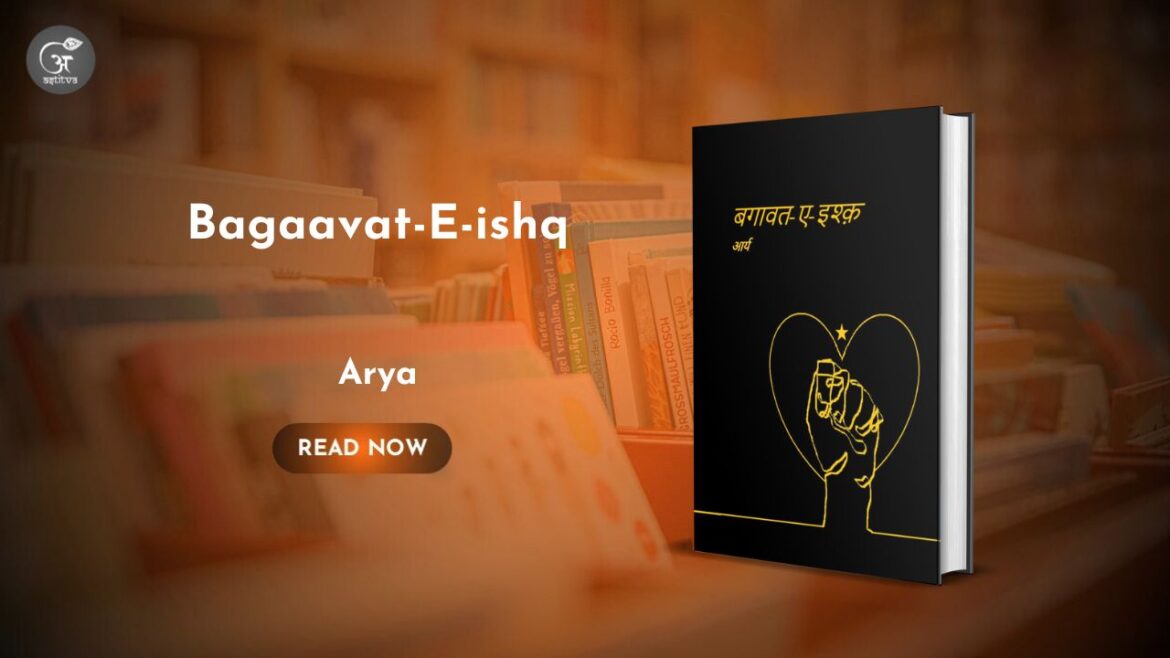
In a time when the world races ahead chasing comfort and conformity, Arya’s debut poetry collection, Bagaavat-E-Ishq, arrives like a quiet revolution — gentle yet fierce, personal yet universal. This book dares to explore the two most transformative forces of human existence: love and rebellion — and in Arya’s world, the two are inseparable.
Bagaavat-E-Ishq is not simply a collection of poems; it is a dialogue between the heart and the mind, between silence and defiance. The poet argues that both love and rebellion are acts of freedom — free from control, untouched by boundaries, and capable of breaking the established order. “Perhaps this is why,” Arya writes, “so many people fear both love and rebellion — because both have the power to destroy what is false and reveal what is true.”
Each poem in this collection can be read through multiple lenses — sometimes it feels like a love poem, sometimes a revolutionary cry, and sometimes both at once. That ambiguity is the book’s greatest strength. Love here is not limited to romance; it is acceptance in its purest form — acceptance without desire, without expectation, without need. It is the act of embracing the soul’s freedom. In contrast, desire binds; love liberates.
Arya’s verses remind us that in a world consumed by hatred and fear, the very act of loving openly becomes an act of rebellion. To love without restraint, in a society where cynicism is celebrated and tenderness is mocked, is perhaps the boldest protest of all.
The poet describes Bagaavat-E-Ishq as a series of conversations with himself — a journey of introspection through the landscapes of emotion, friendship, solitude, and revolt. Each poem is a mirror reflecting fragments of the poet’s identity: shaped by affection, anger, philosophy, and experience. The poems invite readers to pause, reflect, and perhaps hold an honest conversation with their own souls.
In an age where noise overpowers thought and speed replaces reflection, Bagaavat-E-Ishq serves as a gentle reminder that poetry is not escape — it is return: a return to self-awareness, vulnerability, and love. The book’s simplicity of expression is deceptive; beneath the lyrical surface lies profound philosophical depth. Arya’s words carry the rare power to awaken both emotion and intellect.
Atharva Arya is a young poet and a student of philosophy and politics, whose writing embodies a thoughtful blend of introspection and rebellion. His poetry emerges from deep contemplation on existence, capturing the subtle intersections between love and sorrow, time and memory, silence and creation.
For Arya, poetry is not merely the expression of emotion — it is an act of reflection, a rebellion against forgetfulness and indifference. His words carry quiet resistance, revealing the strength hidden in gentleness. He believes that tenderness itself can become an act of defiance — that softness, when truthful, can shake the hardest walls.