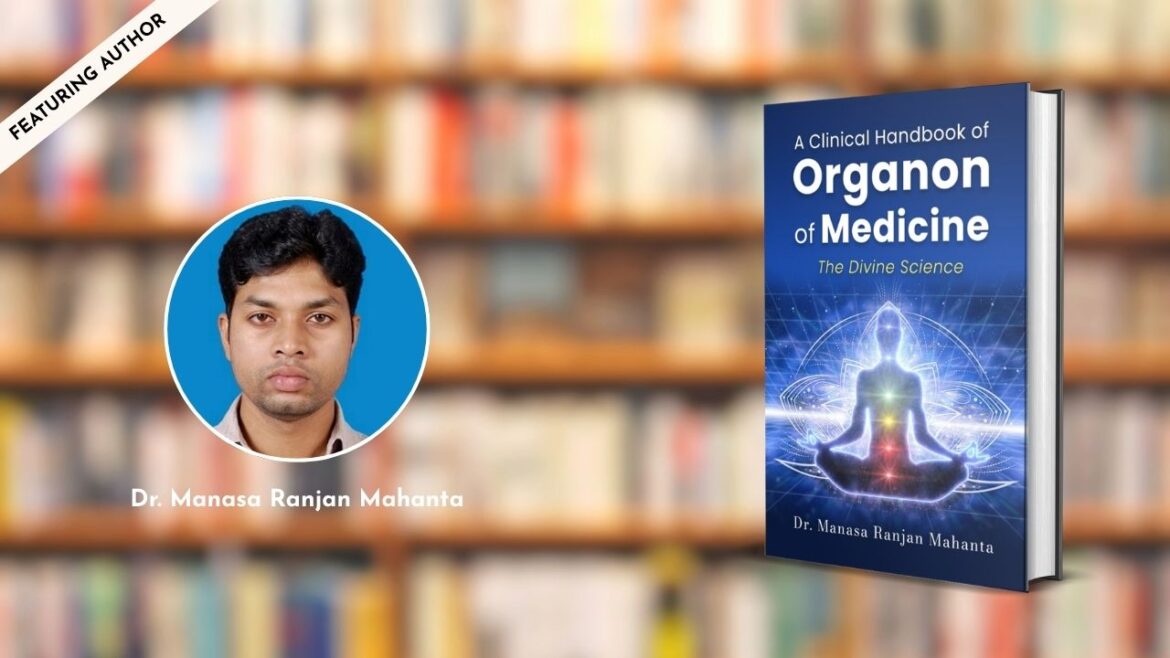
In the world of medicine, there are practitioners who treat diseases and there are thinkers who seek to understand the deeper nature of health, suffering, and healing. Dr. Manasa Ranjan Mahanta belongs to the latter category—a dedicated homoeopathic physician whose work reflects a rare synthesis of clinical experience, philosophical inquiry, and spiritual understanding. Over the past sixteen years, he has devoted himself to the practice of Predictive Homoeopathy, helping patients navigate complex health challenges while continuously exploring the profound principles that govern human well-being.
Dr. Mahanta’s journey into the field of homoeopathy began with his formal education at Mayurbhanj Homoeopathic Medical College and Hospital, Baripada, where he completed his BHMS degree in 2010. Like many young doctors, he entered the profession with a desire to heal. However, what distinguished his path was a deeper curiosity about the nature of disease itself. Rather than viewing illness merely as a physical disturbance, he became increasingly interested in understanding the invisible dimensions of human existence that influence health and recovery.
A significant turning point in his professional life came through his training under Dr. Radhakanta Mohapatra, one of Odisha’s leading practitioners of Predictive Homoeopathy. Under this mentorship, Dr. Mahanta gained invaluable insights into the practical application of homoeopathic principles and developed a deeper appreciation for individualized treatment. This training strengthened his conviction that successful healing requires more than the management of symptoms; it demands a comprehensive understanding of the patient as a whole person.
Over the years, Dr. Mahanta has built a reputation for treating difficult and challenging cases, including patients who had lost hope after exhausting conventional options. His clinical experience has reinforced his belief that every illness carries a deeper story and that the physician’s role extends beyond diagnosis and prescription. According to his understanding, disease is not merely an external event but an expression of imbalance within the individual. This perspective has guided his approach to patient care and continues to shape his work as a clinician.
Currently serving as a Homoeopathic Medical Officer at the Government Homoeopathic Dispensary in Satakuta, Odisha, Dr. Mahanta combines public service with a lifelong commitment to learning and teaching. His interactions with patients from diverse backgrounds have enriched his understanding of human nature and strengthened his conviction that medicine must address not only the body but also the mind and the deeper dimensions of consciousness.
What makes Dr. Mahanta particularly distinctive is his effort to bridge classical homoeopathic philosophy with the spiritual insights of the Upanishads and Vedanta. He believes that many of the concepts introduced by Dr. Samuel Hahnemann, the founder of homoeopathy, can be understood more profoundly through the lens of ancient Indian wisdom. Hahnemann’s emphasis on the vital force, the immaterial aspects of the organism, and the responsibility of the individual in disease resonates strongly with Vedantic teachings concerning consciousness, karma, and self-awareness.
This intellectual and spiritual exploration culminated in his book, A Clinical Handbook of Organon of Medicine: The Divine Science. Rather than producing another conventional commentary on Hahnemann’s Organon, Dr. Mahanta set out to create a practical and clinically relevant guide for students and practitioners seeking a deeper understanding of homoeopathic philosophy. His objective was not merely to explain the aphorisms but to illuminate their application in everyday clinical practice.
The book presents both the fifth and sixth editions of the Organon, allowing readers to appreciate the evolution of Hahnemann’s thought while maintaining a clear focus on practical treatment. Dr. Mahanta’s unique contribution lies in the personal notes and interpretations accompanying the aphorisms. These reflections emerge from years of clinical observation and philosophical contemplation, making complex concepts more accessible and meaningful for contemporary readers.
A central theme in his work is the understanding of the human mind and its role in disease. He explores how perception shapes experience, how mental patterns influence health, and how deeper awareness can contribute to healing. His discussions on karma, causation, and human responsibility provide a distinctive perspective that extends beyond conventional medical discourse. By integrating these ideas into clinical practice, he encourages practitioners to view patients not merely as carriers of symptoms but as individuals whose physical conditions are intertwined with mental, emotional, and spiritual dimensions.
Dr. Mahanta’s writing reflects both humility and conviction. He presents his interpretations not as final truths but as sincere efforts to understand and communicate the profound wisdom contained within the Organon. This openness invites readers to engage actively with the material and develop their own insights through study, reflection, and clinical experience.
Beyond his current publication, Dr. Mahanta continues to pursue new avenues of exploration within homoeopathic philosophy and practice. He regards his first book as only the beginning of a larger mission to make complex homoeopathic concepts more understandable and clinically relevant. With additional works planned for the future, he remains committed to contributing to the growth of homoeopathic literature and education.
In an era when medicine often becomes increasingly specialized and fragmented, Dr. Manasa Ranjan Mahanta represents a holistic vision of healing. His work reminds us that true healthcare involves understanding the whole person—body, mind, and consciousness. Through his clinical practice, philosophical inquiry, and literary contributions, he continues to inspire practitioners and students alike to approach medicine not merely as a science of treatment, but as a deeper journey into understanding life itself.