Few contemporary scholars embody the breadth of intellectual engagement and public scholarship as comprehensively as Professor (Dr.) Lalith Kumar Dharavath. A distinguished academic, prolific author, researcher, administrator, and modern thinker, Dr. Dharavath has spent decades exploring the intersections of governance, society, resilience, and global change. His remarkable career reflects an unwavering commitment to knowledge creation, public discourse, and the pursuit of solutions to some of the most pressing challenges facing contemporary societies.
Born in 1959, Dr. Dharavath built an illustrious academic journey that culminated in his position as Professor of Public Administration at Osmania University, Hyderabad. Over the years, he earned recognition not only as an educator but also as a mentor, institution builder, and thought leader. His contributions extend far beyond the classroom, influencing students, researchers, policymakers, and readers across diverse disciplines.
Throughout his academic career, Dr. Dharavath has demonstrated an exceptional ability to bridge theoretical inquiry with practical realities. His work consistently examines how societies adapt to change, respond to crises, and build sustainable systems of governance. This interest led him to develop innovative conceptual frameworks, including the Resilience Theory Tanda Gor Banjar and Reciprocity Theory and Practice. These theories reflect his commitment to understanding the dynamics of social cooperation, community adaptation, and institutional stability in an increasingly complex world.
What distinguishes Dr. Dharavath from many scholars is the sheer scale and diversity of his scholarly output. Having authored more than 120 books and published over 40 research articles, he has established himself as one of the most prolific voices in contemporary socio-administrative thought. His writings span governance, public administration, social development, resilience studies, geopolitical analysis, and future-oriented policy thinking. Each work reflects a deep curiosity about the forces shaping human societies and a desire to make complex ideas accessible to wider audiences.
His academic achievements are equally impressive. Dr. Dharavath successfully completed major research projects funded by prestigious organizations such as the University Grants Commission (UGC) and the Indian Council of Social Science Research (ICSSR). These projects contributed significantly to the advancement of knowledge in public administration and social sciences while reinforcing his reputation as a rigorous and innovative researcher.
Beyond research, Dr. Dharavath has played a transformative role in nurturing future generations of scholars. Over the course of his career, he supervised more than 25 doctoral candidates and numerous M.Phil. scholars. His mentorship has shaped the academic journeys of researchers who continue to contribute to higher education, public policy, and social development. For many students, he has been more than a supervisor; he has been a guide who encouraged critical thinking, intellectual independence, and a commitment to societal progress.
As an academic administrator and editor, Dr. Dharavath has contributed extensively to the scholarly ecosystem. He has edited books, journals, and academic magazines while serving on numerous editorial and advisory boards. Through these roles, he has helped maintain standards of scholarly excellence and promoted meaningful academic dialogue. His active participation in national and international conferences, seminars, workshops, and webinars further demonstrates his dedication to the exchange of ideas and collaborative learning.
One of the defining characteristics of Dr. Dharavath’s work is his ability to anticipate emerging global trends and interpret them through a multidisciplinary lens. His recent writings explore geopolitical transformations, technological disruption, economic competition, and the evolving nature of international relations. Rather than viewing these developments in isolation, he examines how they interact to create what many scholars describe as a “poly-crisis” era—an age marked by overlapping challenges that require innovative and cooperative responses.
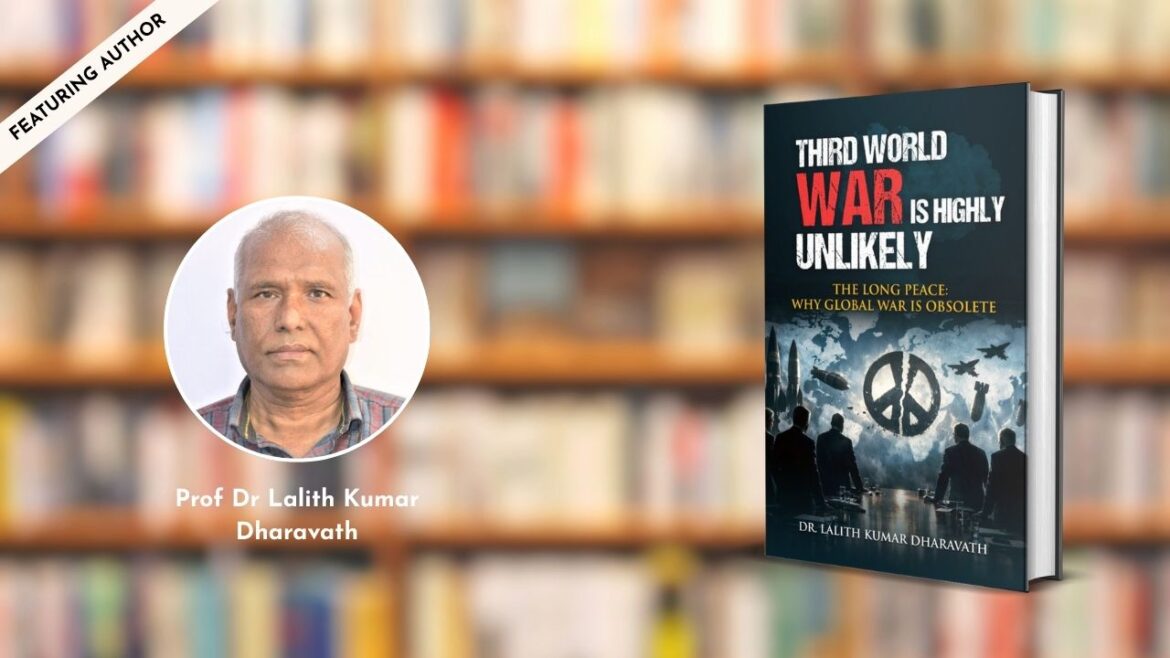
This perspective is particularly evident in his work on global peace and geopolitical stability. In his book, Third World War is Highly Unlikely (The Long Peace: Why Global War is Obsolete), Dr. Dharavath presents a compelling argument that humanity has entered a new phase of history in which large-scale global warfare has become strategically irrational. Drawing upon historical analysis, geopolitical theory, economic interdependence, and technological realities, he examines the structures that discourage direct conflict among major powers. His work challenges conventional narratives of inevitable global confrontation and instead highlights the stabilizing forces that characterize the contemporary international system.
At the heart of Dr. Dharavath’s scholarship lies an enduring optimism about humanity’s capacity to adapt, innovate, and cooperate. While he does not ignore the risks posed by political tensions, technological upheavals, or economic uncertainty, he consistently emphasizes resilience as a fundamental human and societal strength. His intellectual contributions encourage readers to move beyond fear-driven narratives and engage with constructive pathways toward stability and progress.
The recognition he has received through numerous awards and honors reflects not only his scholarly accomplishments but also the impact of his ideas. Colleagues and readers alike regard him as a thinker who combines academic rigor with practical relevance, producing work that resonates across disciplinary boundaries.
Today, Professor (Dr.) Lalith Kumar Dharavath stands as a remarkable example of lifelong learning and intellectual dedication. His career demonstrates how scholarship can serve as a catalyst for understanding, dialogue, and positive change. Whether through his theories of resilience and reciprocity, his extensive body of publications, or his mentorship of future scholars, he continues to contribute meaningfully to the evolving conversation about governance, society, and humanity’s shared future. His legacy is not merely measured by the number of books he has written or the students he has guided, but by the enduring relevance of the ideas he has brought into the world.