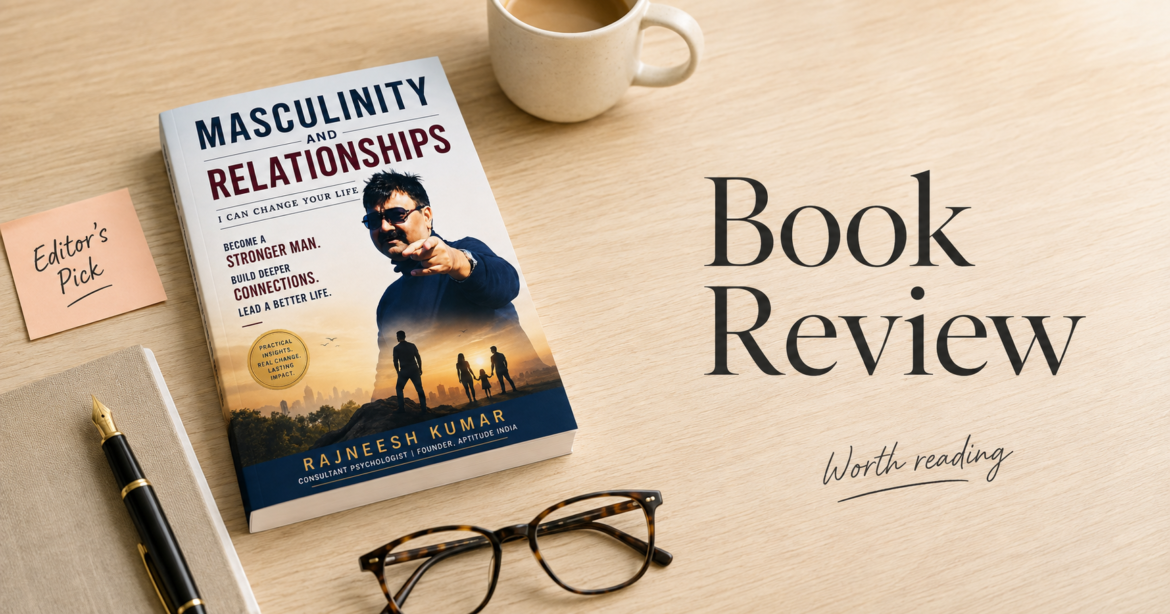
A practical, psychologically grounded guide to emotional strength, self-respect, boundaries, and healthier relationship choices.
There is a particular kind of frustration that emerges when someone can solve complex problems at work, manage money, take responsibility for a family, and still feel completely unprepared for the emotional realities of a relationship. Rajneesh Kumar’s Masculinity and Relationships: I Can Change Your Life begins from that contradiction. Its central argument is simple but consequential: competence in education, career, or social life does not automatically create competence in intimacy. Love, attachment, boundaries, partner selection, conflict, rejection, and recovery demand a different set of skills, and most people are expected to learn them only after painful mistakes. Kumar turns more than twenty-five years of counselling experience into a practical guide aimed especially at readers who want to understand the psychological patterns behind their relationship choices rather than merely receive comforting advice.
One of the book’s strongest qualities is its refusal to treat relationship problems as isolated incidents. Instead of asking only why a particular romance failed, Kumar repeatedly directs attention toward the deeper patterns that make certain situations feel familiar. Childhood conditioning, attachment, self-esteem, emotional dependency, fear of abandonment, and the need for approval all appear as forces that can quietly shape adult decisions. This approach gives the book more substance than a conventional list of dating tips. A reader is encouraged to examine not only the behavior of a partner but also the internal habits that made a particular dynamic attractive, tolerable, or difficult to leave. That shift from blame to pattern recognition is psychologically useful because it restores a sense of agency without pretending that every outcome is under one person’s control.
The focus on masculinity adds another important layer. Kumar does not appear interested in reducing masculinity to toughness, dominance, silence, or endless self-sacrifice. Instead, the book presents emotional strength as the capacity to think clearly under pressure, maintain self-respect, recognize manipulation, communicate boundaries, and recover after loss without allowing pain to destroy one’s direction in life. For men who have been taught that emotional difficulty should simply be endured, this framing can be particularly valuable. It acknowledges the reality of hurt while resisting both victimhood and performative hardness. The result is a model of strength that is more disciplined than dramatic: know what you value, observe behavior carefully, refuse unhealthy patterns, accept disappointment when necessary, and rebuild your life around purpose rather than resentment.
Kumar’s treatment of red flags and green flags is likely to be among the most immediately useful portions for general readers. Discussions about relationships often become vague because people rely on chemistry, attraction, or hope as evidence of compatibility. This book pushes toward observable patterns. Consistency, respect, accountability, emotional stability, openness to communication, and the ability to tolerate boundaries matter more than impressive words or intense beginnings. On the other side, manipulation, chronic disrespect, emotional volatility, guilt-based control, repeated dishonesty, and the erosion of personal boundaries deserve attention before commitment deepens. The value here is not in turning relationships into a checklist, but in encouraging readers to distinguish between emotional intensity and emotional health. That distinction can prevent many avoidable crises.
The book is equally effective when it moves from choosing relationships to surviving their breakdown. Rejection, separation, and divorce are treated not as abstract topics but as experiences that can destabilize identity, confidence, sleep, work, friendships, and one’s sense of future. Kumar’s counselling background gives this material a grounded quality. Recovery is not presented as a matter of repeating positive affirmations until pain disappears. It is portrayed as a process of rebuilding structure: accepting reality, reducing obsessive mental loops, restoring routines, strengthening social and professional purpose, understanding one’s mistakes, and refusing to use a failed relationship as permanent evidence of personal inadequacy. This practical orientation makes the book relevant not only to people currently dating or married but also to anyone trying to regain emotional balance after a difficult ending.
Another strength is the conversational tone. Psychological writing can easily become either too clinical or too motivational. Kumar seems to work between those extremes. The concepts are accessible enough for a reader without formal training, yet the book’s framework is serious about consequences. It repeatedly suggests that poor relationship decisions can affect mental peace, finances, family systems, career focus, and long-term confidence. That seriousness gives the book urgency. At the same time, the direct style may occasionally feel uncompromising to readers who prefer softer language or more nuanced qualification. Advice drawn from counselling experience can sometimes sound definitive because it emerges from recurring patterns seen across many cases. Readers will benefit most when they treat the observations as tools for reflection rather than universal rules that can predict every individual relationship.
What makes Masculinity and Relationships: I Can Change Your Life especially timely is its insistence that self-respect and emotional connection are not opposites. Healthy love does not require abandoning boundaries, and personal strength does not require emotional isolation. That balance is difficult to achieve in a culture where relationship advice is often polarized between romantic idealism and cynical self-protection. Kumar argues, in effect, for a third path: care deeply, but observe clearly; commit sincerely, but do not surrender judgment; understand another person, but do not erase yourself; and when a relationship ends, grieve it without allowing the loss to become your entire identity.
The book’s broad scope—love, marriage, dating, friendship, heartbreak, personal growth, career pressures, and mental resilience—means that not every reader will find every section equally relevant. Yet that breadth is also part of its appeal. It works less like a narrow dating manual and more like a practical handbook for emotional decision-making. Younger readers may use it preventively, before making major commitments. Married readers may find language for boundaries and recurring conflict. People emerging from painful relationships may find a framework for rebuilding. Parents and professionals may even recognize patterns that extend beyond romance into friendships, workplaces, and family relationships.
Ultimately, Rajneesh Kumar’s book succeeds because it treats relationship literacy as a serious life skill. Its message is not that love can be controlled through psychology, nor that heartbreak can be eliminated through perfect judgment. Rather, it argues that awareness improves choices, boundaries reduce avoidable damage, and emotional discipline makes recovery possible when life does not go as planned. For readers who want a direct, experience-informed guide to understanding attraction, attachment, self-respect, manipulation, commitment, and resilience, Masculinity and Relationships: I Can Change Your Life, published by Timeless Script House, offers a substantial and practical starting point. It is a book designed not merely to be agreed with, but to be underlined, questioned, revisited, and applied.
Buy Book: Amazon