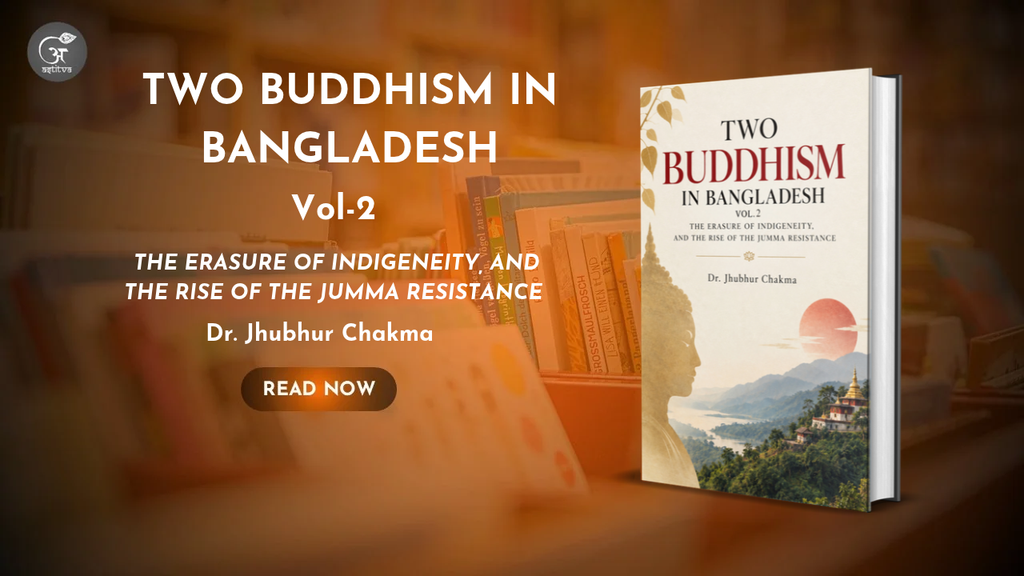
The history of Buddhist communities in Bangladesh is deeply intertwined with questions of identity, cultural preservation, political recognition and the struggle for belonging. In Two Buddhisms in Bangladesh: The Erasure of Indigeneity and the Rise of the Jumma Resistance – Volume 2, Dr. Jhubhur Chakma continues to explore the complex realities experienced by Bengali-speaking Barua Buddhists and Indigenous Jumma Buddhists, bringing further attention to the historical and sociopolitical forces that have shaped their communities.
The book examines how nationalism, state policies, constitutional frameworks and religious identity intersect with the experiences of Indigenous Buddhist communities in the Chittagong Hill Tracts. It sheds light on the challenges of cultural assimilation, marginalization, land dispossession and the struggle for Indigenous recognition, while exploring how the collective identity of the Jumma people has emerged as a powerful expression of solidarity and resistance.
Through scholarly research, historical perspectives and an examination of Buddhist traditions, the work highlights the significance of religious institutions, monastic leadership, community networks and education in preserving Indigenous heritage. It also explores the role of Buddhism in fostering resilience, compassion, cultural continuity and nonviolent responses to structural injustice.
By questioning the assumption that Buddhism in Bangladesh represents a single, uniform experience, Dr. Jhubhur Chakma offers a nuanced perspective on the diverse realities of Buddhist communities. The work connects religious scholarship with Indigenous studies, human rights, nationalism and contemporary political discourse, encouraging readers to reconsider the relationship between faith, identity and citizenship.
Dr. Jhubhur Chakma is an early-career Buddhist studies scholar from the Chittagong Hill Tracts of Bangladesh. He holds a bachelor’s degree in Buddha Dhamma from the International Theravāda Buddhist Missionary University in Yangon, Myanmar, a master’s degree in Religious Studies from Mahidol University, Thailand, and a PhD in Buddhist Studies from the International Buddhist Studies College, MCU, Thailand. He was a 2024 research fellow of the Robert H. N. Ho Family Foundation in Buddhist Studies, administered by the American Council of Learned Societies (ACLS). His research interests include Buddhist philosophy, human rights, Indigenous studies, Buddhist education and the socioreligious experiences of Buddhist communities in Bangladesh. His academic contributions include research articles and papers published in international journals and edited works.
Two Buddhisms in Bangladesh – Volume 2 invites readers to engage with the complexities of Indigenous identity, religious diversity and resistance, offering an important scholarly contribution to the understanding of Buddhism and Indigenous communities in contemporary South Asia.
Explore the histories, struggles and resilience of Bangladesh’s Buddhist communities. Discover Two Buddhisms in Bangladesh – Volume 2 and gain a deeper understanding of Indigenous identity, cultural preservation and the pursuit of justice.





Your perspective matters
Share your thoughts respectfully. Comments are moderated.