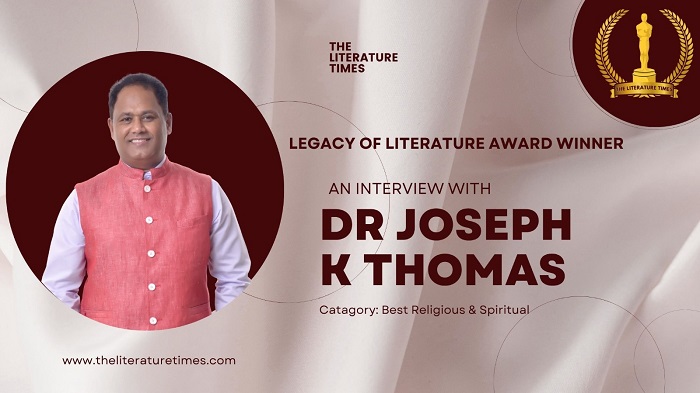
Dr. Joseph K. Thomas is a respected scholar and devout Catholic who has dedicated his work to exploring the spiritual heritage and religious history of India. With a deep passion for documenting lives of sanctity and a keen eye for historical detail, he brings to light the inspiring journeys of Indian Catholic Saints, Blesseds, Venerables, and Servants of God. His book, Indian Catholic Saints, Blesseds, Venerables and Servants of God, reflects his commitment to preserving and celebrating the rich tapestry of Catholic faith as it has unfolded across India’s diverse cultural landscape.
The Literature Times: What inspired you to compile the stories of Indian Catholic Saints and holy figures into one definitive volume?
Dr. Joseph K. Thomas: My inspiration stems from a deep desire to preserve India’s rich, yet often overlooked, Catholic spiritual heritage. Many of these Saints and holy figures lived lives of extraordinary faith and sacrifice, yet their stories remain scattered or inaccessible. This book is an effort to bring their legacies together, offering both devotion and historical insight to readers.
What began as a seed of curiosity, planted in a conversation with my sister, Dr. Sr. Daisy Thomas FCC, a Catholic nun, blossomed into a mission to spotlight the untold lives of India’s own Saints—those who walked barefoot among the poorest of the poor and led not through command, but by example. As I explored further, I realized that while we speak often of global Saints, very little is known—especially among our youth—about the 50+ Indian-born spiritual giants who walked among us. The stories within these pages are not relics of a bygone era. They are a counter-cultural response to the crises of identity, authenticity, and leadership that mark our age.
This book is an attempt to bring them out of the shadows and into the spotlight. These holy figures were not celebrities. They were missionaries, teachers, doctors, social reformers, caregivers, laypersons and peacemakers,. They fought injustice, healed the sick, uplifted the downtrodden, and built institutions that still stand today. They were the original changemakers—before hashtags, before headlines.
The Literature Times: How did you approach the research process for such a historically and spiritually rich subject?
Dr. Joseph K. Thomas: The research was meticulous—combining archival studies, Vatican documents, diocesan records, congregation documents and oral traditions. I collaborated with religious orders, historians, Bishops and theologians to verify facts while ensuring the narratives remained spiritually resonant. Balancing historical accuracy with devotional reverence was key.
Far exceeding the confines of religious literature, this book is a deeply reflective exploration of what it truly means to lead in today’s fragmented world. Through the lives of Saints who lived among lepers, built institutions in obscurity, and embraced martyrdom for the sake of justice and love, my research brings forth timeless principles of purpose, empathy, courage, and servant leadership—qualities that modern executives, educators, and changemakers tirelessly seek but rarely find embodied with such authenticity.
The Literature Times: Among the Saints and Venerables featured in your book, is there one whose life touched you personally the most?
Dr. Joseph K. Thomas: As someone who has worn the Army uniform with pride for 20 years, served in the corporate world with dedication, and worked as an educationist with passion, I’ve had the opportunity to see India through diverse lenses. I’ve served at the High Altitudes of the Siachen Glacier, Leh and Kargil, led corporate initiatives across 40 plus countries in Asia-Pacific & Europe for last 15 years. And yet, the stories that moved me most—the ones that truly stayed with me—are those of quiet devotion, sacrifice, humility, and unwavering faith.
The story of St. Kuriakose Elias Chavara is not just spiritual giant but also visionary institution-builders—true “CEO Saints” who combined faith, innovation, and leadership to create lasting impact. His entrepreneurial and leadership genius in a way that even modern business leaders can learn from:
St. Chavara, CMI – The “Steve Jobs” of Ecclesial Reform, Leadership & Entrepreneurial Strategies:
Disruptive Innovation in Education
Pallikudam (School + Church Model) – He merged education with faith formation, creating a system where children learned both academics and spirituality together.
Co-education in 19th Century Kerala – At a time when girls were rarely educated, he insisted on equal schooling for boys and girls.
Dalit Empowerment – He opened schools for “untouchables,” breaking caste barriers decades before social justice movements.
First Catholic Printing Press in India (1821)
Tech Adoption – He imported a printing press from Europe to mass-produce Malayalam prayer books, catechisms, and newspapers (like Deepika).
Media as Evangelization – Understood the power of information dissemination for faith and literacy.
Scalable Institution-Building
Founded Carmelites of Mary Immaculate (CMI), India’s first indigenous religious congregation for men. Today, CMI runs top-tier institutions like:
Christ University, Bangalore (Top 10 private universities in India) Proved that spiritual mission + education = sustainable growth.
Business Parallels:
Like Elon Musk (disrupting industries), Chavara disrupted education and media.
Like Ratan Tata (philanthropy + business), he combined social justice with institutional excellence.
The Literature Times: India is known for its religious diversity—how do you see the lives of these Catholic figures resonating across different faith traditions?
Dr. Joseph K. Thomas: These Saints often embodied values cherished by all traditions: service (like St. Mother Teresa), interfaith dialogue (St. Devasahayam Pillai), and asceticism (like many Indian mystics). Their lives transcend dogma, offering a shared language of love, sacrifice, and divine pursuit. What sets this work apart, is this books universality. It does not ask the reader to subscribe to a particular faith but invites them to reflect on values that transcend creed: selfless service, moral courage, and an unwavering dedication to uplifting others. It is as much a mirror for CEOs as it is a map for spiritual seekers. The Saints profiled here were builders, reformers, teachers, caregivers, and peacemakers—authentic changemakers who left behind institutions, movements, and legacies that continue to shape lives across generations.
During the book launch, someone asked me, “Is your book about Christianity or is it a religious book?”— “No, this is not just a religious book. It’s a book about leadership, courage, and extraordinary human service. It is about 55 Indian-born holy men and women from the Roman Catholic Church who lived with such integrity, humility, and compassion that their lives continue to inspire generations.” You don’t have to be Christian to understand or appreciate this book. You simply need to have a heart that admires selfless service, a mind that respects resilience, and a soul that yearns for purpose.
The Literature Times: What challenges did you face in gathering authentic, reliable information on some of the lesser-known Servants of God?
Dr. Joseph K. Thomas: Many early Indian Catholics left scant written records, relying on oral histories or fragmentary accounts. One of the greatest challenges was the sheer scarcity of documented records. Many of these holy men and women lived in remote villages or centuries ago, leaving behind little more than oral traditions. In some cases, even basic details like birth dates or photographs were non-existent. For early martyrs and missionaries, accounts were often fragmented—scattered across handwritten letters, fading parish records, or local folklore.
Language barriers added another layer of difficulty. Some testimonies existed only in regional dialects or archaic Portuguese/Latin, requiring painstaking translation. There were also instances where devotion outpaced documentation—stories of miracles or virtues passed down through generations but lacking official ecclesiastical validation.
Despite these hurdles, the search itself became a spiritual journey. Collaborating with elderly clergy, digging through neglected archives, and even visiting ancestral homes of these servants of God helped piece together their legacies. What emerged was a testament not just to their holiness, but to the enduring faith of the communities that kept their memories alive.
The Literature Times: What do you hope readers—Catholics and non-Catholics alike—will take away from this book?
Dr. Joseph K. Thomas: I hope they discover that holiness is not confined to geography or era. These stories reveal how ordinary individuals, shaped by India’s soil, achieved extraordinary sanctity. For non-Catholics, it’s an invitation to appreciate the spiritual tapestry that unites humanity. This book arrives at a moment when society is in desperate search of moral anchors. Amid the cacophony of consumerism and digital distraction, the lives of these Saints emerge as luminous beacons—offering clarity in confusion, unity in division, and purpose in a world that has all but lost its way.
In a world dominated by headlines of power, profit, and polarization, this book is a gentle reminder of a different kind of success—the kind built on truth, love, and service.
To the youth, to the leaders of tomorrow, I say: Don’t just aim to be rich—aim to be righteous.
To the CEOs, founders, and influencers: Don’t just build companies—build communities.
To every Indian: Rediscover the soul of our country through the lives of those who gave everything, yet asked for nothing.
This is not just another book—it is a resurrection of memory, a restoration of dignity, and an invitation to live, lead, and love more deeply. Should even one reader find within its pages the courage to serve without recognition or the resolve to lead with compassion, its mission will have been fulfilled.
This book aims to deliver a simple yet powerful message “You don’t need a pulpit to preach. You just need to serve.” In a world obsessed with overnight fame and material wealth, their stories remind us that legacy is built not in years, but in how much of yourself you give to others.
The Literature Times: How do you think the process of canonization in the Indian context differs from that in other parts of the world?
Dr. Joseph K. Thomas: The Catholic Church has instituted a meticulous process for canonizing Saints, a voyage that begins with the faithful’s devotion to a departed soul. They must have lived a life of heroic virtue—a standard so high it would seem to graze the heavens themselves. This is applicable to universal church irrespective of countries including India.
To grasp the full spectrum of Veneration, one must consider how it fits into the fabric of the Church’s teachings. Saints serve as patrons, intercessors, and models of Christian virtues. They are not merely historical figures but active participants in the spiritual life of the Church. The communion of Saints—a core belief in Catholicism—affirms that the Church transcends the boundaries of time and space, uniting all members, living and departed, in a divine fellowship.
Canonization is a sacred journey of the Catholic Church, a beacon of light that illuminates the path to sanctity, recognizing individuals whose lives were marked by heroic virtue and divine grace. It is a process steeped in tradition and rigorous scrutiny, a testament to the Church’s commitment to venerating those who have lived in faithful service to God and humanity. The process of Sanctification and the declaration of the Sainthood has 4 stages in the Catholic Church. A wait period of at least 5 years is necessary to initiate the process after the death. Sometimes the entire process takes even centuries for the completion.
The Literature Times: Are there any current causes for sainthood in India that you find especially compelling or likely to progress in the near future?
Dr. Joseph K. Thomas: The cause of Blessed Rani Maria, a Franciscan martyr who served the poor, is particularly inspiring. She worked among the poor within the Diocese of Indore (M.P). She dedicated herself to the Catechetical formation and educational instruction during her time as a religious as she moved place to place teaching in different areas.
For Rani Maria, her mission was clear: to uplift the poor and marginalized in the rural parts of India. Her work took her to Udainagar in the state of Madhya Pradesh, where she served the destitute with unwavering dedication. Her commitment to educating and uplifting rural women showcases the transformative power of education in leadership.
However on February 25, 1995, her life was cut short by an assassin’s knife, while she made her way to Indore in a bus due to the hitman Samandar Singh hired by upper caste Hindu landlords in front of more than 50 passengers. She had 54 stab wounds and unto the last breath she said: “Jesus” “Jesus” repeatedly. She died on the roadside at Nachanbore Hill, a forest area about 12 miles from Udainagar, and was buried at the Sacred Heart Church in Udainagar. Her death that shook the very foundations of the community she served. Her martyrdom was a sobering reminder of the cost of discipleship.
I’ve had the privilege of present at the funeral of Blessed Rani Maria in 1995 . In the wake of her death, a remarkable occurrence unfolded, one that epitomizes the power of forgiveness. Her own family, in an act that stunned many, forgave her killer and embraced him as one of their own. This act of forgiveness is often misunderstood or misinterpreted as weakness or surrender, but in truth, it is the ultimate display of strength and conviction, an echo of the forgiveness Christ showed even as he hung upon the cross.
The forgiveness extended by Rani Maria’s family had profound implications. It led to the conversion of her murderer, Samandar Singh, and set in motion a ripple effect of reconciliation that transcended her death. The narrative of her life and afterlife became a testament not only to her sacrifice but to the Christian doctrine of forgiveness, a concept that challenges and inspires to this very day.
In the streets of Udainagar, where Rani Maria once walked, the echoes of her legacy continue to resonate. Through the establishment of the Rani Maria Memorial, her spirit of service lives on, inspiring new generations to embody the virtues of compassion and forgiveness.
Rani Maria’s story is not just about the tragic end she met but also about the key elements that define martyrdom: sacrifice, faith, and love for humanity.