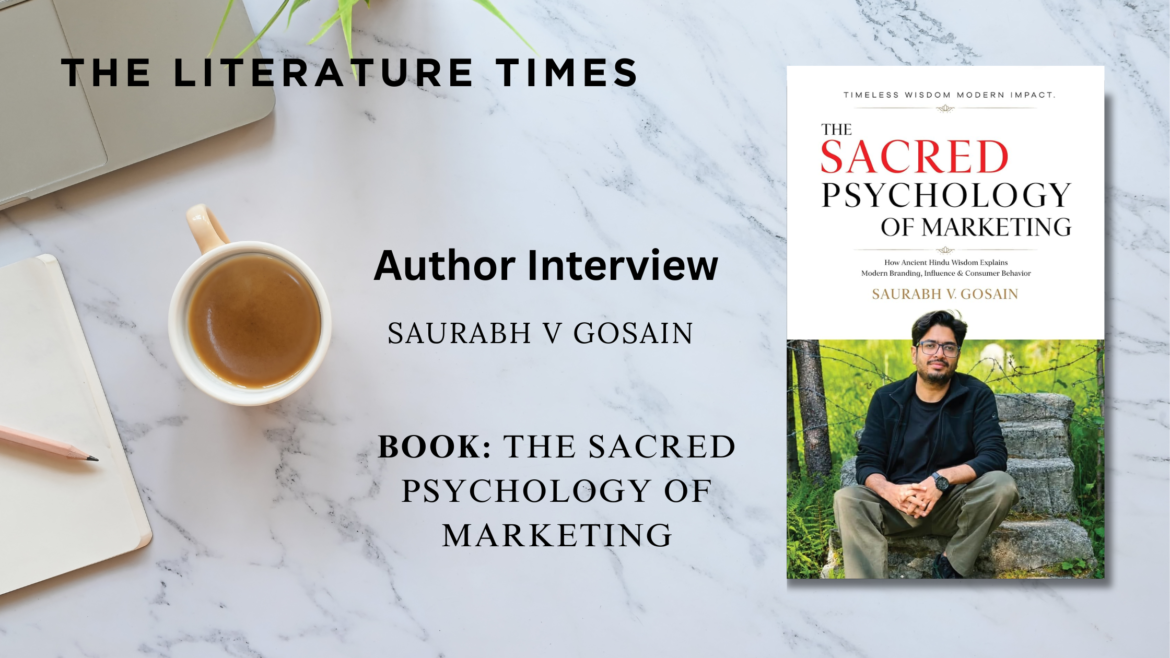
The Literature Times :What was the moment or experience that first made you connect Hindu philosophy with marketing psychology?
Saurabh V Gosain:
Honestly, there wasn’t one dramatic moment. It happened gradually. I started my professional journey on a shop floor in Nehru Place, Delhi, selling computers, laptops and IT products. I was dealing with customers face-to-face, watching them compare products, negotiate prices and decide within minutes whether to trust me.
What fascinated me was that the same product could mean completely different things to different people. One person was looking for price, another for status, another for reliability, and someone else simply wanted the latest technology.
Over time, I started seeing similar patterns in concepts from our ancient wisdom—Maya, Ahamkara, Vasana, Samskara, desire, identity and perception. I began wondering whether the Rishis were asking some of the same fundamental questions that marketers ask today, only from a much deeper perspective.
That curiosity eventually became The Sacred Psychology of Marketing.
The Literature Times :Can you briefly explain the six foundational principles — Dharma, Manas, Vāk, Buddhi, Samskāra, and Prabhāva — and how they map onto modern branding?
Saurabh V Gosain:
I look at these six principles almost like six layers of a brand.
Dharma is the foundation—what the brand stands for and what it is willing to remain committed to, even when doing so becomes inconvenient.
Manas is the mind—the emotional and psychological space in which a consumer experiences the brand.
Vāk is communication—what the brand says, but also how it says it.
Buddhi is discernment—the ability to look beyond short-term tactics and understand what is actually right for the brand and the customer.
Samskāra is about impressions, memories, habits and conditioning. A lot of consumer behaviour is influenced by things people may not consciously articulate.
And Prabhāva is the impact or influence a brand ultimately creates.
So for me, branding is not just about a logo, colours or advertising. It is about what happens between the brand and the human mind.
The Literature Times :You use Krishna, Rama, and Hanuman as strategic archetypes — how should a marketer or founder decide which archetype fits their brand?
Saurabh V Gosain:
I don’t see them as characters that a brand simply chooses for its identity. I see them as different ways of thinking.
Krishna teaches us the importance of context. You cannot communicate effectively without understanding the person, the situation and the moment. The same message may work beautifully in one context and fail completely in another.
Rama represents Maryada—the discipline of keeping your word and maintaining integrity. For a brand, that means making a promise and consistently living up to it.
Hanuman represents devotion, service, loyalty and community. A truly powerful brand doesn’t just have customers; it can create people who feel connected to it and are willing to advocate for it.
So I would ask a founder three questions: Do I truly understand my customer? Can people trust my promise? And have I created something people actually want to belong to?
The Literature Times :The book bridges scripture and strategy — how do you respond to readers who worry that mixing spirituality with commerce cheapens either one?
Saurabh V Gosain:
I understand that concern, and I actually had that question myself while writing the book.
But I am not suggesting that we take a shloka, put it in an advertisement and call that spiritual marketing. That would completely miss the point.
What interests me is how deeply ancient Indian thought examined the human mind—desire, identity, attention, perception, relationships, behaviour and the consequences of our actions. These are also fundamental subjects in marketing.
I am approaching this as a marketer and a lifelong learner, not as a religious scholar. I’m simply asking: what can modern marketers learn when they look at these ideas through the lens of human behaviour?
For me, the real test is not whether spirituality enters the boardroom. The real test is whether the boardroom becomes a little more truthful after it does.
The Literature Times :You cite case studies like Amul, Apple, FabIndia, and Zudio — which of these best illustrates a principle Western marketing theory tends to miss?
Saurabh V Gosain:
Amul is particularly fascinating to me because it demonstrates how a product can become much bigger than the product itself.
Amul is selling dairy products, but in the consumer’s mind it has also created associations with familiarity, humour, nostalgia, trust and a sense of collective identity. The Amul Girl, for example, became part of the cultural conversation.
Modern Western marketing has given us very powerful frameworks around positioning, differentiation, emotional branding and consumer loyalty. But our ancient vocabulary gives us another way of understanding what happens inside the consumer’s mind—through ideas such as Samskāra, Sangha, Maya and Prabhāva.
The product is one thing. What that product comes to mean in someone’s mind is something else entirely.
The Literature Times : How does “Dharma” as a marketing concept differ from conventional ideas like brand purpose or mission statements?
Saurabh V Gosain:
A mission statement can sit on a wall. Dharma has to be lived.
A company can say that it believes in customer care, sustainability, honesty or putting people first. But the real question is: what happens when following that value becomes inconvenient?
What happens when admitting a mistake costs money? What happens when doing the right thing hurts short-term numbers? What happens when nobody is watching?
That is where Dharma becomes meaningful.
For me, Dharma is not a beautiful sentence in a brand book. It is the behaviour of a brand when convenience and what it believes is right come into conflict.
The Literature Times : In your 15 years moving from retail sales to marketing consultant, what real client experience most shaped the ideas in this book?
Saurabh V Gosain:
Interestingly, my earliest retail experience probably shaped me more than any single client.
When you’re standing in front of a customer and trying to sell a computer, you quickly realise that the customer is not simply buying specifications. They are buying according to their own priorities, experiences, aspirations and fears.
Later, while working with different businesses, I saw the same thing at a much larger scale. Businesses often become very focused on what they want to say, but sometimes forget to understand what is already happening inside the customer’s mind.
That experience reinforced one belief for me: the customer is never just a data point. There is always a human being behind the data.
The Literature Times :You say dharma is lived through actions and that humanity transcends religious identity — how does that belief shape the way you advise brands on ethics and growth?
Saurabh V Gosain:
For me, Dharma is ultimately about action.
I don’t think values become meaningful simply because we announce them. They become meaningful when they influence how we treat customers, employees, vendors and even competitors.
I also believe that wisdom should not become the property of a particular identity. If an idea helps us understand human beings better and encourages us to act with greater responsibility, it has value beyond labels.
When I advise a brand, I therefore look beyond the advertising. How does the company treat its customers? How does it respond when something goes wrong? Is the promise stronger than the actual product, or does the experience support the promise?
Because eventually, your actions become your brand.
The Literature Times :For a founder or marketer who isn’t familiar with Hindu philosophy at all, where should they start applying these ideas practically, tomorrow?
Saurabh V Gosain:
I would actually tell them not to start with Sanskrit or complicated philosophy. Start with observation.
Tomorrow, sit with your customer data, your sales team or even your customer conversations and ask three questions:
What are people really buying beyond the physical product?
What memory, aspiration, desire or identity does our brand activate? What promise are we making, and are we actually living up to it?
Saurabh V Gosain:
Then look at your communication. Are you simply talking at people, or are you understanding their context? That is where the Krishna principle becomes practical.
And look at your customer relationships. Are you creating transactions, or are you creating belonging? That is where the Hanuman principle comes in.
If you want one question to take away, ask yourself: If I stopped advertising today, what would my actions say about my brand?
The Literature Times :What’s one modern brand you believe is unknowingly practicing these ancient principles well — and one that’s violating them?
Saurabh V Gosain:
Apple is an interesting example because it has built much more than a product ecosystem. It has created identity, aspiration, community and a strong emotional relationship with its users. From the perspective of the ideas I explore in the book, you can see elements of identity, Prabhāva, storytelling and community operating together.
For the second part, I would be careful about simply declaring that a particular brand is “violating” these principles. Dharma is ultimately about consistency between what a brand promises and what it actually does, and that requires looking at evidence rather than making a blanket judgement.
But the pattern is very clear: when a brand makes a strong ethical or emotional promise and repeatedly behaves contrary to that promise, the gap eventually becomes visible to consumers.
That is perhaps the biggest lesson I have taken from the book—marketing can create attention, but only character can sustain trust.