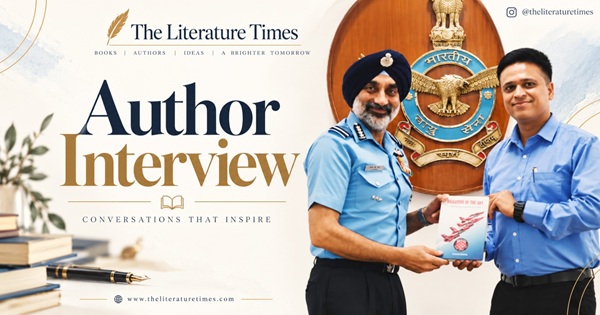
The Literature Times: Aakash, you grew up in an Air Force family. How did that environment shape your fascination with aviation and eventually inspire this book?
Aakash Banga: Growing up on Air Force stations meant waking up to the roar of afterburners and watching flying operations day in and day out. But beyond the machines, it was the rhythm of base life and the dedication of the people that stayed with me. That environment instilled in me not just a love for aircraft and flying, but a deep respect for the men and women who serve this elite organization. When you grow up watching that kind of discipline firsthand, it shapes how you view courage and commitment. Naturally, I was in awe of the Suryakirans, widely known as the ambassadors of the IAF. Writing Masters of the Sky was simply a natural extension of wanting to capture that world from the inside out.
The Literature Times: What first drew you specifically towards the Suryakiran Aerobatic Team and its world of precision flying?
Aakash Banga: Initially, it was the sheer visual spectacle of nine Kiran Mk-II aircraft moving as a single entity (the aircraft SKAT operated from 1996 to 2011). But what truly hooked me was the unseen psychological bond and absolute trust behind it all.
The Literature Times: Your book takes readers beyond the spectacular aerial displays. What did you discover about the pilots that surprised you the most?
Aakash Banga: What surprised me most was their profound humility and composure. When you watch someone pull high-G manoeuvres feet apart from another aircraft, you expect an adrenaline junkie with swagger. In reality, these are remarkably calm, thoughtful, and highly professional individuals. They share simple laughs over chai, talk about their families, and step into high-risk cockpits with quiet reverence rather than bravado. That grounded mindset was fascinating to observe.
The Literature Times: How did you approach capturing the mindset of pilots who operate in such a high-pressure, zero-margin environment?
Aakash Banga: I focused on the human experience behind the machine rather than just technical jargon. I wanted to understand the psychological switch that flips when the canopy closes, and how human vulnerability gets channelled into surgical focus. My goal was to explore what happens inside the mind during split-second decisions and how relentless discipline transforms that mindset into flawless precision in the sky.
The Literature Times: Trust plays an important role in formation flying. What does SKAT teach us about trust and teamwork?
Aakash Banga: In close formation, wingmen do not look at where they are heading; they fix their eyes solely on the leader. SKAT proves that true teamwork demands the complete surrender of individual ego and absolute faith in the pilots beside you.
The Literature Times: The phrase Sadaiva Sarvottam means “Always the Best.” How does this ethos reflect the team’s approach to training and performance?
Aakash Banga: It is not just a motto on an insignia; it is a daily, non-negotiable commitment. Rather than outshining others, it is about an uncompromising standard of self-improvement. For the team, this ethos comes alive in the debrief, where rank disappears and every manoeuvre is dissected with absolute humility. Ultimately, it demands total, unsparing honesty with yourself after every sortie.
The Literature Times: Your interest extends beyond aviation into psychology and human behaviour. How did this perspective influence the way you wrote the story?
Aakash Banga: You see, an aircraft is only as effective as the human mind operating it. Looking through a psychological lens helped me explore how these pilots handle cognitive pressure, conquer stress, and maintain flawless formation in the sky.
The Literature Times: What was the most challenging aspect of bringing the world of SKAT to life while keeping the narrative authentic?
Aakash Banga: For me, the real challenge was translating the raw sensory experience of the cockpit into words without losing the emotional depth. Balancing technical accuracy with a narrative that connects with both seasoned aviators and everyday readers took a lot of work, but it was incredibly rewarding.
The Literature Times: Beyond aviation, what lessons from the Suryakiran Aerobatic Team do you believe can be applied to leadership and everyday life?
Aakash Banga: It really comes down to accountability, mutual respect, and the courage to hold the line for your peers. SKAT proves that when you place the collective mission above personal ego, extraordinary things happen. In their world, leadership is simple: be reliable, back the person beside you, and never compromise on standards.
The Literature Times: What do you hope readers—especially young people—take away from Masters of the Sky after experiencing the journey of the pilots?
Aakash Banga: I hope they realize that excellence is not an accident of talent, but the result of relentless dedication, humility, and trust. I want it to inspire them to chase their own ambitions with courage and purpose.