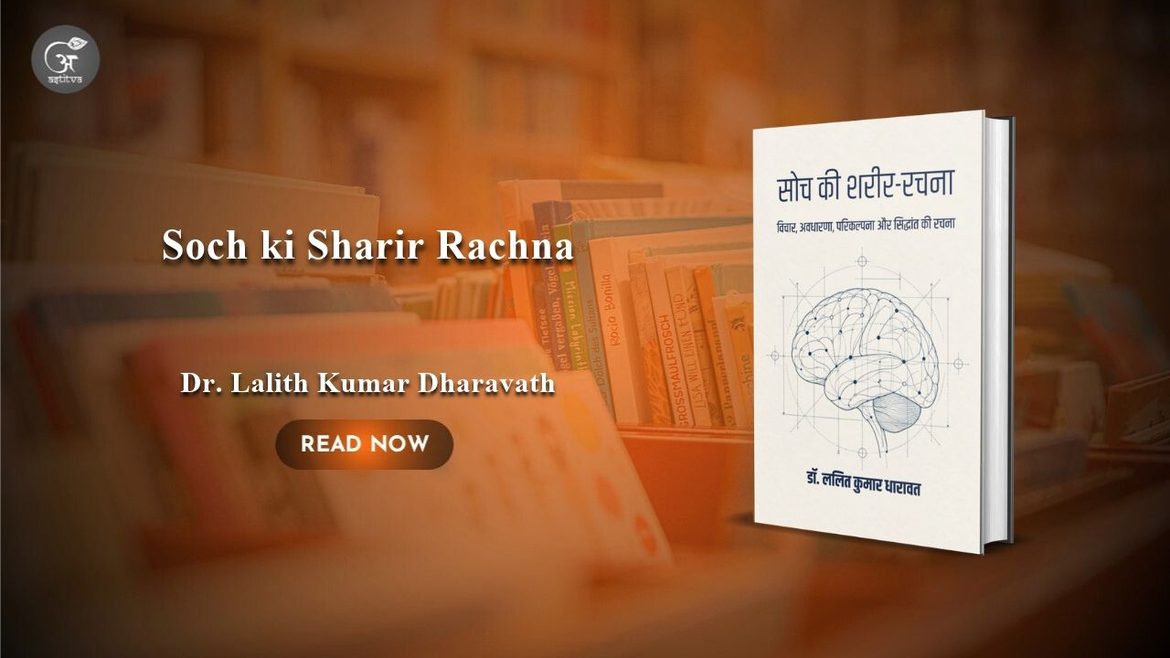
Soch Ki Sharir Rachna: Vichar, Avdharna, Parikalpana Aur Siddhant Ki Rachna by Dr. Lalith Kumar Dharavath presents an illuminating exploration of how human thought develops from an initial spark of imagination into structured knowledge and established intellectual frameworks. Bringing together philosophy, cognitive psychology, epistemology, and scientific reasoning, the book examines the architecture of thinking and the processes through which people generate ideas, develop concepts, test hypotheses, and construct theories.
At the heart of this work lies a fundamental question: how does a fleeting thought become a powerful explanation of reality? Dr. Dharavath approaches this question by tracing the stages through which human intelligence organises experience, transforms observations into meaningful ideas, and evaluates claims through systematic reasoning. The book offers readers a framework for understanding not only how knowledge develops, but also how the quality of human thinking can be strengthened.
The central model follows a cognitive progression from ideas to concepts, hypotheses, and theories. Ideas represent the initial possibilities that emerge through imagination, observation, and mental association. Concepts give these possibilities structure by defining their meaning, establishing boundaries, and connecting them with existing knowledge. Hypotheses then transform concepts into provisional propositions that can be examined against evidence. Theories provide broader explanatory frameworks developed through sustained investigation, empirical scrutiny, and the accumulation of supporting evidence.
By examining these stages in relation to one another, the book encourages readers to recognise that intellectual progress involves more than generating original thoughts. It requires the ability to clarify meaning, formulate questions, test assumptions, and revise explanations when evidence demands it. This systematic approach offers a valuable foundation for students, researchers, educators, and anyone seeking to improve their analytical abilities.
The book also engages with established traditions of scientific and philosophical inquiry. Its discussion of epistemology and the development of knowledge brings attention to the importance of Karl Popper’s principle of falsifiability and Thomas Kuhn’s account of paradigm shifts. These perspectives help readers consider how scientific claims are evaluated, how established frameworks may be challenged, and how intellectual understanding changes over time. By connecting analytical traditions with broader approaches to cognition, the work seeks to establish a shared vocabulary for examining the processes of thought across disciplines.
Historical and contemporary examples further illustrate the proposed framework. In physics, Albert Einstein’s thought experiments and the development of relativity provide a way to explore how imaginative reasoning can lead to concepts, testable predictions, and comprehensive scientific explanations. In economics, the work considers how observations of human exchange and commercial activity can contribute to wider principles of markets and economic organisation. Its engagement with cognitive neuroscience also explores how research into brain activity can deepen our understanding of imagination, reasoning, and the mental processes involved in knowledge formation.
Beyond its academic scope, Soch Ki Sharir Rachna addresses an increasingly important challenge of contemporary life: the ability to distinguish credible information from unsupported claims. In an environment where information circulates rapidly and misleading narratives can influence public understanding, the capacity to examine arguments, assess evidence, identify assumptions, and question conclusions becomes essential. The book encourages readers to approach knowledge actively rather than accepting ideas without scrutiny.
Dr. Lalith Kumar Dharavath brings extensive academic and research experience to this exploration. An Indian thinker, social scientist, and author, he has served at Osmania University, progressing from Lecturer to Professor and undertaking leadership responsibilities as Head of the Department and Chairman of the Board of Studies in Public Administration. His research and teaching have contributed to the study of governance, public policy, social development, and marginalised communities.
With more than three decades of academic experience, Dr. Dharavath has guided doctoral and postgraduate researchers and contributed to research projects supported by national institutions, including the University Grants Commission and the Indian Council of Social Science Research. His extensive writing encompasses books and research articles on subjects ranging from community policing, cybercrime, and security governance to human development and the histories of Banjara and Roma communities. His multidisciplinary scholarship provides a broad foundation for examining the relationship between human thought, knowledge, and society.
Through Soch Ki Sharir Rachna, Dr. Dharavath invites readers to understand thinking as a process that can be examined, developed, and refined. The book offers a framework for moving from unstructured imagination towards disciplined inquiry, encouraging intellectual curiosity while emphasising the importance of evidence and critical reflection. Ultimately, it presents the study of thought as a means of strengthening individual reasoning and contributing to a more informed, questioning, and intellectually responsible society.