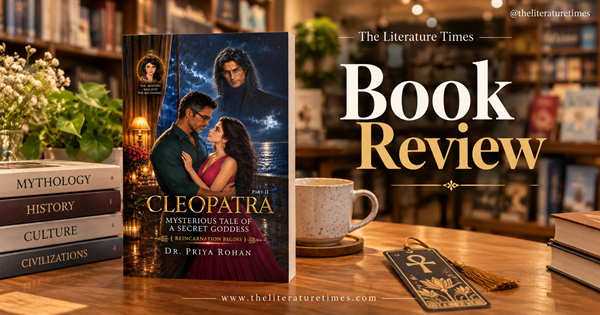
What if history is not merely a record of the past, but a doorway to mysteries that continue across lifetimes? What if the legendary Cleopatra, whose life has fascinated historians and storytellers for centuries, represents something far more profound than an ancient Egyptian queen? In CLEOPATRA: Mysterious Tale of a Secret Goddess – Part II: Reincarnation Begins, Dr. Priya Rohan explores these intriguing possibilities through a captivating blend of mythology, reincarnation, romance, psychological suspense, and supernatural mystery. The novel promises an imaginative journey that challenges conventional understandings of identity, consciousness, love, and the boundaries between existence and eternity.
As the second instalment of the Cleopatra series, Reincarnation Begins expands the central mystery beyond the familiar historical narratives surrounding Egypt’s legendary queen. Rather than treating Cleopatra simply as a historical personality, the story introduces the possibility that her significance extends beyond one lifetime. This intriguing premise creates a foundation for exploring ancient connections, spiritual transformations, and the mysterious forces that may shape human existence across generations.
At the heart of the narrative is Devi, a young girl growing up in rural India. Unlike an ordinary child, Devi possesses an unusual calmness, emotional maturity, and an inner world that seems far beyond her years. Her character introduces an intriguing contrast between outward simplicity and extraordinary spiritual possibilities. Through Devi, the novel examines questions about inherited memories, unexplained familiarity, and the possibility that human identity may transcend the limitations of a single lifetime.
The rural Indian setting adds another dimension to the story. Its cultural and spiritual atmosphere provides an interesting contrast to the grandeur and historical mystery associated with ancient Egypt. By connecting these geographically distant worlds, the narrative suggests that certain experiences, emotions, and mysteries may exist beyond conventional boundaries of time, geography, and civilization. This intersection of ancient history and contemporary life becomes one of the novel’s most compelling conceptual elements.
Reincarnation forms the philosophical foundation of the story, encouraging readers to consider whether consciousness might continue beyond physical existence. Rather than presenting identity as something fixed and permanent, the novel explores it as a mysterious phenomenon potentially shaped by memories, experiences, and connections extending across lifetimes. These ideas invite reflection on the relationship between the conscious mind, spiritual awareness, and the deeper dimensions of human existence.
Love also occupies an important place within the narrative, although it is portrayed as something far more complicated than conventional romantic affection. The story explores the delicate boundaries separating genuine devotion from obsession and emotional attachment from possession. As desire intensifies and relationships become entangled with mysterious connections, the novel raises important questions about the nature of love itself. Can affection remain pure when influenced by unresolved memories or overwhelming emotional dependence? Where does love end and obsession begin?
These psychological tensions introduce a darker dimension to the supernatural narrative. The possibility that relationships may be influenced by forces extending beyond ordinary understanding creates an atmosphere of uncertainty. Readers are encouraged to question whether powerful emotional connections arise from present circumstances, hidden memories, or something more mysterious. This combination of romance and psychological suspense gives the story an emotional complexity that extends beyond its supernatural premise.
Another fascinating aspect is the involvement of archaeologists investigating phenomena that conventional historical explanations cannot fully account for. Their presence introduces an interesting relationship between scientific inquiry and spiritual mystery. Archaeology traditionally seeks to reconstruct the past through physical evidence, while reincarnation and divine consciousness belong to philosophical and metaphysical discussions. Bringing these perspectives together creates opportunities for exploring the limitations of established knowledge and humanity’s continuing fascination with unexplained experiences.
The novel’s thematic ambition is strengthened by the author’s multidisciplinary background. Dr. Priya Rohan is an Indian author, mental health researcher, Neurointegrative Mental Health Specialist, and Integrative Medicine Doctor whose professional interests include consciousness, psychology, and human wellbeing. Her involvement in literature and visual art further reflects a creative curiosity about the relationship between the mind and the mysteries of existence. These interests provide valuable context for understanding the psychological and philosophical questions underlying the Cleopatra series.
One of the most distinctive features of Reincarnation Begins is its reinterpretation of Cleopatra as a possible symbol of something greater than historical royalty. The novel invites readers to reconsider whether the ancient queen’s enduring fascination might represent deeper questions about feminine power, divine consciousness, identity, and spiritual continuity. This imaginative approach allows the narrative to move beyond historical fiction into a broader exploration of mythology and metaphysical possibility.
The combination of multiple genres also gives the book considerable appeal. Readers interested in supernatural mysteries may appreciate its unexplained phenomena, while those drawn to psychological fiction may find the exploration of identity, desire, and obsession particularly intriguing. Admirers of mythology and historical mysteries may enjoy the connection between ancient Egypt and contemporary India.
Ultimately, CLEOPATRA: Mysterious Tale of a Secret Goddess – Part II: Reincarnation Begins presents an ambitious premise that combines historical fascination with spiritual imagination and psychological intrigue. Through Devi’s mysterious existence, the enduring symbolism of Cleopatra, and the exploration of love and consciousness, Dr. Priya Rohan invites readers into a world where the past may never truly disappear.
For readers fascinated by reincarnation, ancient mysteries, supernatural romance, and the unexplored dimensions of the human mind, this novel offers a thought-provoking literary journey. Its central question lingers beyond the story itself: what if some mysteries survive not because history has forgotten their answers, but because their stories have yet to end?