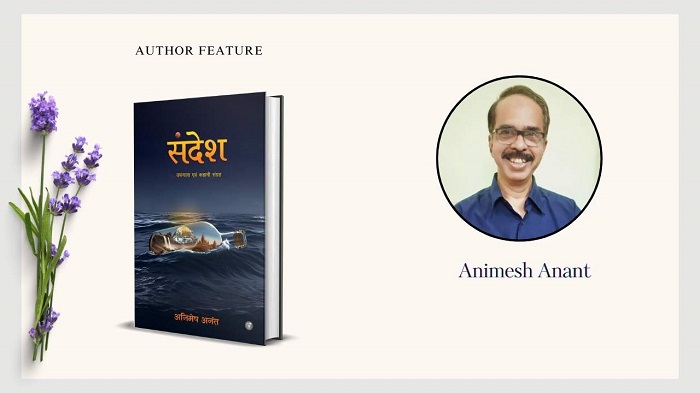
Author Bio: Animesh Anant, My writing is not the result of a planned journey; it’s an authentic expression of experiences gained navigating the worlds of Engineering, software, and the challenging stock market. Despite working in a world of logic and numbers, my private dialogue with words and ideas never stopped. I aim to write in a simple, intimate style, revealing the profound conflicts hidden within ordinary lives. My debut book, ‘Sandesh’—a novel and story collection—is the formal commencement of this exciting creative journey.
The Literature Times: Author, welcome to The Literature Times. Congratulations on the publication of your book! What feedback do you get from your readers? Please share your thoughts on this book.
Animesh Anant: Thank you very much for the warm welcome! It’s a joy to finally share Sandesh with the world.
The feedback has been truly wonderful. What excites me most is hearing how much readers are connecting with the book’s core—that moment in the novel Sandesh when the protagonist is at her lowest point and receives that life-altering ‘message.’ People have told me it made them pause and reflect on their own lives, asking those big questions about purpose and hidden truths. They also seem to love the sheer variety in the collection; it’s a mix of self-discovery, historical retelling from the Ramayana, and even a few simple, tender stories of love and dedication. It really is a journey through different human emotions.
As for my own thoughts, Sandesh is essentially an exploration of finding light in the darkest corners. I wanted to show that even in our greatest weaknesses, there’s an opportunity for profound spiritual and historical discovery. The entire collection celebrates those extraordinary, often unseen, truths that are tucked away inside our ordinary lives. I hope it feels like a conversation about what truly matters.
The Literature Times: What motivates you to become a writer?
Animesh Anant: Honestly, I didn’t choose to become a writer; it felt more like an irresistible urge to translate the noise in my head into something meaningful. The world is full of incredible stories—tucked away in history, in a chance encounter with an elderly couple, or in the deep silence of personal reflection. My main motivation is the feeling that these powerful truths, whether ancient spiritual wisdom or just the secret lives of everyday people, need to be shared. When a story finally clicks into place, and you know you’ve created something that might make a reader pause and look at their own life differently, that’s the ultimate fuel. That connection is everything.
The Literature Times: What are your favourite writing topics? Please tell us a little bit about your literary interests.
Animesh Anant: My literary interests are quite broad, but they all converge on one point: the complex architecture of the human mind and its relationship with ancient wisdom.
I am fascinated by themes of self-discovery—what happens when life strips you bare and forces you to rebuild, which is the heart of Sandesh. I also adore digging into history, not just the dates and facts, but using a historical lens, like with the Ramayana characters in my collection, to see how eternal truths played out in different times. I love contrasting the profound with the mundane; finding a deep, philosophical lesson in something as simple as a journalist’s daily routine or a gentle, everyday act of love. Essentially, if a topic encourages introspection—making the reader look inward and ask ‘Why?’—it captures my attention. I think the best writing should always leave you feeling a little different than when you started.
The Literature Times: We were hoping you might tell us about some of the authors that have influenced you and who you read!
Animesh Anant:.The list is wonderfully long, as every true reader knows! But if I must name the guiding stars, they are the giants who mastered observing the human soul.
From the Indian subcontinent, Premchand and Tagore are foundational. Premchand taught me the power of simplicity, how to capture the social realities and the deep dignity of the common man in plain, accessible language. Tagore, on the other hand, showed me the poetic depths of spirituality and introspection—the kind of timeless truth I explore in Sandesh.
Looking globally, the sheer moral and psychological scale of writers like Tolstoy and Dostoevsky is incomparable. They don’t just write novels; they write about the great spiritual and moral battles happening inside us. Then there is the narrative elegance of Pushkin, and, of course, the brilliant deductive thinking of Arthur Conan Doyle, who inspires me to weave mystery and deep investigation into my storytelling, just like in the journalist’s story in my collection.
These masters taught me that whether you are describing a simple village life or a profound existential crisis, the focus must always be on the truth of the human heart.
The Literature Times: The title is unique and appealing; how did you come up with them? Please tell us the story behind it.
Animesh Anant: The title, Sandesh (Message), is really the entire philosophy of the book in one word.
It stems from a profound personal belief: that somewhere, out there, every single person is waiting for a message—a pivotal piece of information that will finally give their life meaning, spark a crucial change, and define their purpose. It’s that one piece of profound clarity we all crave.
The book is about the moment that message arrives. In the novel, the protagonist is drowning in the deepest darkness, and the ‘Sandesh’ she receives is the catalyst that transforms her world entirely. It’s a concept that transcends spirituality and psychology; it’s about hope, destiny, and the beautiful human search for a defining purpose. I wanted a title that was simple, evocative, and promised that life-changing moment to the reader.
The Literature Times: What are your achievements so far? Tell us something about your writing career.
Animesh Anant: To be perfectly honest, my biggest and proudest achievement so far is holding this book, Sandesh, in my hands. I’ve had a winding professional life—starting as a Mechanical Engineer, then moving into software, and even navigating the challenging world of the stock market. These experiences, full of numbers and logic, ran parallel to a constant, private dialogue with words.
I didn’t have a formal writing career. My journey began spontaneously, sharing thoughts—sometimes serious, sometimes lighthearted—on my website, www.raagbhopali.com, and social media. These were just raw expressions of observations about life, relationships, and society.
Therefore, my true achievement is not a list of past awards, but the fact that I finally took those accumulated experiences and conversations and channeled them into my first official book. This collection is the beginning of my formal writing journey. My style is simply an honest reflection of my diverse background. The goal is not to win awards, but to connect deeply.
The Literature Times: What is your current goal in writing a career? How do you see your future in writing?
Animesh Anant: Right now, my immediate and most important goal is very focused: I want ‘Sandesh’ to reach the people it is meant for. I want the novel’s message of hope and the stories’ diverse perspectives to resonate deeply with readers and spark that internal conversation I mentioned earlier. Success, for me, is measured by the quality of that connection.
Looking ahead, I see my future firmly rooted in storytelling. Since Sandesh blends genres—from profound spiritual exploration to historical reinterpretation—I definitely plan to continue exploring these complex, multifaceted narratives. I want to dive further into the unseen moments of history and the untold conflicts within ordinary people. I plan to write more, experiment more, and keep finding new ways to express the beautiful and challenging architecture of human life. This is just the beginning of a long journey of dialogue with my readers.
The Literature Times: Do you have any other novels in the works? Please keep us updated on your future endeavours.
Animesh Anant: Yes, absolutely! The creative process never really stops. I am excited to share more details soon!
For all updates regarding my future books, new stories, and the general creative chaos in my life, I encourage everyone to follow me on my website and social media. I promise to keep everyone posted!
The Literature Times: How do you view Indian writing in the twenty-first century? What changes do you see in today’s writing style? Do you feel it has been changed by the time?
Animesh Anant: I view Indian writing in the 21st century with tremendous optimism and excitement. It’s undergoing a beautiful and necessary transformation.
The biggest change I see is the democratization of the Indian voice. Earlier, a handful of voices defined Indian literature; today, thanks to platforms like Amazon KDP and the rise of self-publishing, we are seeing an explosion of authentic, regional, and hyper-local narratives. This shift means that the experiences of the small-town, non-metro, and diverse professional backgrounds—like my own—are finally making it to the mainstream.
In terms of style, writing has become more accessible, faster-paced, and strikingly honest. The language is often a fluid blend of Hindi and English—a true reflection of how we speak today.
Yes, time has absolutely changed it. The 21st century writer is dealing with digital anxiety, complex family structures, globalization, and social justice issues head-on. This has made the writing far more topical, fearless, and relatable to the younger generation. It’s a dynamic, exciting era where the depth of our culture is being explored through a highly contemporary and global lens.
The Literature Times: How simple/difficult was it for you to publish your book? What message do you want to send to aspiring authors?
Animesh Anant: Publishing Sandesh was a journey that was both simple and difficult, often at the same time! The simple part was the sheer joy of creation—the writing itself was driven by passion. But learning the publishing side required immense dedication and patience. It’s a steep learning curve, but incredibly rewarding when you finally see your vision realized.
As for aspiring authors, my message is simple: Don’t wait for permission or perfection; just start.
Your unique experiences—whether you are an engineer, a software professional, or a stock market enthusiast like me—are your greatest strength. Don’t let the thought of ‘I am not a writer’ stop you. Write the story that only you can tell. Embrace the struggle of the publishing process, use the available modern platforms, and remember this: Your first book is your letter of introduction to the world. Make sure you finish it. The world is waiting for your voice.