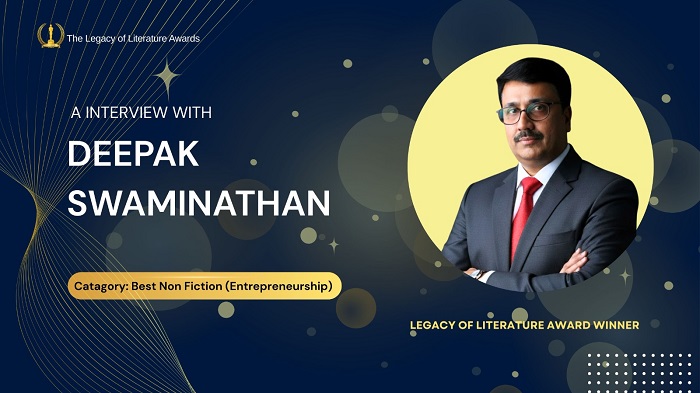
Dr. Deepak Swaminathan is a dynamic, multi-disciplinary entrepreneur with a remarkable track record of building, operating, and scaling successful businesses across Media, Technology, Wellness, Experiential Events, Design, and Animation. Beginning his entrepreneurial journey in the late ’90s with his flagship brand Media Point—which has delivered over 4000 world-class experiential event assignments globally—Deepak has consistently demonstrated strategic brilliance and unwavering ethics. Armed with a postgraduate degree in management and a Doctorate in Management Science, he has an exceptional ability to identify opportunities, decode business models, and cultivate ventures that generate both value and employment. A pioneer in “PHYGITAL” experiences, he recently introduced India’s first immersive virtual platform for expos, events, and engagements. As a mentor, speaker, and author, Deepak continues to inspire first-generation entrepreneurs through real-world insights, grit-driven stories, and his commitment to the “Win-Win” philosophy. His latest work, Ignitions of Inspiration, reflects his deep belief that entrepreneurship is a double-edged sword—powerful, demanding, and transformative when blended with passion and purpose.
The Literature Times: What personal experiences or turning points inspired you to write Ignitions of Inspiration?
Dr. Deepak Swaminathan: As a first-generation entrepreneur from a family that has largely been in traditional employment, the safer, well-trodden path of taking up a job was the obvious expectation. Yet, watching the journeys of entrepreneurs in the news, their successes, their recognition, and the sheer fulfilment they expressed, sparked in me a deep passion to explore entrepreneurship myself.
Several turning points strengthened this conviction:
- Witnessing the struggle of my peers during both my graduate and postgraduate years—many driven by pressure and desperation to secure a job—made me question whether I wanted to walk the same path.
- I realised that choosing employment would limit my freedom to explore ideas and pursue business opportunities with an open mind.
- I felt an intense urge to break free from the monotony of the routine 9-to-5 cycle and carve out a journey of my own making.
These experiences collectively ignited the inspiration behind Ignitions of Inspiration.
The Literature Times: You describe entrepreneurship as a “double double-edged sword.” Could you elaborate on what that means in real-life business scenarios?
Dr. Deepak Swaminathan: Entrepreneurship is a journey of risks and rewards, highs and lows, value creation and scaling. A venture grows—or contracts—in direct proportion to the vision of its founder(s). Among the many pillars that shape an enterprise, financial discipline and sound number-crunching play a critical role in determining its health and long-term success across phases and markets. Opportunities are plentiful and often deeply tempting, but a single misstep—whether an incorrect calculation or an overambitious investment—can impact stability and set a business back by years. Recovering from such setbacks demands immense effort, resilience, and unwavering hard work.
At every stage of growth, the nature of challenges evolves. Founder(s) must constantly stay ahead of the curve, upskill themselves, and foster positivity and motivation within their ecosystem—employees, investors, partners, and every stakeholder who forms part of their universe.
Ultimately, the “never say die” spirit is what truly defines an entrepreneur. Not every deal yields profit, and not every venture unfolds as expected. Much like the unpredictable crests and troughs of a roller coaster, entrepreneurship tests balance, conviction, and the ability to rise stronger after every fall. It is this resilience, this unshakeable belief in one’s vision, that shapes a true entrepreneur.
The Literature Times: Your journey started in the late ’90s with Media Point. How different was the entrepreneurial landscape then compared to today?
Dr. Deepak Swaminathan: India in the late 1990s was shaped by sweeping economic liberalization, an evolving political landscape focused on social justice, and a society gradually embracing modernization. The reforms initiated in 1991 accelerated market expansion, attracted foreign investment, and fuelled the growth of sunrise sectors such as software and automobiles. IT and ITES opportunities began to blossom, privatization became the dominant narrative, and electronic media emerged as a promising space. Although the term “startup” had not yet gained currency, young graduates were increasingly gravitating toward the booming technology domain, where employment prospects were strong and steadily rising.
For SMEs, however, the growth journey was largely organic. Concepts such as pitch hubs and angel investors were still distant, and banks were far less SME-friendly than they are today. Accessing capital without security or collateral was a major hurdle. Securing the very first assignment demanded grit and persistence. Risk-taking was rarely a choice, social pressures often discouraged first-generation entrepreneurs from even considering business as a viable path. Rewards were seldom commensurate with effort, and the enterprise success rate hovered at a modest 8–10%.
Fast-forward to 2025, and the landscape has transformed dramatically. Banks today actively support startups with strong ideas and robust plans. Founders are expected to demonstrate capability through prototypes and seed capital, and a diverse network of investors is now within reach. The startup sector has grown into an industry in its own right, dynamic, celebrated, and central to India’s economic narrative. Yet despite these advancements, the success rate of startups in India remains around 10%. Even so, the ecosystem continues to thrive, with more than 90,000 startups and 118 unicorns as of early 2025.
In essence, building a startup in India now comes with substantial advantages: government-backed tax exemptions and funding schemes, a vast domestic market, reduced compliance burdens through self-certification, smoother access to government tenders, and strong support for intellectual property protection. The Government’s Startup India initiative further streamlines registration, enables easier exits, and connects entrepreneurs to a wide network of mentors, investors, and incubators—creating an environment where innovation can take root and scale.Top of Form
Bottom of Form
The Literature Times: What is one message or lesson from Ignitions of Inspiration that you hope every young entrepreneur carries with them?
Dr. Deepak Swaminathan: If there is one message, I hope every young entrepreneur takes away from Ignitions of Inspiration, it is this: your journey is defined not by the resources you begin with, but by the courage, clarity, and conviction with which you pursue your vision.
Opportunities will emerge and challenges will test your resolve, but when you stay sincere in your efforts, uphold your values, and keep learning with humility, success becomes a natural outcome of your dedication.
Ultimately, entrepreneurship is not about avoiding failures, it is about rising stronger each time, believing in your purpose, and creating impact with every step forward.
The Literature Times: The book discusses temptations, shortcuts, and false promises. Which of these challenges do you believe most entrepreneurs underestimate?
Dr. Deepak Swaminathan: Among temptations, shortcuts, and false promises, the challenge most entrepreneurs consistently underestimate is shortcuts.
Shortcuts often appear attractive because they promise quick results, faster growth, or instant visibility. But what many fail to realise is that every shortcut bypasses a critical learning curve. It skips the very experiences that build resilience, sharpen judgement, and prepare an entrepreneur for the long haul. Shortcuts may offer momentary wins, but they weaken the foundation required for sustainable success.
Temptations can be managed with discipline, and false promises can be filtered with due diligence. But shortcuts are deceptive, they disguise themselves as efficiency, smart work, or speed, and that is precisely why they are dangerous.
Entrepreneurs who stay committed to the process, invest in their growth, and take the long, honest road; no matter how demanding, are the ones who build enterprises that last.
The Literature Times: You have built ventures across multiple industries. How do you decide which opportunities are worth pursuing?
Dr. Deepak Swaminathan: When you’ve built ventures across diverse industries, identifying the right opportunities becomes a blend of intuition, experience, and disciplined evaluation. Much like a butterfly emerging from its cocoon, every phase of the journey adds new layers of learning that sharpen one’s ability to recognise relevant possibilities.
The intuitive mind first senses the potential; the business mind then steps in to rigorously assess its viability. A new opportunity is ultimately shaped by multiple factors — personal aspirations, market needs, identifiable industry gaps, alignment with existing ecosystems, and the capability to scale sustainably.
Above all, the decision to pursue any venture must stem from thorough research and informed judgement rather than impulsive enthusiasm. Sound choices, backed by insight and due diligence, are what lay the foundation for long-term success.
The Literature Times: In your view, what differentiates first-generation entrepreneurs from legacy entrepreneurs in terms of mindset and struggles?
Dr. Deepak Swaminathan: First-generation entrepreneurs and legacy entrepreneurs may share ambition, but their mindsets and challenges are shaped by very different starting points.
A first-generation entrepreneur builds everything from the ground up, credibility, networks, capital, and confidence. Their mindset is defined by hunger, grit, and the need to constantly prove their worth. They face societal pressure, financial constraints, and the emotional weight of stepping into uncharted territory without a safety net. Every decision carries higher stakes, and every mistake is a direct learning experience. Their resilience is self-forged.
A legacy entrepreneur, on the other hand, begins with an established foundation, business knowledge, market reputation, and support systems already in place. Their mindset is shaped by continuity and stewardship: protecting, scaling, and evolving what has already been built. While they face their own set of challenges, their struggles are rarely about survival; they revolve more around adaptation, modernization, and carrying forward a legacy responsibly.
In essence, the biggest difference lies in this:
first-generation entrepreneurs fight to create a place in the world, while legacy entrepreneurs strive to elevate the place they have inherited. Both journeys are valuable, but the path of the first-generation entrepreneur is uniquely demanding and deeply transformative.
The Literature Times: Your virtual “PHYGITAL” platform has been a pioneering initiative. What motivated you to take that leap into immersive digital experiences?
Dr. Deepak Swaminathan: Repeating the same task across 4,500+ assignments in more than 75 geographies eventually diluted the excitement that once came with doing it. At the same time, a surge of new entrants and countless startups in the ecosystem created immense pressure on established organisations like ours. The choices before us were stark; innovate or become irrelevant.
At this crossroads, the entrepreneurial instinct took over. I began exploring fresh possibilities, both within our domain and beyond it. Having already built a trusted brand with a history being in trade for 25+ years, the next step was clear: create something unique that aligned with our strengths. This exploration gave birth to our Phygital extensions.
Our journey in this space began in 2017. The early attempts did not succeed; a few failures forced us back to the drawing board. But each setback sharpened our approach. We reassembled a new team of talented tech professionals and continued refining our vision. The result was the first Made-in-India tech solution in our segment, one that successfully delivered more than 200+ assignments through the pandemic and continues to deliver today.
We are now moving into our next ambitious chapter: building Agentic AI and a universe of intelligent solutions designed for MICE and MSME businesses. The journey of reinvention continues, powered by innovation, resilience, and an unwavering belief in what is possible.
The Literature Times: How important are ethics and compassion in entrepreneurship, especially in a competitive and volatile environment?
Dr. Deepak Swaminathan: Ethics and compassion are not just desirable in entrepreneurship, they are indispensable, especially in a competitive and volatile environment.
In times of uncertainty, the only constants an entrepreneur can rely on are their values and the trust they build. Ethics ensure that every decision is rooted in integrity, transparency, and fairness. This creates credibility, which is often more powerful than capital. When markets fluctuate and competition intensifies, businesses grounded in strong ethics don’t merely survive, they earn long-term loyalty from customers, employees, and partners.
Compassion, on the other hand, humanizes entrepreneurship. It allows leaders to understand people beyond numbers, whether it’s supporting employees through challenges, listening to customers with empathy, or nurturing partnerships with sensitivity. Compassion builds cultures that are resilient, motivated, and deeply committed to a shared vision.
In a world where speed often overshadows sincerity, ethics and compassion become a competitive advantage. They help create enterprises that last, relationships that endure, and leaders who inspire.
Ultimately, in entrepreneurship, the true strength lies not just in building a profitable business, but in building a principled one.
The Literature Times: What do you believe is the single most important trait an entrepreneur must develop to stay in the game long-term?
Dr. Deepak Swaminathan: If I had to identify a single most important trait for long-term entrepreneurial success, it would be resilience.
Markets will shift, plans will fail, people will disappoint, and unforeseen challenges will surface when least expected. What keeps an entrepreneur in the game is not perfection or luck, but the ability to absorb setbacks, learn quickly, recalibrate, and rise stronger each time. Resilience transforms obstacles into insights, delays into discipline, and failures into fuel.
Skills can be learned, capital can be raised, teams can be rebuilt, but without resilience, even the brightest idea cannot survive the realities of entrepreneurship.
Resilience is the quiet force that keeps an entrepreneur moving forward long after others have stopped.
“First-generation entrepreneurs are not born with a legacy, they build one through belief, resilience, and uncompromising sincerity.”
-Dr. Deepak Swaminathan