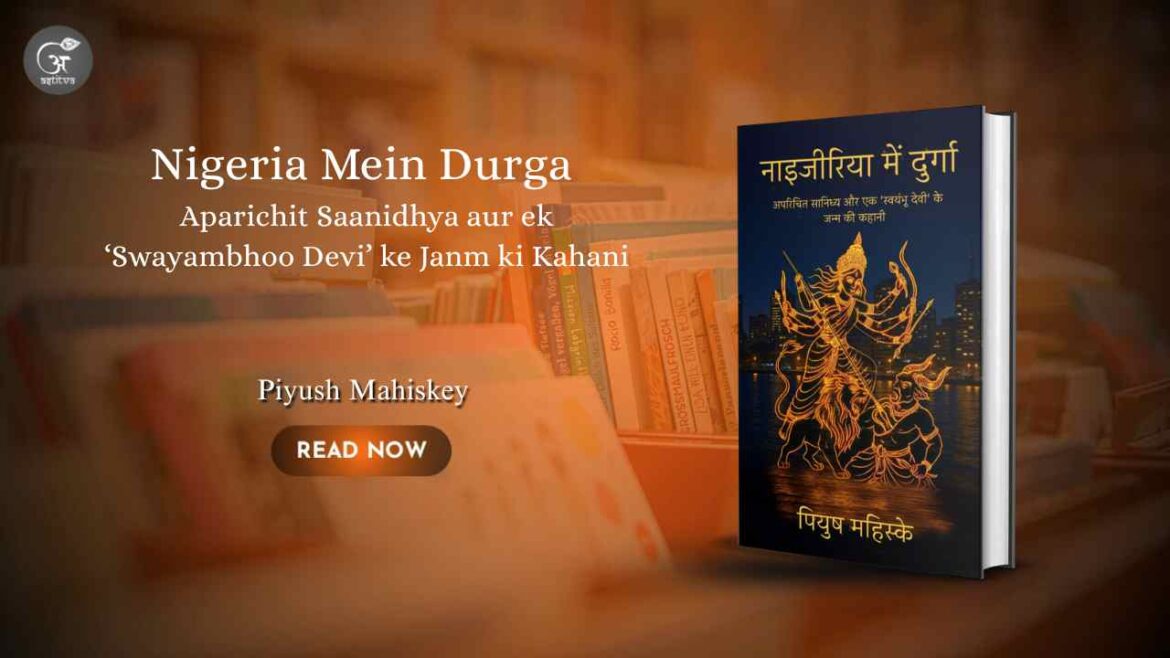
A powerful new literary novel titled Nigeria Mein Durga has been released, offering readers a deeply reflective narrative that blends emotional realism with mythic symbolism. Written with remarkable sensitivity, the book carries the subtitle “Aparichit Saanidhya aur ek ‘Swayambhoo Devi’ ke Janm ki Kahani” and presents a story that explores displacement, faith, trauma, and the unexpected creation of modern myths.
The novel follows the life of Saanidhya Ashtankar, affectionately known as Saani, a disciplined product strategist from Pune who relocates to Lagos, Nigeria. Her life takes an extraordinary turn after a near-death experience that gradually transforms her from an ordinary individual into a symbol of divine revelation for many across India. However, the narrative carefully avoids portraying miracles, instead presenting a deeply human story where emotional truths shape public belief.
The story unfolds across 23 chapters and begins with Anant Joshi’s move from Pune to Lagos, leaving behind his wife Roshni and their son Kush. In Lagos, Anant and Saani’s professional relationship slowly evolves into a profound emotional connection marked by quiet companionship and spiritual undertones.
Alongside this central narrative, the novel explores parallel emotional journeys—Roshni’s unwavering faith, Kush’s symbolic innocence, Anant’s eventual collapse into broken heart syndrome, and Saani’s own internal struggle with identity and perception. The narrative structure reflects the symbolic “Nine Days of Battle,” echoing the emotional complexity of Navratri and leading to Saani’s unintended transformation into a divine figure.
In the final chapter titled “Godwoman,” Saani’s silence becomes a form of scripture, interpreted by society as sacred meaning.
Set against the vibrant yet emotionally complex backdrop of Lagos, the novel treats the city not merely as a setting but as a living emotional landscape. It examines how trauma can be transformed into mythology, how silence is often interpreted as sanctity, and how faith travels across cultures and borders.
Written in restrained yet emotionally precise prose, Nigeria Mein Durga combines technical metaphors with cultural rituals to create a narrative that feels both contemporary and timeless. Rather than relying on dramatic storytelling, the book embraces ambiguity, subtlety, and psychological depth.
Ultimately, Nigeria Mein Durga stands as a thoughtful meditation on emotional truth, diaspora experiences, and the fragile boundary between human vulnerability and divine symbolism. Rooted in Marathi cultural nuance yet universal in its themes, the novel invites readers to reflect on how society constructs faith, identity, and meaning in the aftermath of personal trauma.
This remarkable work promises to resonate with readers who appreciate literary fiction that is introspective, layered, and emotionally profound.