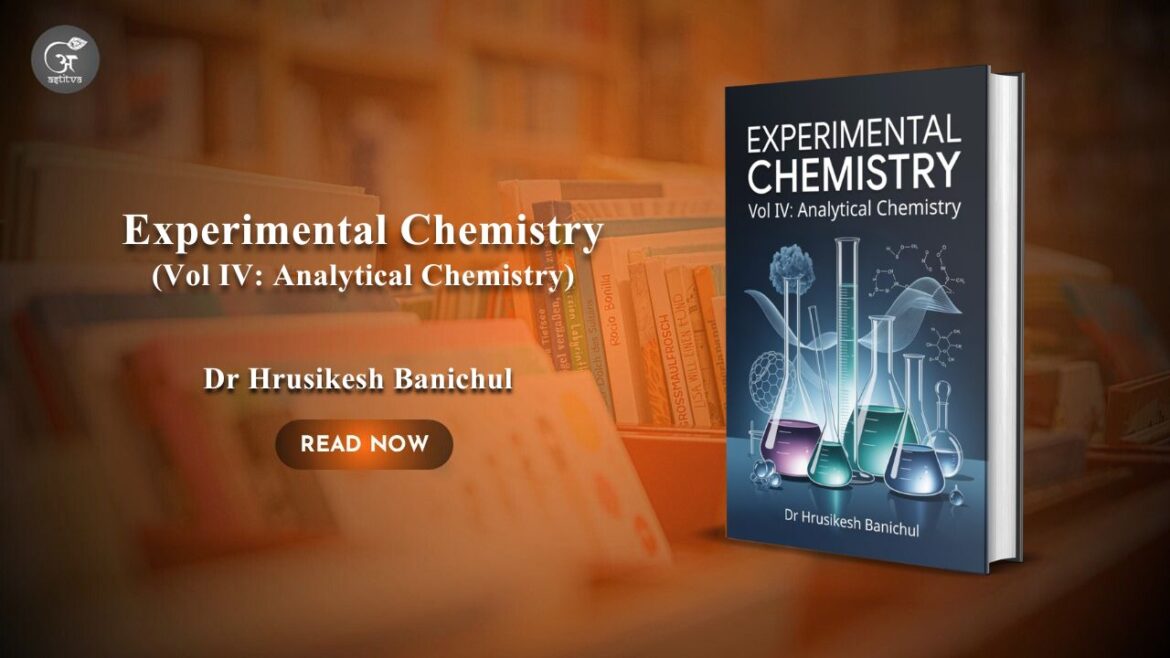
The release of Experimental Chemistry (Vol IV: Analytical Chemistry) by marks a significant milestone in the field of chemistry education, particularly in laboratory-based analytical sciences. This volume is a specialized laboratory manual dedicated to precision, measurement, and environmental assessment, offering students and researchers a structured pathway to mastering modern analytical techniques.
In an era where environmental protection, industrial quality control, and scientific accuracy are more important than ever, analytical chemistry plays a critical role in understanding and improving the world around us. This book has been carefully designed to bridge the gap between pure chemistry and its real-world applications by focusing on rigorous experimental protocols and data-driven analysis.
Experimental Chemistry Vol IV provides a comprehensive toolkit for modern analysts. It introduces learners to environmental testing of water and soil, enabling them to evaluate the quality of natural resources with scientific accuracy. These experiments are essential for understanding pollution levels, environmental safety, and sustainable resource management.
A major strength of the book lies in its coverage of advanced instrumental techniques such as spectrophotometry and chromatography. These methods are widely used in modern laboratories for substance identification, separation, and quantitative analysis. By presenting these techniques in a clear, step-by-step manner, the book ensures that students develop both conceptual understanding and practical confidence.
The volume also explores separation science in depth, including solvent extraction and spectrometric verification methods. These techniques are essential for isolating and analyzing chemical components in complex mixtures, making the book highly relevant for academic research, industrial laboratories, and environmental testing centers.
One of the most distinctive features of this book is its strong emphasis on error analysis and statistical data interpretation. In scientific research, accuracy is not only about performing experiments but also about validating results with mathematical precision. This book teaches students how to identify, minimize, and analyze errors using statistical tools, ensuring high-quality and reliable scientific reporting.
The structured approach of the book makes it suitable for undergraduate and postgraduate students, researchers, laboratory technicians, and educators. Each experiment is designed to promote analytical thinking, technical accuracy, and scientific discipline. Teachers and institutions will find it particularly valuable as a teaching resource for practical chemistry training.
Beyond academic learning, Experimental Chemistry Vol IV also highlights the importance of analytical chemistry in real-world applications. From environmental monitoring and industrial quality control to pharmaceutical testing and research development, the principles covered in this book have wide-ranging significance in modern science and technology.
The release of this volume reflects the growing need for skill-based, application-oriented science education. By combining environmental analysis, instrumental techniques, and statistical validation, the book offers a complete learning experience that prepares students for professional excellence in analytical chemistry.
With its balanced integration of theory, practice, and data science, Experimental Chemistry (Vol IV: Analytical Chemistry) stands as an essential contribution to modern chemical education. It is poised to become a trusted companion for students and researchers committed to precision, accuracy, and scientific integrity.