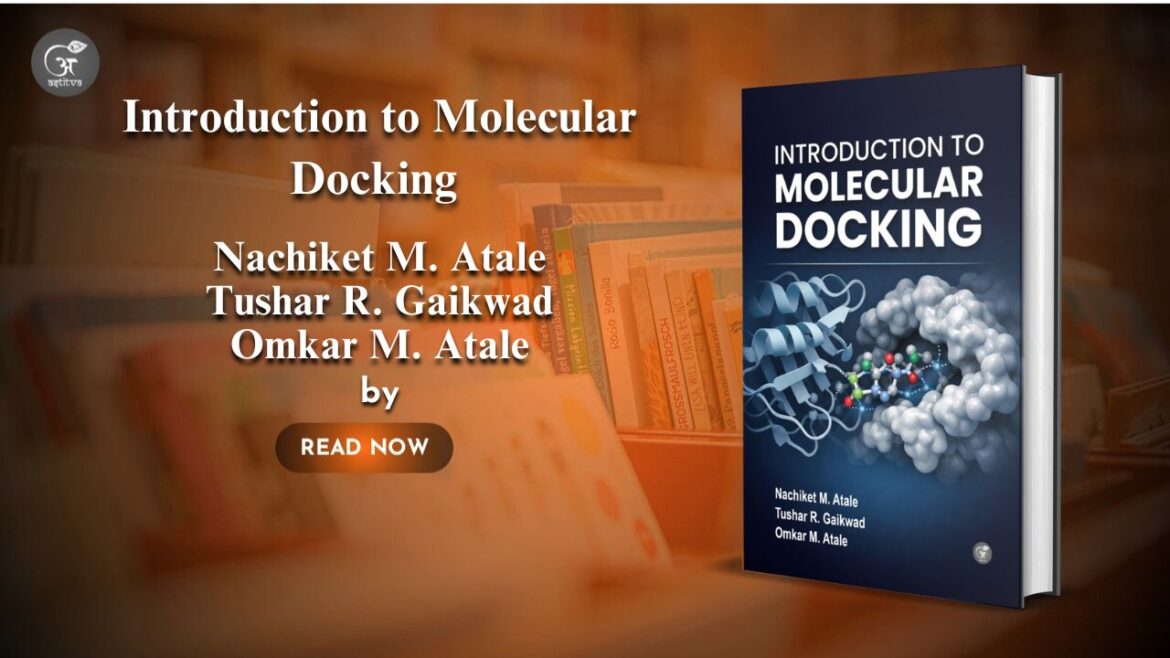
“Introduction to Molecular Docking”: A Clear Gateway to Modern Computational Drug Discovery
The rapidly evolving field of computational biology has become central to modern drug discovery, and Introduction to Molecular Docking, authored by Nachiket M. Atale, Tushar R. Gaikwad, and Omkar M. Atale, arrives as a timely and accessible guide for students, researchers, and professionals alike. Designed to bridge the gap between theory and practice, the book presents molecular docking in a way that is both academically rigorous and easy to understand.
Molecular docking is a computer-based technique used to predict how small molecules, known as ligands, bind to larger biological targets such as proteins, DNA, or RNA. This book introduces the subject using simple analogies and visual explanations, allowing readers to clearly imagine how molecular interactions occur and why they are crucial in biology and medicine. At its core, docking seeks to answer two essential questions: where does a ligand bind to a receptor, and how strong is that binding? The authors guide readers through these concepts with clarity and precision.
The book thoughtfully traces the historical development of molecular docking, beginning with Emil Fischer’s “lock-and-key” model proposed in 1894 and advancing through Daniel Koshland’s “induced fit” theory. It highlights the major breakthroughs in computational chemistry during the 1970s and 1980s that laid the foundation for modern docking techniques. Readers are introduced to pioneering software such as DOCK and to widely used tools like AutoDock, GOLD, and Glide, which enabled virtual screening of thousands of compounds before laboratory testing. The book also explores how artificial intelligence and machine learning are now transforming docking accuracy and accelerating drug discovery.
To ensure strong conceptual grounding, Introduction to Molecular Docking includes a concise review of essential biological and chemical principles. Topics such as DNA, RNA, proteins, enzymes, and the forces governing molecular interactions—hydrogen bonding, ionic interactions, van der Waals forces, and hydrophobic effects—are clearly explained. Fundamental docking concepts including binding sites, active sites, docking poses, and binding affinity are discussed in detail, while common misconceptions are addressed to help readers develop a realistic understanding of the technique.
One of the book’s standout features is its practical orientation. Step-by-step workflows are presented to guide readers through real docking exercises, making the book particularly useful for beginners and early-career researchers. Case studies and illustrative examples reinforce learning and demonstrate real-world applications.
The authors bring diverse expertise to this collaborative work. Nachiket M. Atale, a PhD student at the Institute of Science, Dr. Homi Bhabha University, Mumbai, contributes extensive practical experience in molecular docking, phytochemicals, and simulations, along with a strong teaching background. Omkar M. Atale, an M.E. graduate in Mechatronics from the University of Adelaide, adds technical strength in software applications and computational workflows. Tushar R. Gaikwad, an M.Sc. Microbiology graduate, integrates computational biology, bioinformatics, and data analysis expertise, offering a modern interdisciplinary perspective.
Overall, Introduction to Molecular Docking succeeds in making a complex scientific field approachable without compromising depth. By combining theory, history, practical guidance, and real-world relevance, the book serves as a valuable resource for anyone seeking to understand or apply molecular docking in research and drug development.