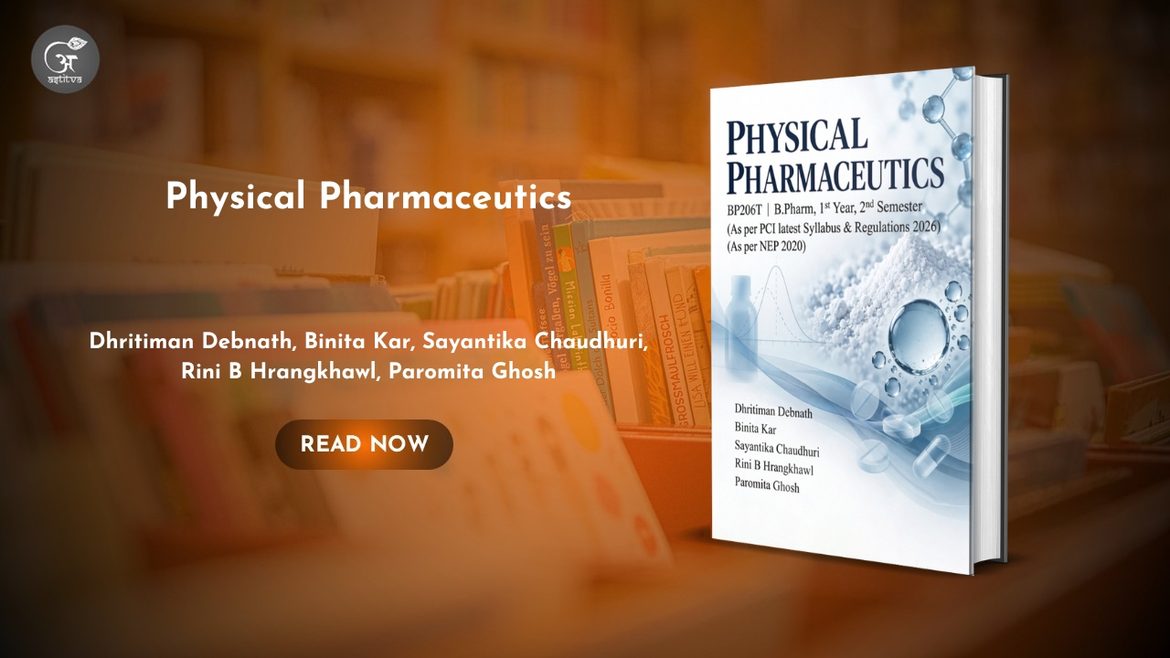
The academic landscape of pharmaceutical education welcomes a valuable new addition with the release of Physical Pharmaceutics (BP206T), authored by Dhritiman Debnath, Binita Kar, Sayantika Chaudhuri, Rini B Hrangkhawl, and Paromita Ghosh. Developed specifically for B.Pharm Second Semester students, the textbook has been structured in accordance with the updated Pharmacy Council of India (PCI) syllabus and aims to provide students with a clear, systematic, and application-oriented understanding of physical pharmaceutics.
Physical pharmaceutics forms an essential bridge between fundamental scientific principles and the formulation, development, stability, and performance of pharmaceutical dosage forms. Recognizing the importance of this subject in pharmacy education, the authors have designed the book to make complex concepts accessible while maintaining the scientific depth required at the undergraduate level.
The textbook is systematically divided into five units covering Solubility and Distribution Phenomena, Interfacial Phenomena, Colloidal and Coarse Dispersions, Rheological Studies, and Micromeritics. These units introduce students to essential topics such as solubility and its measurement, pH and buffers, partition coefficient, critical solution temperature, surface and interfacial tension, surfactants and HLB, adsorption, zeta potential, colloidal systems, suspensions and emulsions, rheological properties, particle-size analysis, specific surface area, and powder-flow characteristics.
A notable feature of Physical Pharmaceutics (BP206T) is its emphasis on connecting theoretical principles with their pharmaceutical significance and practical applications. Important concepts including solute–solvent interactions, Raoult’s law, buffer capacity, surface phenomena, electric double layers, sedimentation, emulsification, Newtonian and non-Newtonian flow, and powder characterization are presented in a structured manner. The discussion of micromeritics further demonstrates how particle characteristics influence dissolution, bioavailability, content uniformity, formulation behavior, and pharmaceutical processing performance.
The book also gives careful attention to methodologies, equations, instrumentation, derivations, and applications, helping students develop both conceptual understanding and examination readiness. To encourage revision and self-assessment, every unit incorporates Multiple Choice Questions (MCQs), Short Answer Questions, and Long Answer Questions. These exercises reinforce key definitions, concepts, diagrams, methodologies, instrumentation, and pharmaceutical applications while also supporting students preparing for competitive examinations such as GPAT.
With contributions from Dhritiman Debnath, Binita Kar, Sayantika Chaudhuri, Rini B Hrangkhawl, and Paromita Ghosh, Physical Pharmaceutics (BP206T) brings together academic clarity, curriculum relevance, practical understanding, and examination-focused learning in a single resource. The book is expected to serve as a useful companion for undergraduate pharmacy students as well as an academic reference for teachers.
By establishing a strong foundation in the physical principles underlying pharmaceutical systems, the textbook also prepares students for advanced learning in pharmaceutics, formulation development, industrial pharmacy, and drug-delivery sciences. Its balanced combination of theory, pharmaceutical applications, and assessment-oriented content makes Physical Pharmaceutics (BP206T) a timely addition to contemporary pharmacy education.