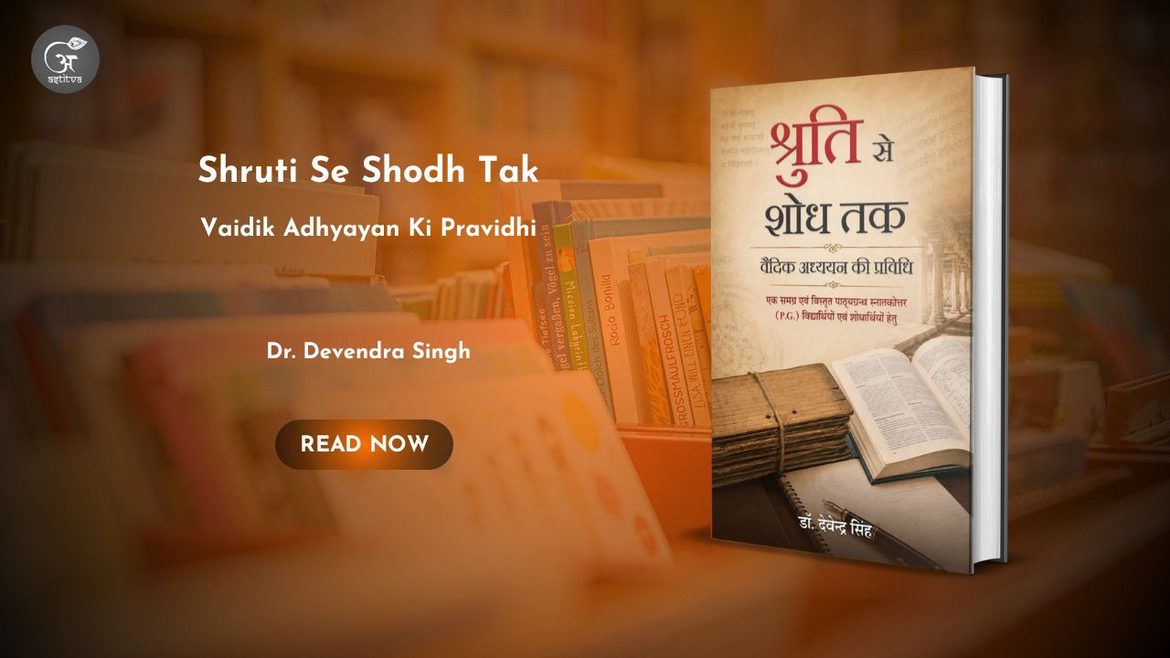
Vedic literature represents one of the most profound and enduring foundations of India’s intellectual, cultural, linguistic, and philosophical heritage. Its study requires not only reverence and curiosity but also a systematic and well-defined research methodology. Addressing this important need, Dr. Devendra Singh’s Shruti Se Shodh Tak: Vaidik Adhyayan Ki Pravidhi presents itself as a comprehensive and practical guide for postgraduate students, research scholars, and anyone engaged in the academic study of Vedic literature.
The book addresses one of the most common challenges faced by students entering the field of Vedic studies: while they may possess deep enthusiasm and respect for the Vedic tradition, they often remain uncertain about where and how to begin their research. This work seeks to remove that uncertainty by presenting the complete research process in a systematic, logical, and accessible manner.
Organized into six chapters, the book takes the reader through the various stages of Vedic research, beginning with the fundamentals of research and progressing towards contemporary and technology-driven methodologies. The first chapter introduces the concept and types of research, the Indian understanding of pramāṇa, and the principles of research ethics. It establishes the intellectual and ethical foundation necessary for undertaking meaningful academic research.
The second chapter focuses on the selection of a research problem, literature review, source materials, and the preparation of a research proposal. Since the quality of research depends significantly on identifying an appropriate research question and working with reliable sources, this section provides valuable direction to students and scholars at the beginning of their research journey.
The third chapter introduces important areas such as textual criticism, manuscriptology, critical editions, and Vedic accentuation. These methods are particularly significant in Vedic studies, where the preservation, transmission, comparison, and authentication of textual material require careful scholarly attention. The chapter enables researchers to approach Vedic texts with greater methodological precision.
The fourth chapter explores a range of analytical approaches, including linguistic, metrical, etymological or nairukta, comparative, and statistical methods. By introducing these diverse methodologies, the book encourages researchers to examine Vedic material from multiple perspectives and develop interpretations supported by systematic analysis and evidence.
The fifth chapter provides practical guidance on the structure of a thesis, citation practices, transliteration, and academic publication. Research is not complete merely through the collection and analysis of information; it must also be presented in a clear, organized, and academically acceptable form. This chapter therefore serves as a practical reference for scholars preparing dissertations, research papers, and publications.
The sixth chapter brings Vedic studies into the contemporary research landscape by introducing emerging areas such as digital humanities, computational textual analysis, and artificial intelligence. Through this discussion, the book demonstrates how modern technological tools can open new possibilities for the study and analysis of ancient Vedic texts while maintaining the importance of traditional scholarly approaches.
The appendices further enhance the practical value of the book. They include a glossary of technical terms, an IAST transliteration table, a model format for a research proposal, and an answer key to the practice questions. These resources make the book particularly useful as a ready reference for students and researchers working in the field.
The author, Dr. Devendra Singh, is Assistant Professor and Head of the Department of Sanskrit Language and Literature at Sanchi University of Buddhist–Indic Studies, Madhya Pradesh. He completed his M.A. from Banaras Hindu University, Varanasi, and earned his Ph.D. from Jawaharlal Nehru University, New Delhi. He is the author of several books, and his research papers have been published in reputed academic journals. Under his supervision, six scholars have been awarded Ph.D. degrees and two scholars have received M.Phil. degrees.
Dr. Singh’s academic journey includes participation in the World Indology Conference held at Rashtrapati Bhavan, New Delhi, in 2015, a significant international gathering of distinguished Indologists. His international academic engagements also include participation in the World Sanskrit Conferences held in Bangkok and Canberra, as well as the 12th World Hindi Conference in Fiji, where he served as a member of the official delegation of India’s Ministry of External Affairs.
Shruti Se Shodh Tak: Vaidik Adhyayan Ki Pravidhi is more than a collection of rules and techniques for conducting research. It presents research methodology as a vision that gives direction to curiosity and transforms scattered questions into structured academic inquiry. By bringing together the depth of the Vedic tradition and the rigor of modern research methodology, the book creates a meaningful bridge between traditional knowledge and contemporary scholarship.
For postgraduate students, research scholars, teachers, and academics engaged in Sanskrit, Vedic studies, Indian knowledge traditions, and related disciplines, this work can serve as a valuable academic resource. It offers a structured pathway from the first question of a researcher to the systematic exploration, analysis, documentation, and publication of knowledge. In this way, Shruti Se Shodh Tak: Vaidik Adhyayan Ki Pravidhi makes a significant contribution to the growing field of methodological studies in Vedic scholarship and stands as a reliable guide for every serious seeker of Vedic research.