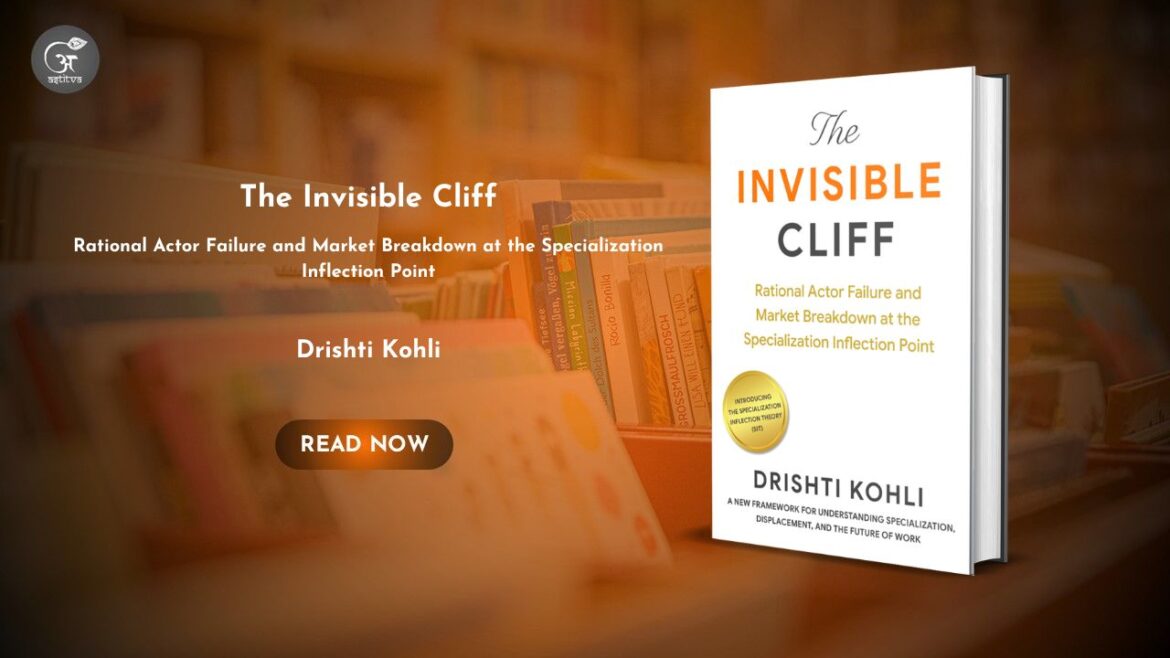
The literary and academic world welcomes a significant new contribution to the future-of-work discourse with the release of The Invisible Cliff: Rational Actor Failure and Market Breakdown at the Specialization Inflection Point by Drishti Kohli. This groundbreaking work in labour economics and policy design challenges conventional assumptions about workforce disruption and presents a compelling new framework for understanding career vulnerability in an era of rapid technological change.
At the center of the book is a powerful and thought-provoking question: Who is truly at risk in the modern economy? Contrary to popular belief, Drishti Kohli argues that the greatest threat is not faced by unskilled workers, but by highly specialized professionals whose expertise may suddenly lose value as industries evolve. Through rigorous research and innovative analysis, the author introduces the Specialization Inflection Theory (SIT), an original framework designed to help individuals, employers, and policymakers identify and address this hidden risk before it becomes irreversible.
The theory is built upon three critical variables: Task Routinizability, which measures how rule-bound a worker’s responsibilities are; Industry Velocity, which reflects the speed of change within a sector; and Career Stage, which evaluates the remaining time available for adaptation and redirection. Together, these variables create a four-zone risk matrix that helps determine whether a worker is approaching a critical inflection point—the moment when continued specialization ceases to provide security and instead increases vulnerability.
Through vivid examples and relatable characters, the book demonstrates how intelligent, capable, and rational individuals can unknowingly move toward structural career cliffs. It reveals how workers often continue making seemingly logical decisions that ultimately expose them to long-term displacement, not because of personal failure, but because of larger systemic forces operating beyond their awareness.
Beyond individual stories, The Invisible Cliff provides a detailed examination of three fundamental market failures that contribute to workforce instability. The first is information asymmetry, where employers and institutions possess knowledge about future workforce needs that individual workers often lack. The second is negative externalities, where the social and economic costs of automation and technological disruption are borne by society rather than the organizations driving change. The third is time inconsistency, which explains why workers frequently postpone necessary adaptation until opportunities for effective action have diminished.
Drishti Kohli argues that awareness alone cannot solve these challenges. Instead, meaningful intervention requires thoughtful policy design, proactive employer participation, and systemic reforms that help workers navigate economic transitions before they reach critical tipping points. The book offers practical insights and policy recommendations aimed at creating more resilient labour markets capable of responding to technological transformation.
While India serves as the primary lens through which many of these issues are examined, the book’s scope is truly global. Drawing on case studies from Ohio, Germany, Bangladesh, and beyond, it highlights how specialization risks transcend geography, affecting workers across diverse economic and industrial contexts. This international perspective makes the book relevant not only to policymakers and economists but also to business leaders, educators, career professionals, and workers seeking to understand the future of employment.
What makes The Invisible Cliff particularly compelling is its blend of analytical rigor and human empathy. Rather than reducing labour market challenges to statistics and projections, the book focuses on the real people behind economic transitions, emphasizing the personal consequences of structural change and the urgent need for better systems of support.
Drishti Kohli brings a unique perspective to this work. As a forensic risk professional who has spent her career studying how failures emerge—not suddenly, but gradually and predictably—she has developed a remarkable ability to identify the warning signs that often go unnoticed until it is too late. Her expertise in examining complex organizational risks inspired her to apply the same analytical lens to labour markets, uncovering patterns that challenge existing assumptions about career security and economic resilience.
Reflecting on her motivation, Kohli explains that she built the map she wished someone had handed her. By identifying the hidden forces shaping modern careers and exposing the invisible cliffs that many workers unknowingly approach, she offers readers a framework for understanding, anticipating, and navigating the future of work.
Timely, insightful, and deeply relevant, The Invisible Cliff: Rational Actor Failure and Market Breakdown at the Specialization Inflection Point stands as an important contribution to contemporary economic thought. It is a book that not only diagnoses one of the defining challenges of our time but also provides a roadmap for individuals, organizations, and governments seeking to build a more adaptive and sustainable future.