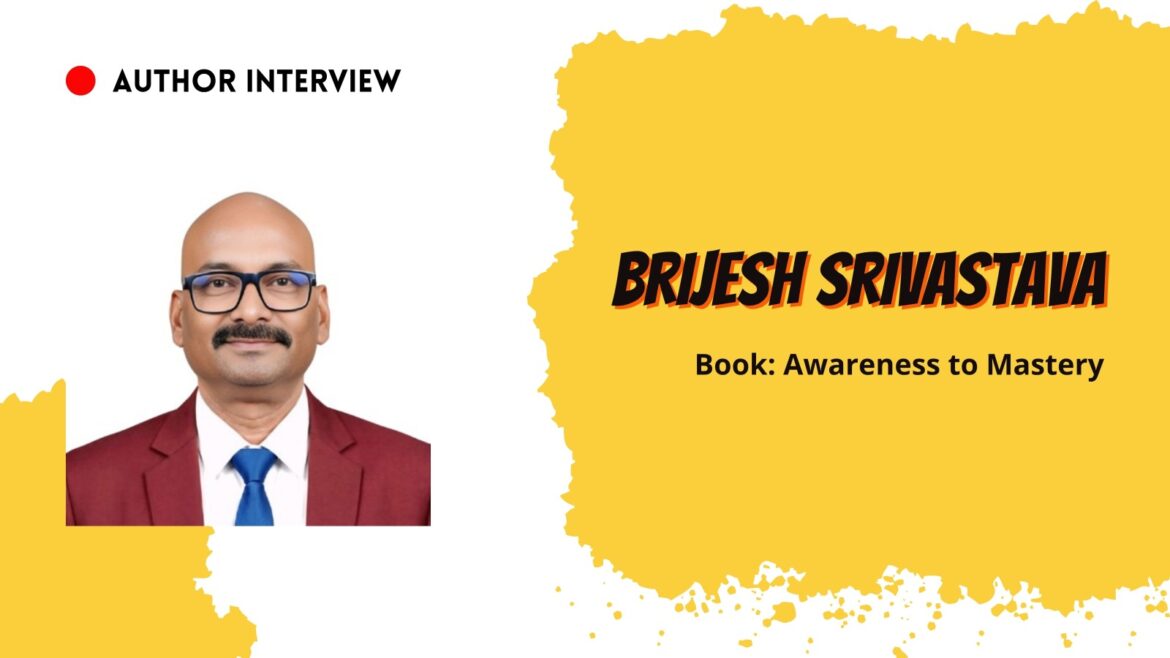
The Literature Times: Q1. Awareness to Mastery is a rather intriguing title. What does it actually mean — and why did you choose it over something more conventional, like ‘How to Crack IIT JEE’?
Brijesh Srivastava: Ha! “How to Crack IIT JEE” would have sold more copies at a railway station bookstall — I will admit that. But it would have been a lie by title. Because the book is not about cracking anything. It is about building something — the one internal foundation that determines whether all the preparation a student does actually converts into performance when it matters.
Awareness is where it begins. Not awareness of the syllabus — awareness of oneself. How the mind behaves under pressure. Where attention goes. What fear does to memory retrieval. What silence in the examination hall feels like, and how to use it rather than dread it.
Mastery is where it ends — but mastery not of a subject, of a self. The student who has mastered their own mind walks into any examination hall with something no coaching centre can provide.
The HCF — Highest Common Factor — was the mathematical anchor I needed. Every great performance, whether in JEE, NEET, UPSC, or CAT, shares a common factor. That factor is awareness. The title was the book’s argument, compressed into three words.
The Literature Times: Q2. You are an IIT Roorkee alumnus, a former General Manager at RITES, a civil engineer by training. What on earth qualifies you to write a book about the mind?
Brijesh Srivastava: Thirty-six years of watching the mind operate under pressure — and occasionally fail.
I have stood on project sites where the most technically qualified engineer in the room made catastrophic decisions because he was anxious, distracted, or emotionally overwhelmed. I have mentored young engineers who knew everything the textbook required, but could not perform in a client meeting. I have watched brilliant students — students who had prepared harder than anyone — underperform in examinations because something inside them collapsed at the critical moment.
The mind is not separate from the work. It is the instrument doing the work. And yet we spend years sharpening every other instrument — syllabus, coaching, mock tests, time management — and almost nothing sharpening this one.
A cardiologist does not need to be a philosopher to tell you that stress kills. I do not need a PhD in neuroscience to tell you that awareness saves performance. I needed thirty-six years of site experience, and I have them.
The Literature Times: Q3. The book speaks a great deal about neuroscience — prefrontal cortex, cortisol, the amygdala. Were you not worried that this would go over the heads of a Class 12 student preparing for JEE?
Brijesh Srivastava: I was worried about the opposite — that I would talk down to them.
Today’s JEE or NEET aspirant is one of the most cognitively intense human beings on the planet. They are processing volumes of information at a speed that would exhaust most professionals. They deserve to be spoken to as serious people, not as children who need everything simplified into colour-coded boxes.
But I was also careful. Every neuroscience concept in the book is accompanied by a real story — from my own experience, or from someone I mentored, or from the documented research behind it. The prefrontal cortex is not introduced as a biology lesson. It is introduced as the answer to a question every aspirant has asked: why did I forget everything the moment I sat down for the exam?
When you tell a student that chronic exam stress literally shrinks the prefrontal cortex — the seat of rational thinking and memory retrieval — and that this is not their fault but a physiological reality with a physiological solution, you do not lose them. You earn their attention completely.
The Literature Times: Q4. There is a beautiful story in the book about a girl called Vanchhana and a park and a pendulum. Can you tell us about her — and why her story became so central to this book?
Brijesh Srivastava: Vanchhana was not a student I formally taught. She was a neighbour’s child — curious, bright, perpetually asking questions about things that had nothing to do with her textbooks. One afternoon, years before she appeared for JEE, we were sitting in a park. She pointed at a swing and called it a pendulum — the way any coached student would.
I said: do not call it a pendulum. Just watch it move.
She watched it for a long time. And then she began to notice things — the rhythm, the slight variations, the way the arc changed. She was not analysing. She was present.
Years later, after JEE Main results, she came to my house. Touched my feet. Tears in her eyes. She said: “Uncle, I solved four or five maths questions only because of what you taught me.” She was not talking about a formula.
She is now Dr. Vanchhana — MBBS, MS Surgery student. And in my book, she wrote four words: “This book works. I am the evidence.”
Her story is central to the book because it proves the argument. Awareness is not a technique. It is a way of seeing. And it can be cultivated in a park, with a swing, on an ordinary afternoon.
The Literature Times: Q5. You write that coaching centres teach the ‘what’ but not the ‘how’ of the mind. Is this not a little unfair to institutions that have produced thousands of toppers?
Brijesh Srivastava: Not unfair at all — because I say this with full respect for what coaching institutions achieve. They are extraordinary at what they do. The best of them are academically rigorous, exceptionally organised, and staffed by teachers who genuinely care about their students.
But here is the structural reality: a coaching centre’s job is to deliver the syllabus. That is what parents pay for. That is what the entrance exam tests — on paper. The coaching centre is not hired to manage a sixteen-year-old’s anxiety at 3 AM the night before the examination. It is not designed to teach a student what to do when the mind goes blank in the examination hall.
This is not a failing — it is a boundary. And the book lives in the space beyond that boundary.
Coaching gives the aspirant the road. This book gives them the legs to walk it. Together, they are formidable. That is not criticism. That is completion.
The Literature Times: Q6. The Bhagavad Gita appears several times in the book. In a book aimed at JEE and NEET students, is that not a rather unexpected companion?
Brijesh Srivastava: Unexpected — perhaps. Appropriate — entirely.
Arjuna is, in every meaningful sense, a student about to face the most consequential examination of his life. He has prepared for years. He is technically capable. He has the best teacher available. And then, at the moment of performance, he collapses. His bow drops. His mind overwhelms him.
What Krishna gives him is not more syllabus. He gives him a framework for action without attachment to outcome — which is, if you think about it carefully, exactly what an aspirant needs walking into an examination hall. Write the paper. Do not sit there calculating what rank this answer will earn you. That calculation is the enemy of performance.
The Gita survived three thousand years not because it is religious but because it is precise. When a text that ancient maps perfectly onto what modern neuroscience is now proving about focus and performance — I do not apologise for including it. I celebrate it.
The Literature Times: Q7. You have a chapter on the night before the examination. Most books say: sleep well, eat right, revise lightly. You seem to say something rather different. What do you actually say?
Brijesh Srivastava: I say: do not revise at all.
And I mean that seriously. The night before an examination is not a study session. It is a preparation of the instrument — which is the mind, not the notebook.
Every hour of frantic last-night revision is a withdrawal from the sleep bank that the prefrontal cortex desperately needs. Sleep is not rest. During deep sleep, the brain consolidates everything it has learned across months of preparation. It transfers knowledge from short-term to long-term memory. It repairs the neurological pathways that stress has been eroding.
A student who sleeps eight hours the night before an examination will outperform — on average — a student who stayed up revising. This is documented science, not optimistic advice.
What I actually recommend for the night before: light physical movement, one familiar meal, no new information, and one specific mental exercise I describe in the book — a quiet review not of content but of confidence. Review the things you know well. Not the things you fear you have forgotten. Go in full, not afraid.
The Literature Times: Q8. The book contains a chapter titled ‘The Enemy Inside’. That sounds almost dramatic for a self-help book. What is this enemy?
Brijesh Srivastava: Self-doubt — but a very specific kind of self-doubt that most books do not name accurately.
It is not the doubt that says ‘I have not studied enough.’ That doubt is often useful — it sends you back to the textbook. The enemy I am describing is the doubt that arrives after you have studied enough. The doubt that says: even though I have prepared, I will fail. The doubt that is no longer about knowledge — it is about identity.
This doubt is neurologically different from ordinary worry. It activates the threat-response system. It releases cortisol. It narrows attention precisely when attention needs to be wide and clear.
And here is the dramatic part — this enemy is not external. No teacher planted it deliberately. No parent intended to create it. It was assembled, piece by piece, from a thousand small moments: a comparison made, a rank displayed, a comment overheard. It lives inside the student and operates at the moment of highest stakes.
The chapter is called what it is called because the student deserves to know the truth: the most dangerous opponent in any examination is not the paper. It is the voice that says you cannot do this. And that voice can be silenced — with awareness.
The Literature Times: Q9. You write about parents at length — which is unusual for a book aimed at students. Why do parents deserve a chapter?
Brijesh Srivastava: Because in most Indian homes, the examination is not taken by one person. It is taken by the entire family.
The student sits in the hall. But for months before that — and often for years — the anxiety, the hope, the pressure, and the commentary have been a family project. A parent who checks the mock test score before asking how the child is feeling is not being cruel. They are being human, and frightened, in the way parents are frightened when they love someone and cannot control the outcome.
But that fear transmits. Children are extraordinarily sensitive receivers of parental anxiety — often more sensitive than the parent realises. A mother who cannot sleep the night before her son’s JEE exam is not just a worried parent. She is, neurologically speaking, an additional source of stress in her child’s environment.
So yes — parents needed a chapter. Not to blame them. To give them something useful to do with their love. Because love channelled as pressure produces one result. Love channelled as calm, stable confidence produces quite another.
The chapter for parents is, in some ways, the most important chapter in the book.
The Literature Times: Q10. Finally — you have written four books now, with more on the way. At this pace, Brijesh ji, when exactly do you plan to stop?
Brijesh Srivastava: When the questions stop arriving.
There is a line I often return to — from Sahir Ludhianavi, perhaps the most precise poet of the human condition: ‘Duniya ne tajrabaat-o-hawaadis ki shakl mein, jo kuch mujhe diya hai wo lauta raha hoon main.’ The world gave me something, in the form of experience and difficulty. I am returning it.
I spent thirty-six years accumulating. I am now in the returning phase. And I find — rather to my own surprise — that the more I return, the more there seems to be left to give.
The books on engineering documentation, on professional stress, on examination readiness — these were the debts I knew I owed. Awareness to Mastery and Beyond the Syllabus are for the young minds I watched struggle without the right tools. The books that follow are for the engineers who built this country and were never told their experience was worth writing down.
When will I stop? Ask me again in ten years. I suspect the answer will be the same.