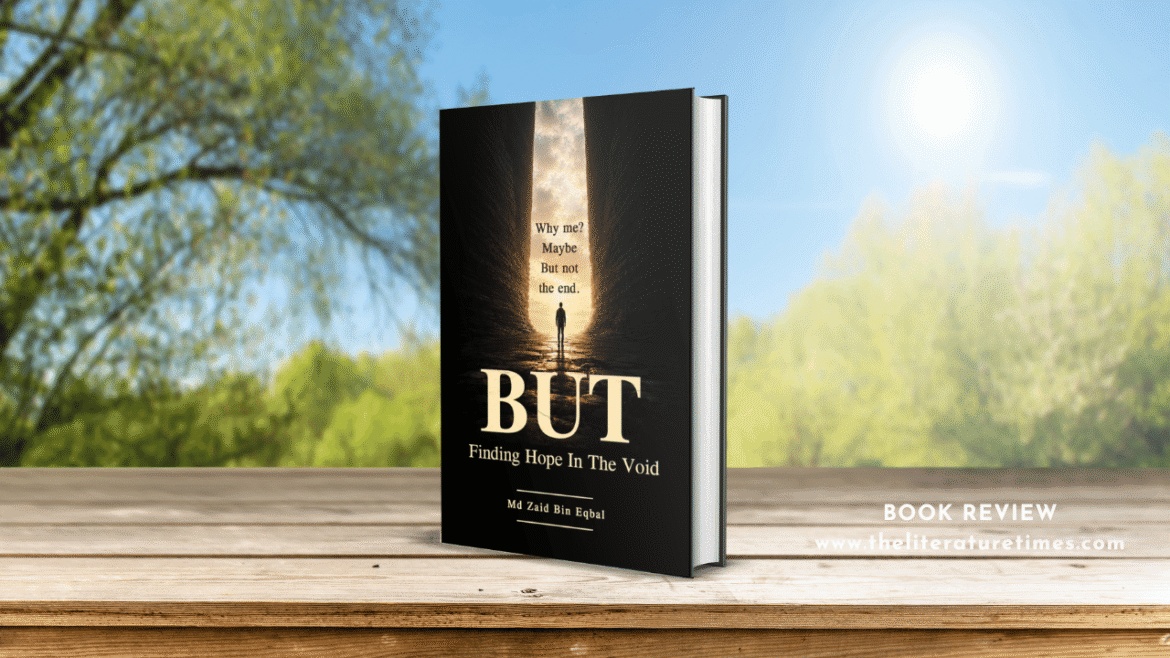
There are books that try to tell us how to live, books that promise transformation, and books that offer neatly packaged answers to difficult questions. BUT: Finding Hope in the Void by Md Zaid Bin Eqbal appears to belong to a different category. It does not attempt to fix life or convince readers that everything will eventually be perfect. Instead, it acknowledges something much more honest: sometimes life simply hurts, and sometimes the most meaningful thing we can do is keep going even when we do not have all the answers.
Written by medical student, writer, and keen observer of human behaviour Md Zaid Bin Eqbal, the book explores loneliness, self-doubt, identity, emotional struggles, unanswered questions, and the invisible burdens people often carry without telling anyone. At its heart is a remarkably simple idea the word “BUT.” That small word becomes a doorway between despair and possibility.
The premise of the book is immediately relatable. Life can feel overwhelming. People can appear perfectly fine on the outside while privately dealing with anxiety, loneliness, uncertainty, disappointment, or exhaustion. Modern life often encourages people to hide these struggles behind productivity, smiles, social interactions, and carefully constructed identities. BUT: Finding Hope in the Void turns its attention toward the things that remain unseen.
One of the book’s strongest qualities is its refusal to offer artificial positivity. There is no suggestion that difficult emotions can simply be defeated by thinking positively. Instead, the book seems to recognize that pain and hope can exist simultaneously. A person can be struggling and still have reasons to continue. Someone can feel lost and still be moving toward something. A difficult chapter can exist but it does not necessarily represent the entire story.
This is where the title becomes particularly effective. “BUT” is not presented merely as a conjunction; it becomes a psychological shift. “Life is difficult, but…” “I am hurting, but…” “I don’t know what comes next, but…” The word creates space for another possibility without denying what came before it. That distinction is important. Hope in this context is not presented as the opposite of suffering. Rather, it grows alongside suffering.
Eqbal’s background as a medical student also gives the book an interesting perspective. His interest in psychiatry, emotional resilience, and human behaviour suggests a writer fascinated by what happens beneath the surface of everyday life. Yet the book does not position itself as a clinical manual or a definitive guide to mental health. Instead, it emerges from reflection, observation, lived experience, and difficult questions. This makes its approach more conversational than instructional.
Another appealing aspect is the book’s focus on ordinary emotional experiences. Not every struggle has a dramatic story behind it. Sometimes it is the accumulation of small disappointments, isolation, self-doubt, expectations, or thoughts that become difficult to silence at night. By giving attention to these quieter experiences, the book has the potential to resonate with readers who may not see themselves represented in more conventional narratives about suffering.
The idea of being “still here” is particularly powerful within the book’s overall message. In a culture that often measures achievement through visible accomplishments, simply continuing can seem insignificant. Yet for someone going through a difficult period, getting through another day may itself be an act of resilience. The book appears to recognize that survival does not always look heroic. Sometimes it looks like getting out of bed, answering a message, attending class, going to work, or simply deciding to try again tomorrow.
Importantly, BUT: Finding Hope in the Void does not seem to promise that every unanswered question will receive an answer. That is one of the reasons its message can feel more authentic. Life does not always provide closure on demand. People change, relationships end, plans fail, identities evolve, and uncertainty remains a permanent part of being human. The challenge, then, is not necessarily to eliminate uncertainty but to learn how to exist within it.
The book will likely appeal particularly to young adults and readers navigating periods of self-discovery, academic or professional pressure, loneliness, emotional uncertainty, or questions about purpose. Its themes are broad enough, however, to reach anyone who has experienced the strange contradiction of appearing fine while privately feeling anything but fine.
As a debut work, the book’s greatest strength is arguably its sincerity. Eqbal does not write from a position of having solved life. Instead, he writes as someone willing to sit with difficult questions. That humility is important because readers struggling with their own uncertainties rarely need another voice telling them that they are approaching life incorrectly. Sometimes they need someone to acknowledge that the struggle is real while reminding them that it is not necessarily permanent.
Ultimately, BUT: Finding Hope in the Void is less about discovering a magical solution to suffering and more about discovering a different way of looking at it. Its central message is deceptively simple: pain can exist, but possibility can exist too.
That “but” may be small, yet it carries considerable emotional weight.
For readers who have ever wondered “Why me?”, felt trapped inside their own thoughts, or stared at the future without knowing whether things would become lighter, this book offers companionship rather than certainty. It does not promise an easy road. It simply suggests that the road continues.
And perhaps that is where its deepest hope lies.
You are still here.
And that matters.
Book Link: https://amzn.in/d/0bhPC0DO