The Literature Times : What inspired you to write Vinoda’s Vengeance, and why did you choose the Indo Greek kingdom of Menander as the setting for this story?
Naveen Sridhar : The inspiration for Vinoda’s Vengeance dates to my school days, when fragments of ancient history first caught my attention, particularly the philosophical dialogue of the Milinda Panha and a classroom story set in the Indo-Greek world that left me unsatisfied. Years later, those early impressions resurfaced and aligned with my fascination with classical drama, especially the works of Sophocles, ultimately shaping the foundation of this novel.
I was driven by a desire to explore the intersection of cultures at a time when Greek and Indian civilizations didn’t merely clash but coexisted and influenced one another in profound ways. What began as a simplistic story evolved into a far more layered narrative that examines identity, conflict, and the complexities of human choices within a richly imagined historical world.
The Literature Times : Vinoda is a courageous and determined protagonist. How did you develop her character, and what qualities do you hope readers will admire most about her?
Naveen Sridhar : I did not portray any known historical person or model. The qualities are resilience, consistency, and distinguishing right from wrong in all actions, even making sacrifices if it serves the purpose.
History is full of heroic deeds by men, such as warriors, kings, or saints, and rarely by female characters. If any, the motivation for a heroic deed is different. I have explored this aspect in one of the last chapters, aptly titled “Not for Fame or Fortune.”
The Literature Times : Your novels are known for blending historical accuracy with compelling storytelling. What kind of research did you undertake while writing Vinoda’s Vengeance?
Naveen Sridhar : I had to research Gándhára culture and the convergence of Hellenism, Buddhism, and Hinduism. In addition, I had to work out the classical and Hellenistic periods, especially the culture, traditions, and values from the Greek point of view.
The Literature Times : One of the central themes in your work is the meeting of different cultures. What message do you hope readers take away from the interaction between Greek and Indian civilizations in this novel?
Naveen Sridhar : I believe culture progresses primarily through exposure to other cultures. Despite fears of a ‘clash of cultures’, in the modern world, with ever more contacts and intermingling due to digitalization, the internet, immigration, and tourism, a ‘globalization of culture’ is steadily advancing. This is the time to welcome and hail the traditional open-mindedness of ancient times, before the advent of outright intolerance.
The Literature Times : Having written books on subjects ranging from ancient history to memoirs and even ventriloquism, how has your diverse background influenced your approach to storytelling?
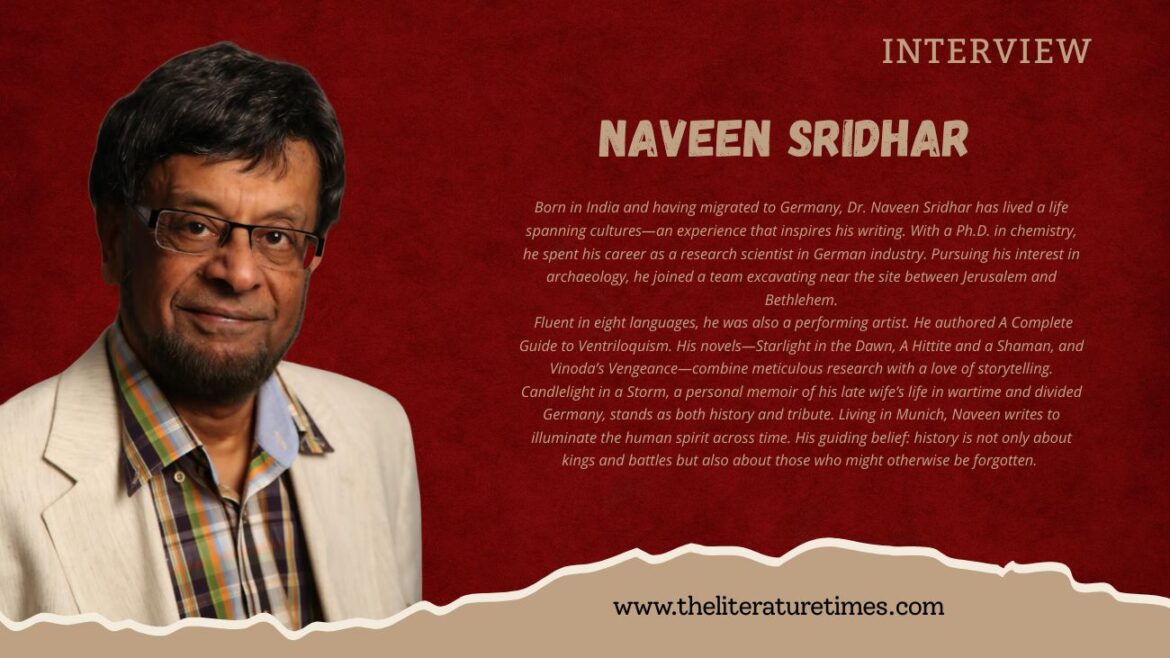
Naveen Sridhar : A great question. A lifelong commitment to inquiry, both scientific and human, shapes my writing. As a research scientist, I developed a rigorous approach to exploration and attention to detail, which I later carried into storytelling. My interest in archaeology reached a climax when I took part in an excavation in Israel at a site between Jerusalem and Bethlehem.
As for writing, I began with a guide to entertainment. The motivation to write fiction came only after writing the biography of German women during and after World War II (Candlelight in a Storm), which stuck to facts: events, reports, and personal contacts. My scientific background kept me from writing fiction. But the response (major award, etc.) opened the door, allowing my fantasy to take part in my debut historical fiction set in Mesopotamia about the first-ever literary person (Starlight in the Dawn). In the story about the first-ever peace treaty between two ancient powers (A Hittite and A Shaman), I had to navigate the principles and sensitivities of two civilizations. The scientific caution to stick to facts and truth stayed on, but only by setting boundaries and limitations like plausibility. The research experience helped me dig into the deep past. Languages helped me not be hindered by ancient languages and scripts.
The Literature Times : You have hinted that your next novel is set in Ancient Rome. Without revealing too much, what can readers look forward to in your upcoming work, and what continues to draw you to writing historical fiction?
Naveen Sridhar : Yes. I am now working on a story set in Ancient Rome. The exciting part is its relevance to modern times, both in a period of relative peace and prosperity and in a time affected by the erratic whims of world leaders, trade barriers, and the consequences for ordinary people.
Next in the queue is an untold story set in the past and staged in India, which had a serious effect on a mighty power of the era.