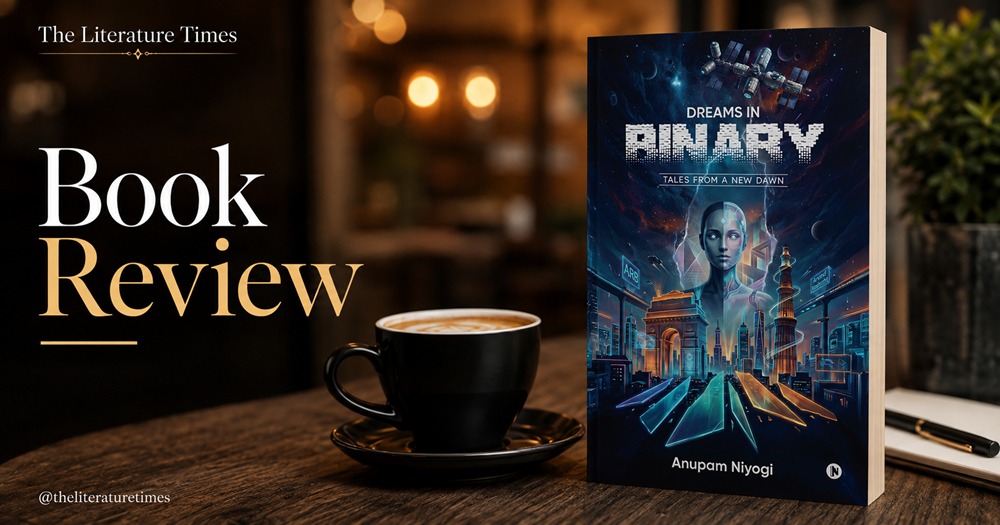
Anupam Niyogi’s Dreams in Binary: Tales From A New Dawn presents science fiction not simply as a vehicle for technological wonder, but as a way of interrogating the social habits, prejudices, and contradictions that people often learn to accept without question. The collection contains seven stories, each directed toward a pressing social concern, and this gives the book a clear thematic identity from the outset. Rather than treating speculative fiction as an escape from reality, Niyogi uses it as a lens through which reality can be made sharper, stranger, and more difficult to ignore. The result is a collection interested in the moral consequences of the world we are already building, even when its stories move into imagined futures, dystopian possibilities, satire, or speculative settings.
One of the strongest aspects of the book is the breadth of issues it is willing to engage. The supplied description points to prejudices related to homophobia, questions of morality, the futility of war, dystopian futures, and political satire, among other concerns. That range suggests a collection that is less interested in repeating a single message than in examining different forms of social conditioning. Science fiction is especially suited to this kind of work because it can rearrange familiar structures and ask readers to see them from unfamiliar angles. A prejudice that may appear normalized in everyday life can become stark when transferred into an imagined world; a political habit can appear absurd when pushed to its logical extreme; the cost of war can become more visible when the narrative removes the usual rhetoric surrounding it.
Niyogi’s background as a journalist and content writer is particularly relevant to this approach. Having worked with major media organizations, including The Times of India, he brings to fiction a professional habit of observing public issues, identifying tension, and recognizing stories within broader social developments. The book’s description makes this connection explicit: his newsroom experience helped him identify pressing issues, while his natural interest in world-building provided the fictional form through which to explore them. This combination gives Dreams in Binary an appealing dual character. It is imaginative, but its imagination is anchored in social awareness. It asks speculative questions because the present has already supplied enough material to make those questions necessary.
The author has described the book as both a defense mechanism and a counterattack against problems he felt were affecting the contemporary world but which he could not directly address. That creative impulse gives the collection an additional layer of urgency. Fiction can offer a writer distance from an issue while simultaneously allowing a deeper confrontation with it. In speculative fiction, a writer does not have to reproduce the world exactly as it is; instead, the world can be altered until its hidden assumptions become visible. This is one of the genre’s enduring strengths, and Dreams in Binary appears to make purposeful use of it. The stories are therefore not merely commentaries attached to futuristic settings. The speculative framework itself becomes part of the argument.
The title, Dreams in Binary: Tales From A New Dawn, also carries an effective tension between the human and the technological. “Dreams” suggests imagination, desire, fear, memory, and emotional possibility, while “binary” evokes systems, codes, oppositions, and the increasingly digital structures through which modern life is organized. Without assuming details beyond what has been provided, the title alone aligns well with the collection’s central project: to examine people and societies at the meeting point of human values and constructed systems. The phrase “A New Dawn” introduces the possibility of change, but not necessarily simple optimism. New beginnings can expose old prejudices just as easily as they can overcome them, and speculative fiction is often most compelling when it refuses to assume that progress in technology automatically produces progress in ethics.
The book’s writing approach is likely to appeal to readers who value social relevance within genre fiction. Because the collection consists of seven stories rather than a single continuous narrative, it can approach its concerns from multiple directions and tonal registers. One story may work through satire, another through dystopian anxiety, another through moral conflict or the implications of prejudice. This variety can give readers room to reflect between narratives, while also allowing the author to test different speculative frameworks. For a debut solo work, the short-story format is also a useful showcase of range: it allows Niyogi to demonstrate world-building across several imagined situations without being restricted to one fictional universe.
The social themes described for the book give it relevance beyond established science-fiction audiences. Readers who are interested in contemporary debates around identity, social prejudice, conflict, political behaviour, and moral responsibility may find the speculative approach accessible even if they do not usually read the genre. At the same time, readers already familiar with science fiction are likely to recognize the tradition in which imagined futures are used to question present-day assumptions. This dual accessibility is an important strength. The collection does not need to choose between being socially conscious and entertaining as speculative fiction; its stated purpose depends on the two working together.
Another notable strength is the emphasis on introspection. The book is described as offering readers a reflective look at the society they have been conditioned to accept. That phrase is important because it shifts the reader’s role from observer to participant. The stories are not simply asking, “What is wrong with the world?” They are also implicitly asking, “What have we accepted as normal, and why?” This is where speculative fiction can be particularly effective. By introducing distance, it creates the possibility of recognition. Readers may find themselves judging an imagined society, only to realize that the fictional system resembles values or behaviours already present in their own environment.
For The Literature Times, Dreams in Binary: Tales From A New Dawn stands out as an ambitious debut collection that uses science fiction as a form of social inquiry. Its value lies in its willingness to connect imaginative world-building with issues that are immediate, uncomfortable, and recognizably contemporary. Niyogi’s journalistic experience appears to inform the book’s alertness to social fault lines, while his creative instinct allows those issues to be reframed through speculative narratives rather than presented as argument alone. The intended audience includes readers of science fiction, social and political satire, dystopian literature, and contemporary short fiction, as well as readers interested in stories that invite ethical reflection.
Ultimately, the collection’s strongest promise is that it treats imagination as a tool of resistance rather than retreat. Dreams in Binary asks what fiction can do when direct commentary feels insufficient, and its answer is to build new worlds capable of exposing the unresolved problems of the existing one. The seven-story structure, the range of social concerns, and the author’s stated motivation give the book a coherent sense of purpose without requiring every story to make the same point. It is a collection for readers willing to be entertained by speculative possibilities while also being challenged by what those possibilities reveal about the present.