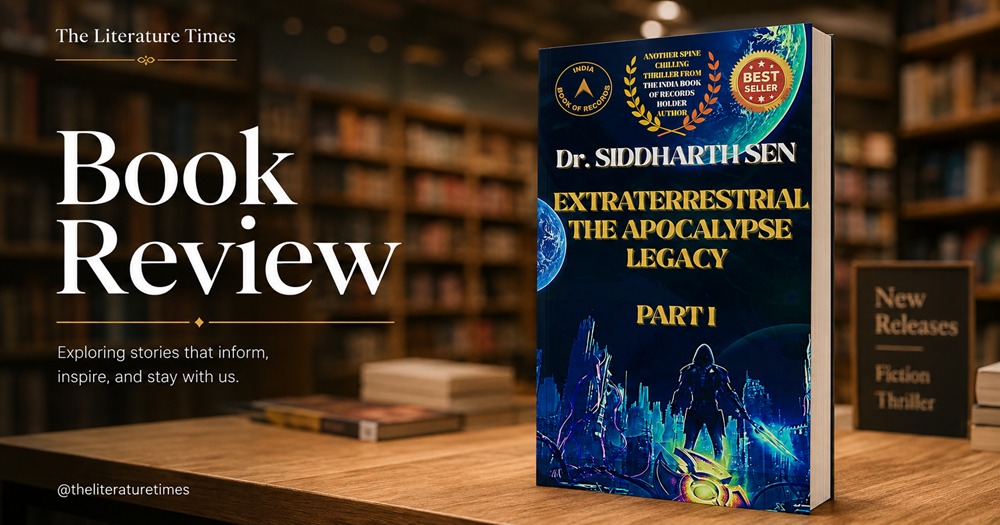
Science fiction often works best when it takes a familiar human fear and enlarges it until the reader can no longer look away. Extraterrestrial The Apocalypse Legacy by Dr. Siddharth Sen is presented in exactly that spirit: as the opening part of a trilogy built around a disturbing possibility that humanity is not merely facing danger from outside itself, but may already be losing a war it does not fully understand. The premise is deliberately unsettling. The world is described as being on the edge of catastrophe, human confidence is questioned, and another presence is said to be watching closely. Rather than framing the extraterrestrial threat as a conventional invasion defined by weapons, armies, or spectacular destruction, the book’s central idea is that the danger operates slowly and almost invisibly. That conceptual choice gives the novel its strongest hook. It shifts the reader’s attention from the obvious fear of attack to a more psychological fear: what if destruction is already underway, and what if people fail to recognise it until the damage is irreversible?
At the centre of the story are Aasha and her team, whose role is described as exposing a frightening truth about the extraterrestrial presence. The available description does not attempt to reveal the mechanics of every discovery, and that restraint is appropriate for a thriller-oriented science-fiction narrative. What matters most at the level of theme is the movement from ignorance to recognition. The characters are positioned against something larger than themselves, and the central conflict therefore becomes more than a physical struggle for survival. It is also a struggle to understand reality. This creates a useful tension between what humanity assumes and what may actually be happening. The book questions human ideas of power, superiority, and control, asking whether our confidence in our place on Earth is justified. That question gives the story philosophical weight without requiring the science-fiction premise to abandon its page-turning intent.
One of the book’s most relevant concerns is vulnerability. Modern life encourages the belief that technological advancement, information, and human organisation make civilisation increasingly capable of controlling its future. Sen’s premise challenges that confidence. The extraterrestrial does not need to announce itself through dramatic force; its power appears to lie in remaining unnoticed while its impact grows. This idea allows the novel to engage with anxieties that feel recognisable even outside the science-fiction genre: fear of unseen systems, hidden causes, delayed consequences, and threats that become clear only after people have already adapted to them. The resulting atmosphere is one of uncertainty rather than simple spectacle. For readers who enjoy science fiction that uses danger to raise questions about human behaviour and collective complacency, this approach is likely to be one of the book’s strongest points.
The writing concept also benefits from the fact that the novel is the first part of a trilogy. A first instalment carries a difficult responsibility: it must create enough urgency to satisfy the reader while also opening a larger narrative world that can develop across later volumes. Extraterrestrial The Apocalypse Legacy is positioned as the beginning of that broader arc. The description suggests escalation rather than closure, with Aasha and her team discovering the nature of the threat while humanity’s survival remains uncertain. This structure naturally supports suspense. The reader is not being asked only whether a particular crisis can be solved, but whether the entire understanding of the crisis is still incomplete. That sense of an expanding mystery is particularly suited to speculative fiction, where the gradual revelation of rules, motives, and consequences can be as compelling as action itself.
Another notable strength is the human counterpoint built into the premise. The book states that humanity has already lost the war against the extraterrestrial, yet also suggests that something within human beings may still provide a path toward survival. That contrast is important because it prevents the novel from becoming purely fatalistic. The apocalypse is not presented only as destruction; it becomes a test of what remains valuable when conventional power fails. Although the supplied description does not define the exact quality that may save humanity, the idea invites readers to consider resilience, awareness, courage, cooperation, or other distinctly human capacities. The narrative therefore appears to balance dread with possibility. The threat may be overwhelming, but the human response still matters. This tension between defeat and hope is one of the most effective foundations for an apocalyptic story because it gives emotional significance to survival rather than treating it as a purely mechanical objective.
For readers, the book’s value lies primarily in the questions it creates. What happens when human beings misunderstand the scale of a threat? How much of survival depends on knowledge rather than strength? Can something be defeated if people do not first recognise how it operates? And if humanity’s greatest resources fail, what internal quality remains? These are large questions, but the premise places them inside a story of investigation and danger rather than presenting them as abstract arguments. That is an effective way to make speculative ideas accessible. Readers who prefer science fiction driven by mystery, mounting danger, and existential stakes are likely to respond strongly to the concept. It may also appeal to readers of apocalyptic thrillers who enjoy stories in which the central danger is not immediately visible and where discovery is itself part of the suspense.
The intended audience is therefore broader than readers who seek only futuristic technology or space-based adventure. The book is likely to suit those who enjoy science fiction with a psychological edge, readers interested in end-of-the-world scenarios, and thriller readers who appreciate escalating revelations. Its darker framing, including the suggestion that humanity may already have lost the war, gives it a more unsettling tone than a straightforward adventure. At the same time, the possibility of a human answer to the crisis creates enough emotional balance to keep the story from becoming entirely bleak. The combination of fear, investigation, survival, and philosophical uncertainty gives the novel a clear identity within contemporary speculative storytelling.
Extraterrestrial The Apocalypse Legacy ultimately succeeds most strongly as a premise-driven opening to a larger story. Its central idea is memorable because it avoids the simplest image of extraterrestrial conflict and replaces it with something more insidious: an enemy that does not need to attack openly in order to win. By placing Aasha and her team in the position of uncovering that reality, the novel creates a framework for suspense while raising questions about humanity’s assumptions, fragility, and capacity to respond. The book’s promise lies not only in discovering what the extraterrestrial is doing, but also in discovering what human beings might still possess that can resist it. As Part I of a trilogy, it establishes a sense of scale, danger, and unanswered possibility. For readers drawn to high-stakes science fiction with thriller energy and an apocalyptic imagination, it offers a concept designed to provoke both curiosity and unease.