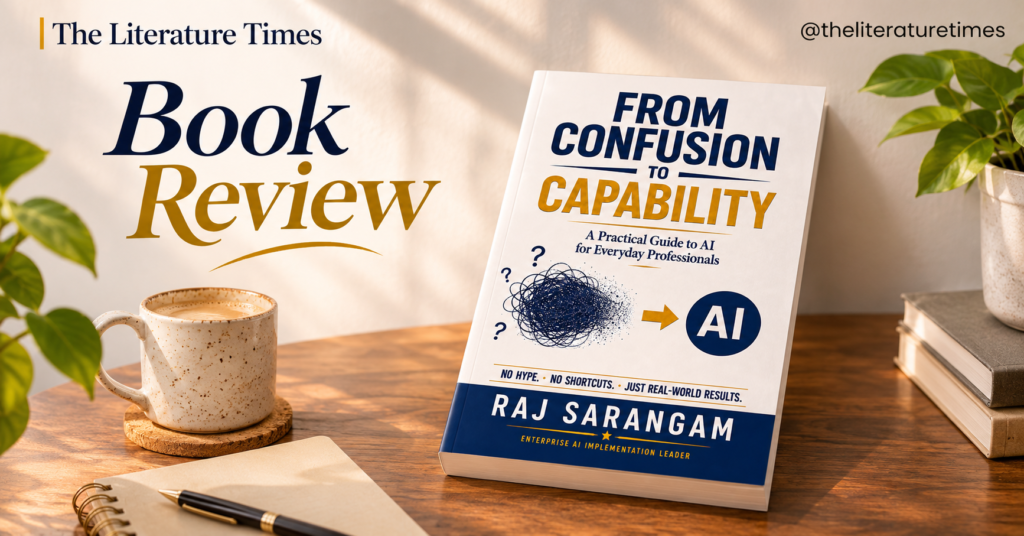
The rapid development of artificial intelligence has transformed conversations across workplaces, industries and professional communities. From automated communication and data analysis to research and business decision-making, AI is increasingly becoming part of everyday professional life. Yet, alongside its growing presence, many working professionals continue to experience uncertainty about how to use these technologies effectively. There is often a considerable difference between hearing about AI and understanding how it can contribute to actual work. In From Confusion to Capability, Raj Sarangam addresses this gap through a practical approach to artificial intelligence, helping readers move beyond uncertainty and develop the confidence to use AI tools responsibly and productively.
One of the book’s most relevant starting points is the anxiety experienced by professionals who feel that technological developments are moving faster than their ability to adapt. Discussions about new AI tools, changing workplace expectations and the future of employment can create the impression that everyone else is already ahead. For individuals without a technical background, understanding where to begin can be particularly challenging. Sarangam recognises this reality and positions his book as a guide for professionals who want practical knowledge rather than another collection of predictions about the future of technology. Its central objective is to make AI understandable and useful within the context of everyday professional responsibilities.
Unlike discussions that focus primarily on what artificial intelligence might achieve in the coming years, From Confusion to Capability concentrates on what professionals can do with AI today. The book explores its practical applications in writing, research, analysis, communication and decision-making. These areas represent important aspects of modern professional work, making the subject relevant across different industries and organisational roles. Whether someone is preparing reports, gathering information, analysing data or improving workplace communication, AI tools can potentially support several stages of these activities. By connecting AI with familiar professional tasks, the book makes the subject more accessible and reduces the distance between technological concepts and practical application.
A particularly important strength of the book’s premise is its balanced approach towards artificial intelligence. While AI offers opportunities to improve productivity and simplify certain processes, it also has limitations that users must understand. Automated systems can produce inaccurate information, misunderstand context or generate outputs that appear convincing without being reliable. Sarangam emphasises the importance of recognising these limitations and verifying AI-generated information before relying on it. This is an essential lesson in an environment where speed and convenience can sometimes take priority over accuracy. The book encourages readers to approach AI as a working tool that requires human supervision rather than an independent authority whose outputs should automatically be trusted.
The relationship between human judgement and artificial intelligence forms another significant theme. As AI becomes increasingly capable of handling routine tasks, professionals must reconsider how they allocate their time and expertise. Delegating repetitive activities to technology can create opportunities to focus on responsibilities that require interpretation, critical thinking and informed decision-making. However, effective delegation also requires knowing which tasks are appropriate for AI and which require direct human involvement. The book’s emphasis on using AI without surrendering professional judgement addresses this important distinction. It reinforces the idea that technological capability becomes valuable when combined with human understanding, responsibility and experience.
The book also places considerable importance on practical implementation. Its proposed 30-day action plan gives readers a structured direction for putting their learning into practice. This feature is particularly relevant because understanding the potential of AI does not necessarily translate into regular usage. Many professionals may experiment with different tools but struggle to incorporate them into consistent working habits. A time-bound action plan offers a way to approach adoption gradually, allowing readers to develop familiarity through practical engagement. Rather than treating AI learning as an abstract or technical exercise, the book presents it as an ongoing process that can be integrated into everyday professional routines.
Another notable aspect of the book is its accessibility. The author makes it clear that readers do not need a technical background to begin developing AI capabilities. This approach broadens its potential audience beyond technology specialists and individuals working directly in artificial intelligence. Managers, business professionals, researchers, consultants, entrepreneurs and employees across different sectors can all benefit from understanding how AI can support their responsibilities. By avoiding unnecessary technical complexity and focusing on practical applications, the book aims to make AI adoption less intimidating for those who are still finding their way into this evolving field.
Raj Sarangam’s professional background adds an important dimension to the subject. With more than two decades of experience in large organisations, he has worked across enterprise transformation and technology delivery at companies including HP, Tyson Foods, Mars and Cengage. His professional work has involved major technology programmes, operational implementation and documented business value exceeding $10 million. Rather than approaching AI exclusively from a management perspective, Sarangam also pursued hands-on learning to understand how these technologies function in practice. He completed a Master Program in Computer Vision and Deep Learning, earned certification as an AI Project Manager and developed practical experience across image classification, object detection, document scanning, automation workflows and agentic AI.
His current work leading an AI-agent-driven transformation at Cengage further connects the book’s ideas with the realities of enterprise technology implementation. His experience involves coordinating AI agents across areas such as collections, disputes, cash applications, reporting and forecasting. These responsibilities bring attention to aspects of AI adoption that extend beyond selecting a tool or developing a technical solution. Governance, data quality, testing, risk management, organisational adoption and operational change are equally important when introducing AI into business environments. His educational qualifications, including an MBA from the University of Houston, an MS in Computer Science from McNeese State University and a BS in Chemical Engineering from BITS Pilani, reflect an interdisciplinary professional background.
The book’s greatest strength lies in its focus on building durable AI capability rather than encouraging temporary experimentation or dependence on technological trends. Its message is particularly timely because artificial intelligence is changing not only how tasks are performed but also what organisations expect from their employees. Professionals who understand how to work alongside AI, evaluate its outputs and apply their own judgement may be better prepared to navigate these changes. At the same time, the book’s emphasis on practical learning makes its message relevant to individuals who may feel overwhelmed by the volume of information surrounding AI.
Overall, From Confusion to Capability by Raj Sarangam offers a timely and practical perspective on developing confidence in an increasingly AI-driven professional environment. It addresses the concerns of individuals who recognise the importance of artificial intelligence but need a clear starting point for applying it in their daily work. By bringing together practical applications, responsible usage, human judgement and a structured action plan, the book presents AI adoption as a learnable professional skill rather than an intimidating technological challenge. Its central message is straightforward: the future of work does not simply belong to those who know about AI, but to those who understand how to use it thoughtfully and effectively. For professionals seeking to move from uncertainty towards meaningful technological capability, this book offers a relevant starting point.
Rating: 4.8/5


Your perspective matters
Share your thoughts respectfully. Comments are moderated.