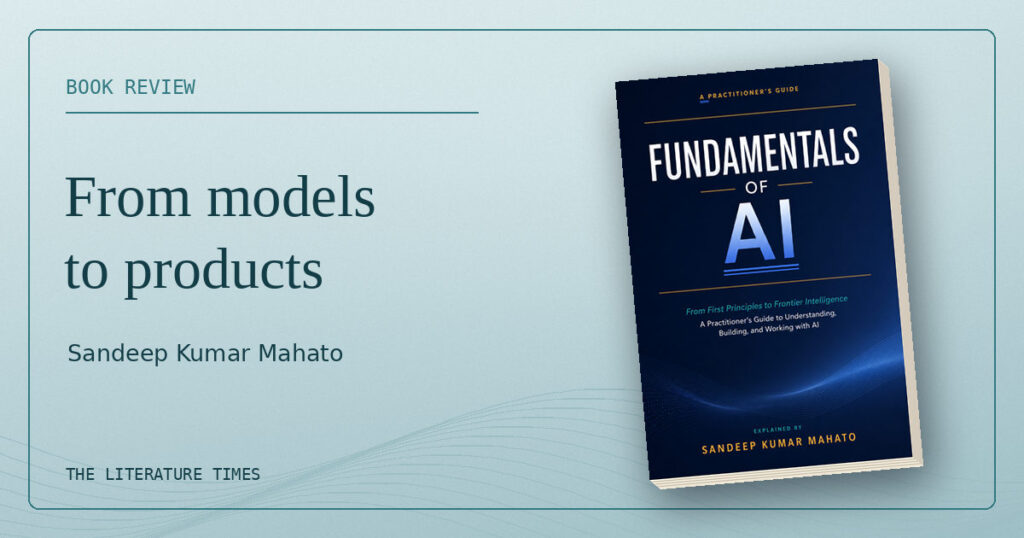
The first obstacle in learning about artificial intelligence is often deciding what to learn first. A reader might encounter neural networks in a course, large language models in a product demo and AI agents in a meeting, without knowing how the three fit together. In Fundamentals of AI, Sandeep Kumar Mahato sets out a route through that confusion. He begins with AI history and classical machine learning, then moves through neural networks and the practical work of deploying models before turning to newer ways of building with them.
That sequence is the book’s strongest editorial choice. Starting with the difference between a task defined by rules and one learned from examples gives readers a better foundation than starting with a tour of the latest tools. It also helps make sense of terms that are too easily grouped together. A language model generates text; retrieval gives a system relevant material to work with; an agent can be set up to take steps toward a goal. Those are different jobs, and choosing between them starts with knowing what problem needs to be solved.
Why deployment belongs in an introduction
The inclusion of MLOps, the work of deploying and maintaining machine-learning systems, broadens the value of the guide. A model that performs well in a demonstration does not automatically make a dependable product. A team still needs to decide how to test it, what counts as a failure and who will notice if its performance changes. Bringing that operational perspective into an introduction gives product and business readers better questions to ask of a technical team. It also gives developers a reason to think beyond the first successful experiment.
Mahato’s emphasis on familiar examples is well suited to that audience. For a reader who does not write code, a concrete setting can make it easier to separate a tool’s apparent fluency from its ability to carry out a task reliably. Consider a support assistant: finding the right returns policy and writing a reassuring answer are two different problems. Whether the assistant should be allowed to issue a refund is a third. A reader who learns to separate those jobs is better placed to judge what a demonstration actually proves.
Who should pick it up
The breadth of the book comes with a trade-off. At 193 pages, a guide that takes in AI history, model development and several generations of newer tools is best treated as a starting point. Readers whose immediate goal is to implement a production system will need to follow it with a more specialized resource. In particular, a reader who wants to build a retrieval system will eventually need to test the quality of the documents it retrieves, while someone building an agent will have to decide which actions require supervision. Neither problem is solved by knowing the vocabulary alone.
For students, developers crossing into AI and product managers who need a firmer footing in technical discussions, however, that breadth is useful. The value of Fundamentals of AI is the order it gives the subject: understand what a model does, see how it becomes part of a system, and only then ask where more autonomy is worth the cost. It is a sensible route into a field that is often introduced in the opposite order.
Book Link – https://amzn.in/d/0bYTTYrW







Your perspective matters
Share your thoughts respectfully. Comments are moderated.