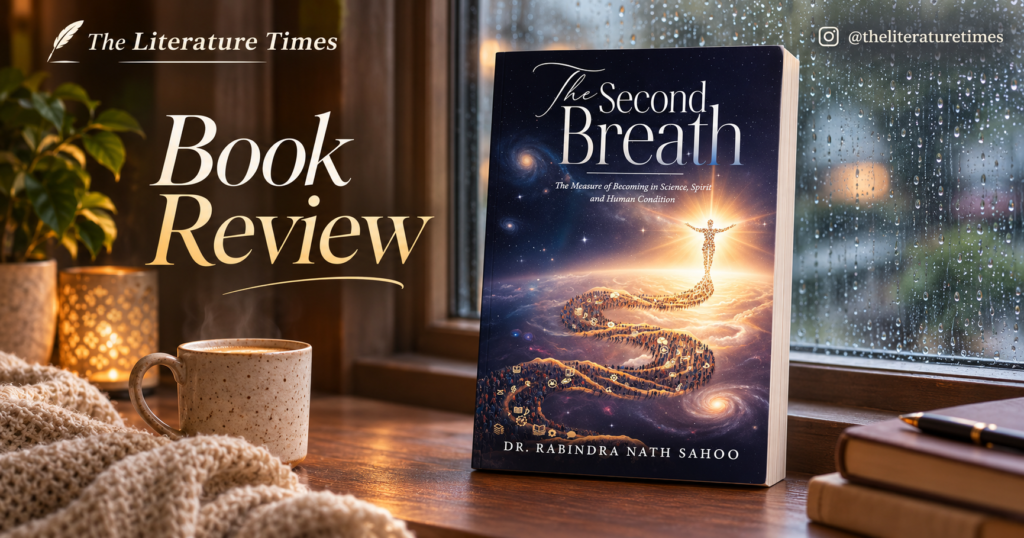
Life is often understood through the experiences we gather, the challenges we overcome, and the choices that shape our journey. Yet, beyond the visible milestones of existence, there are deeper questions about human purpose, consciousness, responsibility, and the meaning of living. Dr. Rabindra Nath Sahoo’s The Second Breath: The Measure of Becoming in Science, Spirit and Human Condition explores these questions through an interdisciplinary perspective that brings together science, philosophy, spirituality, and human experience. The book presents an opportunity to look beyond measurable realities and reflect on the deeper dimensions that influence human existence.
At the heart of the book lies an interesting exploration of population dynamics and its relationship with the broader human condition. Population studies play an important role in understanding demographic changes, including birth rates, mortality, migration, and the carrying capacity of the Earth. Through scientific measurement and statistical analysis, population dynamics helps societies anticipate future challenges and make informed decisions about resources, development, and sustainability. However, the author encourages readers to consider whether numerical measurements alone can explain the complete nature of human life. While statistics can describe changes in population, they cannot independently capture the emotions, moral decisions, spiritual experiences, and philosophical questions that define human existence.
One of the central ideas presented in The Second Breath is that science provides a framework for understanding the world, but human life cannot be restricted to scientific explanations alone. The book examines the relationship between measurable realities and the unseen dimensions of existence. It suggests that philosophy and spirituality can offer additional perspectives through which humanity may understand its responsibilities and place in the world. This approach gives the subject a wider meaning, connecting population studies with questions of ethics, consciousness, sustainability, and collective well-being.
The author’s discussion of uncertainty also adds an important philosophical dimension to the work. Human knowledge continues to evolve, and many aspects of existence remain open to interpretation. Philosophy encourages individuals to question established assumptions, examine different perspectives, and recognise the limitations of their understanding. Spirituality, meanwhile, introduces the importance of values, moral responsibility, and inner awareness. By bringing these perspectives together, Dr. Sahoo presents an argument for a more balanced understanding of life, where scientific knowledge and philosophical reflection can complement one another.
Another noteworthy aspect of the book is its emphasis on sustainability and humanity’s relationship with the natural world. Population growth and decline are not simply numerical developments; they also influence the availability of resources, environmental stability, social structures, and the future of communities. The author connects these concerns with the need for responsible human choices. The idea of balancing survival with transcendence suggests that development should not be measured only through material progress. It should also consider the quality of human relationships, environmental responsibility, and the values that guide society. This broader perspective makes the subject relevant to readers interested in population studies, social development, environmental concerns, and philosophical thought.
The title, The Second Breath, also carries a symbolic significance when considered alongside the author’s personal journey. Born on 15 August 1957, Dr. Rabindra Nath Sahoo describes a life shaped by financial hardship, challenging circumstances, education, professional responsibilities, and continuous personal development. His journey began in an environment marked by extreme poverty and inherited family difficulties. Despite these circumstances, education became an important foundation for his future. He graduated with an MBBS degree in 1981 and subsequently entered public healthcare service in Odisha.
His professional journey included approximately ten years of government service in the Health and Family Welfare Department, where he worked as an Assistant Surgeon from April 1983 to May 1993. His decision to resign in protest against excessive political interference reflects a significant period of professional struggle. He later established a private clinic in a remote part of Odisha, balancing family responsibilities with his commitment to serving the local community. In December 2003, he returned to government service and continued his professional journey through various responsibilities and promotions, eventually retiring as Additional Director of Health Services on 31 August 2019.
This background adds another layer of meaning to the book. After years of medical service and administrative responsibilities, Dr. Sahoo entered a new phase of life devoted to reading, writing, reflection, and continued community service. His transition from a structured professional career towards intellectual and spiritual exploration reflects the idea of beginning again. The concept of a second breath can therefore be understood as more than a physical experience. It represents renewal, rediscovery, and the possibility of finding new meaning at different stages of life.
The book’s philosophical direction is further supported by the author’s reflection on the relationship between past experiences and future possibilities. The reference to Søren Kierkegaard’s observation that life must be understood backwards but lived forwards complements the broader theme of the work. Experiences, whether joyful or difficult, contribute to an individual’s understanding of the world. However, life continues to demand new decisions, fresh perspectives, and the willingness to move forward. This idea connects the author’s personal experiences with the book’s wider exploration of human development.
The Second Breath: The Measure of Becoming in Science, Spirit and Human Condition is particularly suited to readers who appreciate interdisciplinary discussions and reflective writing. Those interested in science, population dynamics, philosophy, spirituality, healthcare, and social responsibility may find its central themes thought-provoking. Its approach encourages readers to look beyond conventional boundaries between academic disciplines and consider how different forms of knowledge can contribute to a more complete understanding of humanity.
Overall, Dr. Rabindra Nath Sahoo presents a work that seeks to connect scientific reasoning with philosophical insight and spiritual awareness. Rather than treating these areas as competing perspectives, the book encourages readers to recognise their potential for complementing one another. Its central message is that scientific progress becomes more meaningful when guided by ethical values, human understanding, and responsibility towards the natural world. Through its combination of intellectual reflection and the author’s life experiences, The Second Breath invites readers to reconsider what it means to live, grow, and contribute to society. It ultimately leaves readers with an important thought: understanding life requires more than measuring its changes; it also requires recognising the meaning behind them.





Your perspective matters
Share your thoughts respectfully. Comments are moderated.