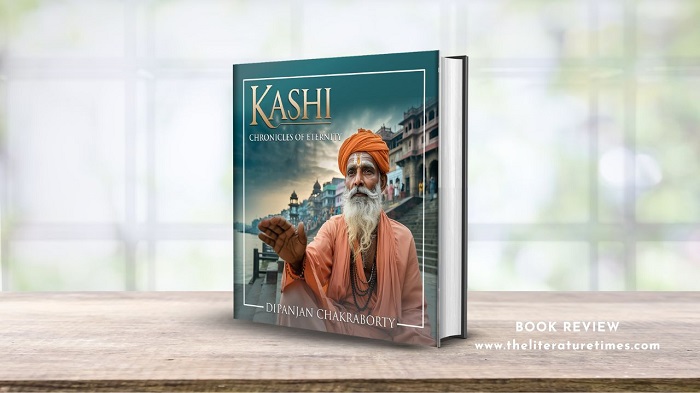
Kashi is not a place; it is a presence. This truth pulses gently through every page of Dipanjan Chakraborty’s extraordinary photographic chronicle, Kashi: Chronicles of Eternity. What he offers in this book is not merely a visual journey, but a soulful invocation—an attempt to translate the ineffable spirit of one of the world’s oldest living cities into light, shadow, and silence.
At first glance, this may appear to be a photography book, but to call it that would be to diminish its essence. It is, instead, a meditation: a collection of moments that breathe, pause, whisper, and glow with the intangible energy of Kashi. The city is not merely photographed here; it is felt, absorbed, and remembered. For over thirty years, Kashi has lived within Chakraborty—not as geography, but as emotion. And that lifelong resonance shapes every frame and every word in this remarkable offering.
A Journey of the Soul, Not the Lens
What sets this book apart is the author’s refusal to treat photography as documentation. Instead, he uses the lens as a companion on an inward journey—a vessel through which he seeks to understand the city and, at times, himself. In the introduction, Chakraborty admits something rare: that Kashi often slipped beyond his grasp, and so did he. This vulnerability becomes the guiding spirit of the book. He does not claim mastery over the city; he acknowledges being shaped by it, humbled by it, and at times even erased by its vastness.
This honesty imbues the narrative with a quiet grace. The photographs are not loud or demanding; they are contemplative, holding space for stillness. Whether it is the hush of early morning light on the ghats, the shadow of a lone boatman, or the meditative presence of a sadhu absorbed in ritual, each image feels like a breath taken mindfully.
The Sections: A Tapestry of Themes
The book is divided into soulful themed sections—Shunya, Diganta, Shahar, Akhara, and Pratibimb—each capturing a distinct mood of Kashi.
Shunya, or the search for silence, becomes a spiritual invocation. The monochrome fragments evoke a sense of suspension between the temporal and the eternal. These frames hold not stories but silence—spaces where the sacred becomes almost tangible.
Diganta, the edge of infinity, reflects Chakraborty’s fascination with the horizon as a metaphor for transcendence. The images here draw the viewer toward vastness, toward the threshold where the earthly dissolves into something unseen yet deeply felt.
Shahar grounds the reader in the living city—its rhythms, its people, its tireless continuity. These photographs capture Kashi not as a distant mythical place but as a breathing civilization where human lives intersect with centuries of memory.
Akhara is perhaps the most visceral and intimate section. These images, drawn from the world of wrestlers and warrior monks, reflect the raw physicality and ancient discipline that continue to thrive in hidden corners of Kashi. Chakraborty’s narrative here is tender, almost reverent, as he describes becoming a silent observer to bodies sculpted in dust and devotion.
Pratibimb closes the journey with portraits of the city’s soul—its faces. These are not posed photographs but encounters: fleeting, unexpected, deeply human. The expressions, gestures, and glances speak volumes, revealing stories of endurance, wisdom, faith, and quiet dignity. In these faces, the author sees not just individuals but reflections of Kashi itself—ageless, enigmatic, alive.
A Lyrical Blend of Image and Word
One of the book’s greatest strengths is its fusion of photography with a poetic literary voice. Chakraborty’s writing is tender, contemplative, and profoundly moving. His words are not captions; they are reflections—each one adding a deeper resonance to the image it accompanies. He does not explain Kashi; he surrenders to it, and in that surrender lies the book’s power.
Passages describing his decades-long intimacy with the city are hauntingly beautiful. He writes of narrow alleys as though they are childhood memories, of fleeting shadows as though they hold ancient truths, of dawn light as though it carries divine breath. The emotional honesty with which he describes his struggles—moments of doubt, silence, and longing—gives the book an authenticity rare in photographic works.
More Than a Book: A Sacred Offering
Kashi: Chronicles of Eternity succeeds because it never tries to reduce the profound into the literal. Kashi cannot be captured—it can only be evoked. Chakraborty understands this deeply. His work does not claim completeness; it offers fragments, impressions, sacred hints. And in these fragments lies an entire universe.
This book becomes a spiritual companion for anyone who has ever felt drawn to Varanasi. It is for those who have walked the ghats and sensed something indescribable, for those who believe cities can carry souls, and for those who understand that some places are not lived in—they are lived through.
For readers who have never visited Kashi, the book serves as an initiation—a doorway into a world where time folds onto itself, where the divine flows through daily life, and where every corner feels like a whispered story from eternity.
A Masterpiece of Emotion and Memory
Dipanjan Chakraborty has created more than a photographic record; he has crafted a timeless homage to a city that continues to shape him. Each image, each word, is infused with devotion and memory. The book feels like a prayer—gentle, yearning, and luminous.
Kashi: Chronicles of Eternity is a masterpiece for lovers of art, culture, spirituality, and the ancient mystique of India. It is a book that stays with the reader long after it is closed, reminding us that some places live forever—not just in history, but in the human heart.